
Modeling and Predicting Opinion Formation with Trust Propagation
Modeling and predicting opinion formation with trust propagation in online social networks
The paper introduces a trust-aware voter model that couples opinion formation with trust propagation in social networks. By integrating self-trust, interpersonal trust, and indirect trust (transitivity), the model achieves state-of-the-art performance in predicting transient opinion profiles on platforms like Twitter.
TL;DR
Researchers have developed a new mathematical framework that doesn't just look at what people think, but how much they trust the source of information. By modeling trust as a propagating force (like a "friend of a friend" recommendation), this model can predict the future trend of public opinion on Twitter using only the first few hours of a discussion.
Background: Beyond the Steady State
In the world of statistical physics applied to sociology, we have spent decades looking at the "frozen" state—the final consensus or polarization of a group. However, in the fast-paced world of Online Social Networks (OSNs), the process is just as important as the result. Most prior works assume that every neighbor has equal influence. This paper argues that influence is earned through trust, and trust is a dynamic, evolving variable.
Problem & Motivation: The Missing Link of Trust
Why do current models fail to predict real-world shifts?
- Lack of Memory: Standard voter models are Markovian—they don't remember if a neighbor was right or wrong in the past.
- Direct vs. Indirect Trust: We don't just trust people we know; we trust people our friends trust. This "trust propagation" was missing from the mathematical descriptions of opinion dynamics.
- Transient Patterns: We need to understand the "in-between" stage—how an opinion moves from 40% to 80%—to create actionable predictions.
Methodology: The Co-evolution of Trust
The authors define a system where two opinions ( or ) compete. The transition probability is governed by a ratio of Interpersonal Trust and Self-Trust.
The Core Mechanism
- Self-Trust (): How much an agent trusts their own current view, reinforced when neighbors agree with them.
- Indirect Trust (): Calculated via common neighbors. If I trust Bob, and Bob trusts Charlie, I am statistically more likely to adopt Charlie's opinion.
 Figure 1: The interplay between direct and indirect trust in the network.
The evolution follows a Mean-Field approach where the population is divided into groups based on their interaction frequency. The authors derive that the opinion density changes as an exponential mixture function, a significant departure from the linear or simple sigmoid growth models.
Experiments & Results: Predicting Twitter
The model was tested on both synthetic (Scale-Free and Small-World) networks and real Twitter data regarding topics like "iPhone" and corporate reputations.
Key Findings:
- Breaking Magnetization: Unlike the standard voter model where the average opinion is conserved, trust dynamics break this symmetry, allowing the majority opinion to "snowball" and dominate.
- Accuracy of Prediction: By analyzing the initial 10% of posts on a topic, the model could predict the stable plateau level of the opinion with remarkable precision.
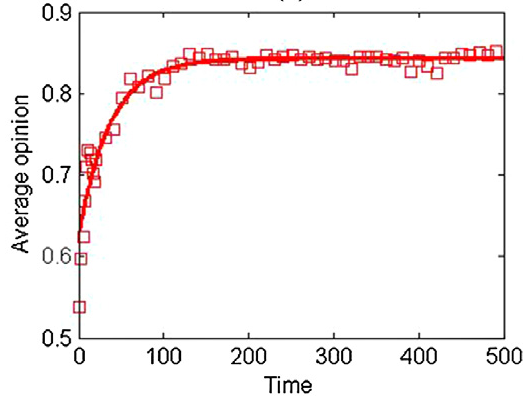 Figure 2: Prediction vs. Actual Twitter data. Note how the dashed prediction lines closely follow the solid empirical data even with limited initial input.
The Hub Effect
In scale-free networks, "hubs" (influencers) with high degrees of connectivity act as catalysts for trust propagation. However, even without a direct link, the indirect trust mechanism allows opinions to jump across different communities, facilitating a faster global consensus.
Critical Analysis & Conclusion
This paper bridges the gap between theoretical statistical physics and practical social media analytics.
Takeaway: Trust is the currency of influence. By quantifying trust as a historical accumulation of agreement, we can move from merely describing social systems to predicting them.
Limitations: The model assumes binary opinions. In reality, sentiments are a spectrum (e.g., Five-star ratings or nuanced political stances). Furthermore, "distrust" (negative edges) is modeled as a lack of trust rather than an active repulsive force, which could be a fruitful area for future study.
Future Outlook: This research opens the door for real-time "Opinion Weather Forecasts" for brands and policy-makers, allowing them to intervene before a minority distrust becomes a majority consensus.