
RepostsTree: Decoding the Temporal Dynamics of Sina Weibo Information Cascades
Modeling and Predicting the Re-post Behavior in Sina Weibo
This paper introduces a RepostsTree based method to model and predict the information diffusion (re-post behavior) on Sina Weibo. By treating the cascading process as a compound Poisson process and leveraging a hierarchical tree structure based on user influence, the model effectively predicts future repost counts in a dynamic, temporal manner.
TL;DR
How much attention will a single post gain? This paper tackles the "Repost Prediction" problem on Sina Weibo. By organizing reposts into a hierarchical RepostsTree and modeling the diffusion as a compound Poisson process, the authors provide a dynamic way to predict how information scales through social layers.
Academic Positioning: This work bridges the gap between pure statistical physics (heavy-tailed distributions) and practical social network analysis, offering a structured alternative to simple linear regression.
Problem & Motivation: The Asymmetry of Attention
In social networks, user attention is notoriously asymmetric. While some posts vanish into the void, others explode into viral cascades. Predicting the aggregate number of reposts is a staple of social media analytics, but previous methods faced two major hurdles:
- Platform Specificity: Mechanisms on Sina Weibo (like "Verified" status and specific media types) differ significantly from Twitter.
- Temporal Dynamics: Information doesn't spread at a constant rate. Linear models fail to capture the "bursty" nature of human behavior.
The authors observed that while global human activity is non-Poissonian (heavy-tailed), individual segments of a repost chain—triggered by influential "boosters"—can be modeled more simply.
Methodology: The RepostsTree Architecture
The core innovation is the RepostsTree. Instead of treating a post's life as a single timeline, the authors view it as a hierarchy:
- Root: The original microblog.
- Nodes (Boosters): Reposts from users with high "contribution value" (determined by follower counts).
- Orphan Collector: A secondary mechanism to handle reposts from users whose follower/followee relationship isn't immediately visible via API.
Mathematically Modeling the Cascade
The authors posit that the reposting process is a compound Poisson process. If is the total time series of reposts, it is divided into sub-series based on the tree structure: For each subset, a Poisson distribution is estimated using Maximum Likelihood Estimation (MLE). The total predicted count for a future time is the sum of these individual expectations.
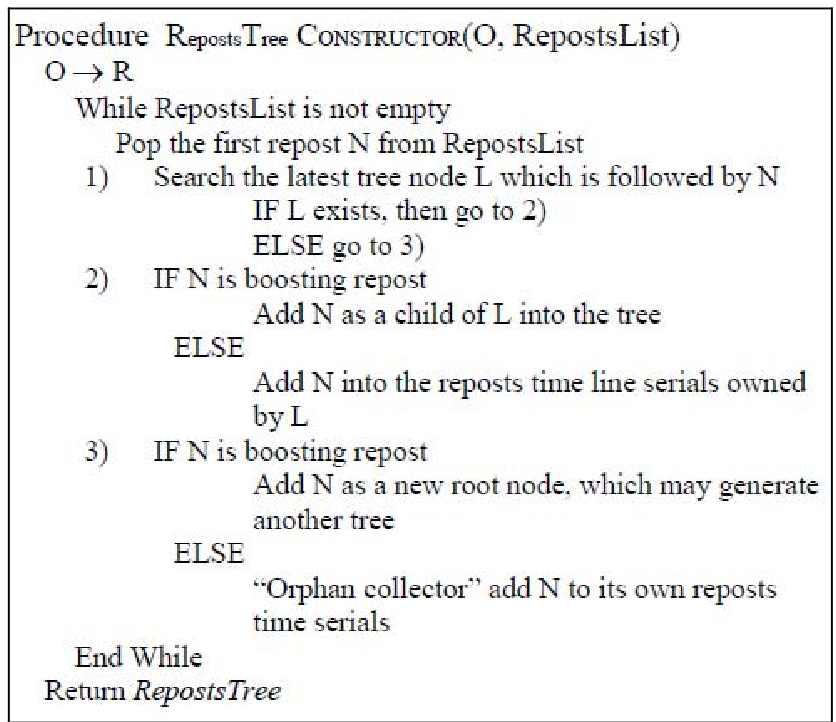 Figure 1: The logical flow of constructing the hierarchical RepostTree based on user influence.
Experiments & Results: Iterative Accuracy
The authors tested their model on two main datasets: a broad 142K microblog set for feature analysis and a 253 repost-list set for deep tree modeling.
1. Feature Analysis
Through Pearson Correlation and PCA, they found that:
- MaxMediaWeight (presence of video/voting) and Followers are the strongest predictors.
- Linear Regression performed poorly (), proving that "repostability" is non-linear and context-dependent.
2. Predictive Performance
The tree-based model was tested iteratively. As the post "ages" and more data is fed into the training set (e.g., assessing at 2h, 10h, vs 24h), the error rate consistently drops.
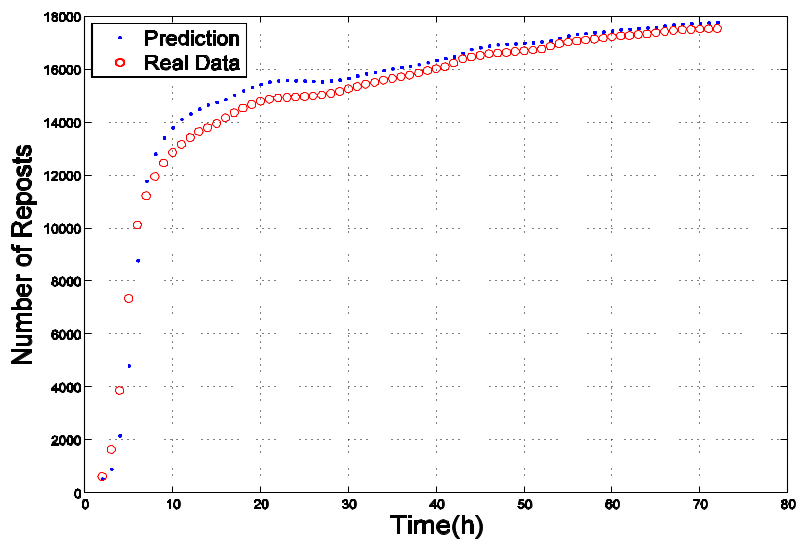 Figure 2: The predictive error rates at different timestamps; accuracy improves as the RepostTree matures.
Deep Insight: Why does Poisson work?
A classic critique of Poisson models in human dynamics is that they cannot account for "burstiness" (long periods of inactivity followed by rapid actions). However, the authors argue that in the context of Sina Weibo, heavy tails primarily appear in the final phase of a post's life. By the time the "tail" dominates, the majority of the repost volume has already occurred, allowing the Poisson-based RepostTree to remain effective for the most active periods of the cascade.
Critical Analysis & Conclusion
Takeaway: Influence on Weibo is hierarchical. By identifying "booster" nodes and segmentation, we can turn a complex, heavy-tailed problem into a series of manageable Poisson estimations.
Limitations:
- Iterative Lag: The model requires initial data in a "warm-up" phase to build the tree.
- API Constraints: The "Orphan Collector" is a necessary but imperfect patch for limited follower data.
Future Outlook: Transitioning from this structural model to "model-free" deep learning (like Transformers or RNNs) could potentially capture the exogenous shocks and linguistic nuances that a Poisson process ignores.