
Beyond the First Click: Modeling Indirect Influence in Social Big Data
Modeling and Propagation Analysis on Social Influence Using Social Big Data
The paper proposes a dual-layered framework for quantifying social influence using big data from mobile communication (SMS/MMS). It introduces a bidirectional weighted graph model to measure both direct and indirect influence, integrated with an extended SIR (Susceptible-Infectious-Recovery) model to analyze propagation dynamics.
Executive Summary
TL;DR: This research tackles the challenge of quantifying a user's true "reach" in a mobile social network by moving beyond simple direct interactions. By combining a bidirectional weighted graph with a novel Influence Spreading Tree algorithm, the authors measure how influence ripples through a network. Their findings, validated on a massive Chinese cellular dataset, demonstrate that high-degree nodes are not just local leaders but catalysts for global information diffusion.
Context: This work positions itself as a structural advancement in Influence Maximization (IM), bridging the gap between simple centrality metrics and complex, computationally expensive greedy algorithms.
The "Indirect" Bottleneck
In social network theory, we often focus on Direct Influence (DI)—how many people you talk to and how often. However, real-world "viral" effects depend on Indirect Influence (II)—your ability to influence the "friends of your friends."
Existing models usually ignore this ripple effect or become computationally paralyzed when faced with Social Big Data. The authors argue that without a formal mechanism to traverse the network beyond one-hop neighbors, any influence evaluation is fundamentally incomplete.
Methodology: The Power of the Tree
The authors propose a two-step mathematical approach to define a node's global footprint.
1. Bidirectional Weighted Social Graph
The network is modeled as , where represents the total traffic of SMS/MMS from user to .
2. The Influence Spreading Tree (Algorithm 1)
To calculate indirect influence, the authors use a Breadth-First Search (BFS) to build a spanning tree rooted at each node.
- Physical Intuition: The tree represents the most likely path an "influence signal" travels.
- Mathematical Weighting: As the signal moves down the tree, it is attenuated by the number of branches (fan-out) and the edge weights.
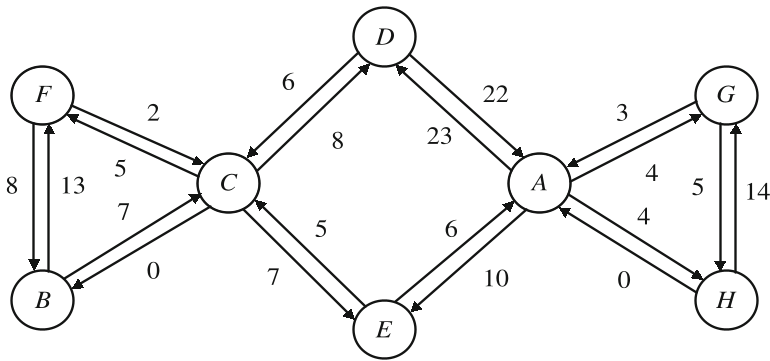 Figure 1: Conceptual bidirectional weighted graph representing SMS/MMS interactions.
3. Influence Propagation via Extended SIR
To test the model, they adapt the SIR (Susceptible-Infectious-Recovery) epidemic model. A node transitions from Susceptible to Infectious if the incoming influence exceeds a transmission threshold .
Experiments and Results
Using a dataset of 119,268 users, the team compared their "Social Influence Evaluation Model" against traditional baselines:
- Degree Centrality: Simple but lacks depth.
- Climb Greedy: Accurate but slow.
- Random: The baseline benchmark.
Key Findings:
- Scalability: The tree-based approach effectively handles the "5V" challenges of big data.
- Superior Spread: As seen in the performance charts, the proposed model significantly outperforms Degree Centrality and Set Cover models in "Influence Spread" (the number of infected nodes over time).
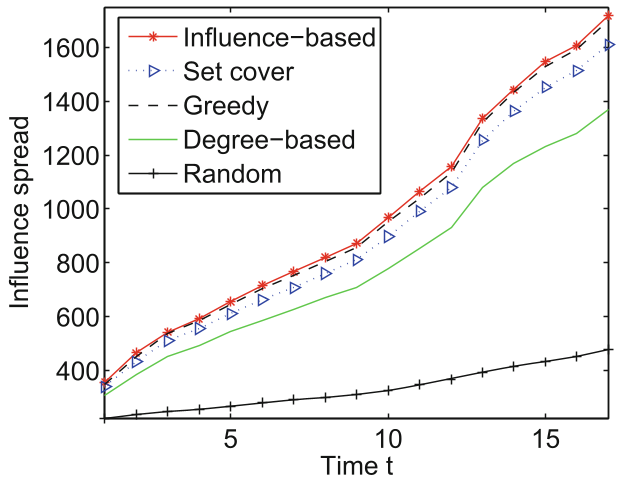 Figure 2: Performance comparison showing the proposed model (red line) significantly leading over Random and Degree-based methods.
Critical Analysis & Conclusion
Takeaway
The paper effectively proves that weighted connectivity matters more than raw volume. A user with fewer, more intense connections may have a larger "Influence Spreading Tree" than a "hub" with many weak, superficial ties.
Limitations
While robust, the model primarily relies on SMS/MMS data, which is becoming less central in the era of WeChat, WhatsApp, and Telegram. Furthermore, the model treats all messages as equally influential, ignoring the sentiment or context of the communication (e.g., a "negative" influence).
Future Work
The authors intend to incorporate causal relationships and distinguish between positive, negative, and controversial influence, which will be essential for modern social media moderation and marketing.