
Protein, Social Hubs, and Collapse: Deconstructing the Mesa Verde Village Simulation
Modeling Protein Exchange across the Social Network in the Village Multi-Agent Simulation
This paper introduces a multi-agent simulation of the ancient Village (A.D. 600–1300) that integrates protein constraints (hunting deer/rabbits) into a Cultural Algorithm (CA) framework. It models how agents utilize hierarchical social networks—Kinship, Economic, and Hub—to survive environmental stressors and resource scarcity.
Executive Summary
TL;DR: This research investigates the 700-year occupation and ultimate abandonment of the Mesa Verde region by Pueblo Indians. By integrating a hunting model (protein acquisition) with Cultural Algorithms, the authors demonstrate that the collapse was a result of social networks losing their "resiliency" over time as they struggled to buffer the population against fluctuating animal resources and droughts.
Background: Positioned at the intersection of Computational Archaeology and Multi-Agent Systems (MAS), this work moves beyond simple environmental determinism. It posits that the "Social Intelligence" of a population—its ability to learn and exchange—is the primary variable in survival.
The Problem: Why Did the Pueblo Settlers Leave?
For decades, scientists hypothesized that the A.D. 1300 abandonment was caused by a "mini ice age" or simple drought. However, earlier models (e.g., Kohler's) could not explain population drops during the mid-1100s. The authors argue that previous models ignored social complexity and protein requirements. Maize alone isn't enough; without deer, hares, and rabbits, the social fabric begins to fray.
Methodology: The Core Engine
The simulation is built on two pillars: Cultural Algorithms (CA) and Hierarchical Social Networks.
1. The Cultural Algorithm Framework
The model utilizes a "Belief Space" where situational, normative, and topographic knowledge is stored. This allows agents to not only act as individuals but to inherit "cultural wisdom" about where to hunt and whom to trust.
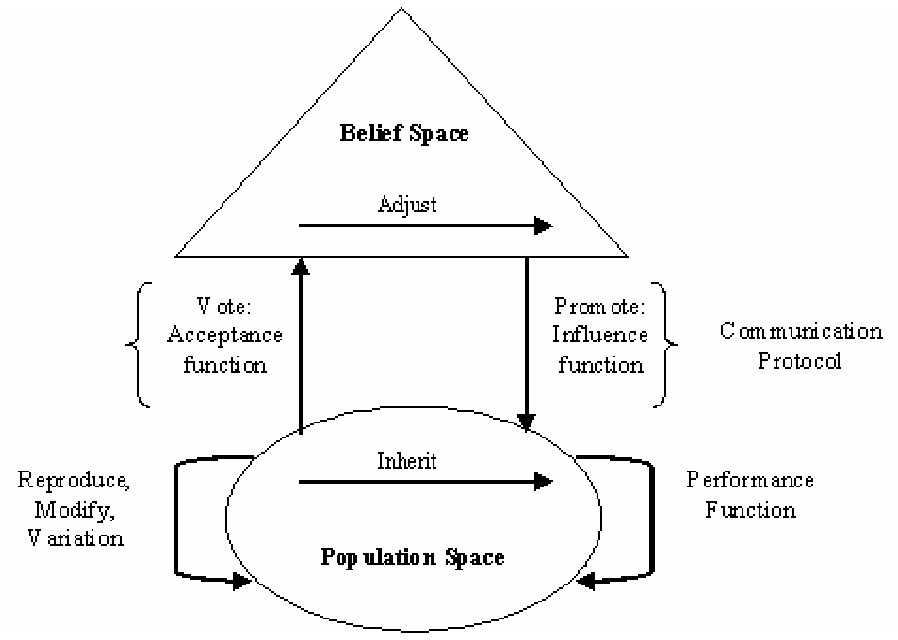 Figure 1: The Cultural Algorithm framework showing the interaction between Population and Belief Space.
2. Hierarchical Exchange Networks
Social survival is modeled through three distinct layers:
- Kinship (GRN): Generalized Reciprocal Exchange. "Safety net" sharing among family without immediate repayment.
- Economic (BRN): Balanced Reciprocal Exchange. Trade based on reputation and "quality factors."
- Hub Network: Emergent regional nodes where successful agents coordinate large-scale exchanges.
3. Optimal Hunting (Marginal Value Theorem)
Agents don't just hunt randomly. They use Charnov’s Marginal Value Theorem to decide when a hunting patch is exhausted and when to move. When local hunting fails, they trigger their social networks to request protein.
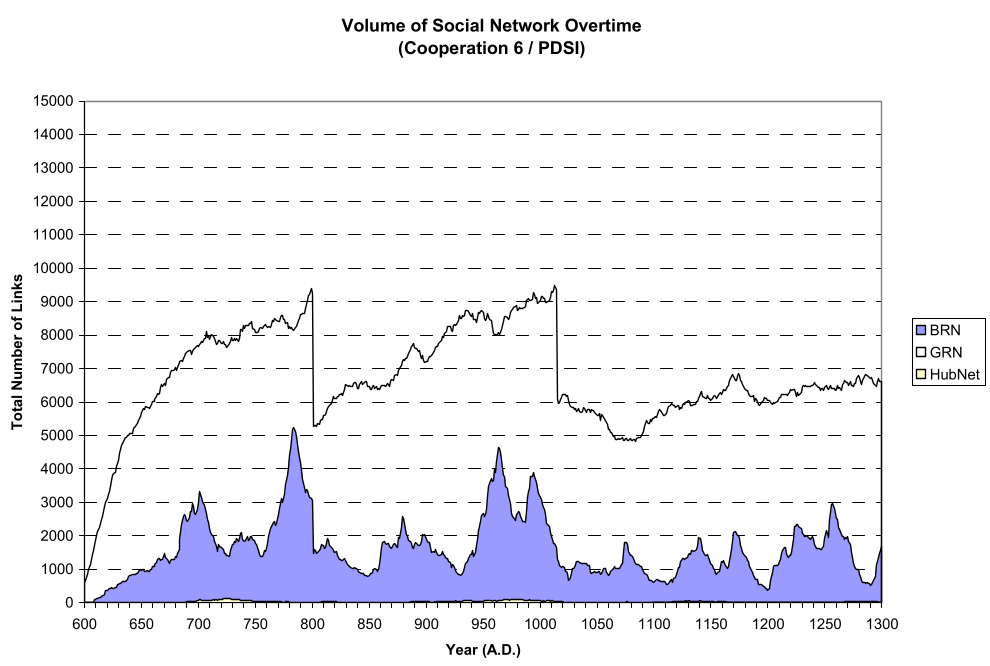 Figure 2: Illustration of agents managing hunting cells based on productivity thresholds.
Experiments and Results: The Erosion of Resilience
The most striking finding is the Network Volume analysis. While the population could survive a single drought, each subsequent environmental stressor reduced the "peak" efficiency of the social network.
- Lagged Recovery: Droughts hit the Economic (BRN) and Hub networks harder than the Kinship (GRN) network.
- The Hub Decay: After every collapse (A.D. 850, 1050, 1200), the Hub network re-emerged but was consistently weaker than before.
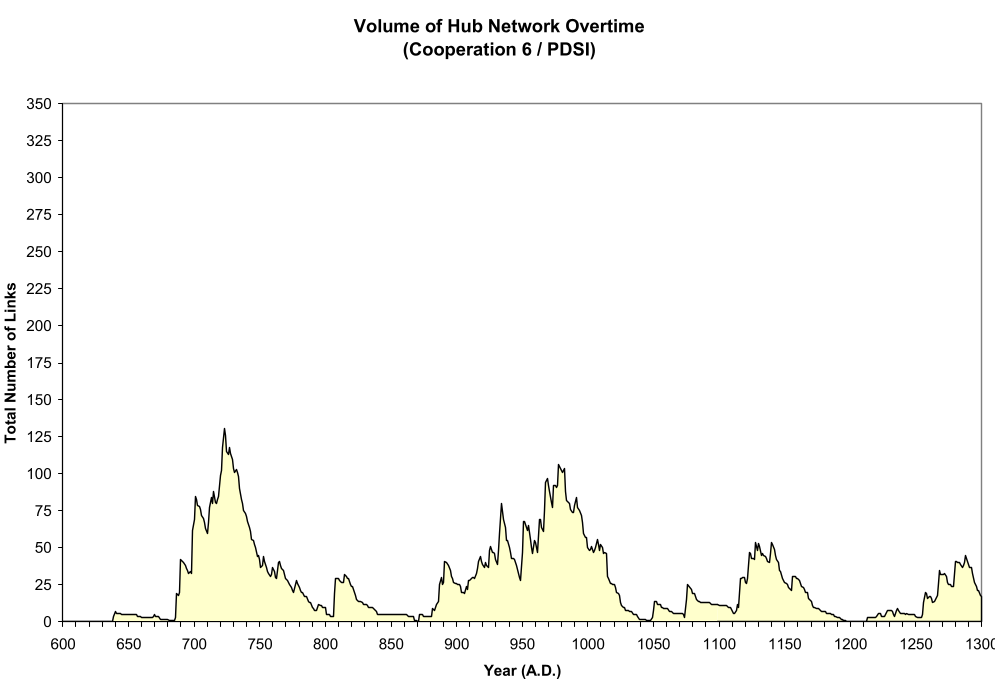 Figure 3: The declining volume and complexity of the Hub network over 700 years.
By A.D. 1270, the Hub network's capacity to redistribute resources was significantly diminished, making the population highly vulnerable to the final drought that led to the total evacuation of the region.
Deep Insight & Conclusion
The "Village" simulation proves that social intelligence is a finite buffer. The introduction of protein constraints showed that even a community with sophisticated trading and kinship rules cannot survive indefinitely if the "cost" of the social network (the resource requirement) exceeds the "yield" of the environment.
Takeaway for AI/MAS Research: This work highlights the importance of "Belief Spaces" in multi-agent coordination. Survival isn't just about individual optimization; it's about the resiliency of the links between agents. When the "Social Volume" of a system decreases, collapse is inevitable, regardless of individual agent intelligence.
Limitations: The model is a closed system. The authors acknowledge that out-migration and in-migration (external population flow) were not fully captured, which might explain why simulated population counts were lower than actual archaeological findings.