
Scaling Social Intelligence: Modeling Relationships via t-Cherry Junction Trees
Modeling social network relationships via t-cherry junction trees
The paper introduces a framework for modeling large-scale social network relationships using t-cherry junction trees, a recent advancement in probabilistic graphical models. By approximating complex joint distributions with compact tree structures, the authors achieve efficient link recommendation and exact inference on a 100,000-node Twitter dataset.
TL;DR
Social networks are massive, and their dependency structures are a nightmare for traditional probabilistic models. This paper leverages t-cherry junction trees to provide a compact, parallelizable, and mathematically guaranteed approximation of these relationships. By developing an efficient "graceful" upgrade path for model complexity, the authors successfully map 100,000 Twitter users and perform sub-two-minute link recommendations.
The Intractability of Social Ties
Directly modeling the joint distribution of binary variables (where ) is impossible, as the state space is .
Traditional approaches like Factor Graphs often fail because:
- Social networks are rife with dependency loops.
- Inference via Loopy Belief Propagation might never converge.
- Heuristic models lack a "quality metric" for how well they approximate the true underlying distribution.
The authors pivot to Junction Trees, which handle loops by grouping variables into "clusters." However, finding the optimal junction tree is NP-hard. Enter the t-cherry junction tree—a specific subclass shown to contain the maximum weight (best approximation) for a given treewidth.
Methodology: The "Graceful" Upgrade
The researchers don't just build a tree; they refine it. They introduce a two-step scheme to transform a lower-order (simpler) tree into a higher-order (more accurate) one:
- Order Update Process: Adds a variable to each cluster by "stealing" one from a neighbor, ensuring the Running Intersection Property remains intact.
- t-Cherry Conversion: Re-establishes the specific t-cherry properties where every separator between clusters is exactly size .
Key Architecture: The Greedy Construction
The algorithm utilizes a "Table Construction" phase that pre-calculates the weights of all potential cluster-separator pairs based on Mutual Information.
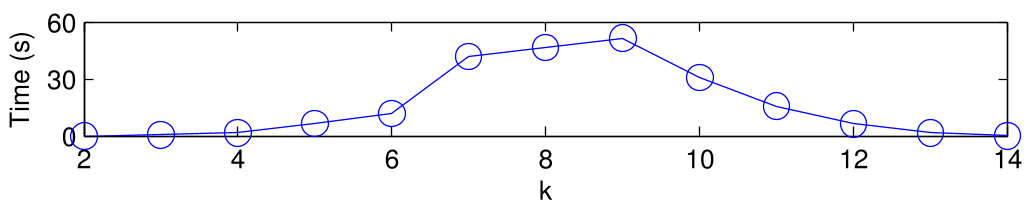 Figure 1: The performance bottleneck lies in table generation, which the authors elegantly parallelized using cloud computing.
Experiments & Twitter Application
The authors applied this to a 100,000-user Twitter dataset. To manage the scale, they used METIS to partition the graph into 1,560 subgraphs, built individual t-cherry trees for each, and then stitched them back together.
| Metric | Achievement |
|---|---|
| KL-Divergence Improvement | +150% via Order Update |
| Upgrade Speed | 5 seconds (vs 1.5 hours from scratch) |
| Inference Time | < 2 minutes for 100,000 variables |
| Recommendation AUC | 0.5519 (purely topological) |
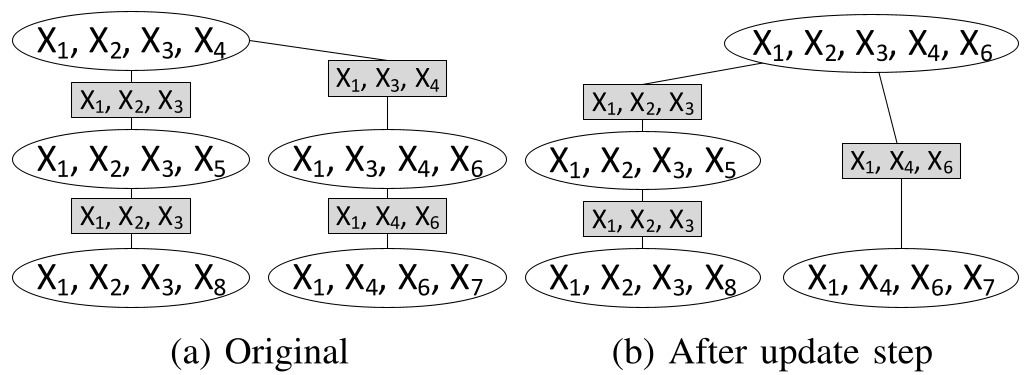 Figure 2: Example of a single update step moving from a 4-order to a 5-order junction tree.
Critical Analysis & Insight
The real breakthrough here isn't just the application to social networks—it's the computational efficiency of the conversion process. building a 5-order tree from scratch took 90 minutes, while their "graceful" upgrade took only 5 seconds.
Limitations:
- The AUC (0.5519) is relatively low, likely because the authors used a purely topological approach (ignoring user profiles/text).
- The partitioning step (METIS) might lose critical long-range dependencies that bridge different sub-communities.
Future Outlook
This work paves the way for "Dynamic Graphical Models." As social networks evolve, these trees could potentially be updated locally rather than globally. Combining these topological trees with Semantics (NLP) could lead to significantly higher recommendation accuracy while maintaining the rigorous guarantees of Junction Tree inference.