
Beyond Contagion: Deciphering the Interplay of Social Networks and Environment on Obesity
Modeling the influence of social networks and environment on energy balance and obesity
This paper introduces a novel computational model of obesity that integrates social network influences and environmental factors. Unlike prior "contagion" models, it simulates weight change as a result of energy balance dynamics driven by peer influence on food intake and physical activity, validated across synthetic and real-world student networks.
TL;DR
Obesity is often modeled as if it were a virus spreading through social circles. This paper challenges that oversimplification by introducing a mechanism-based model where social and environmental influences compete to alter food intake and physical activity. By applying this to real-world data, the researchers found that certain social structures act as a shield, making populations more resilient to an "obesogenic" environment.
The Problem with "Contagious Obesity"
For years, the academic consensus has leaned heavily on the idea that obesity is socially contagious. If your friends are obese, you are more likely to become obese. However, current models (like the Bahr model) simplify this to a "majority vote" system: if enough of your friends are obese, you "flip" to being obese.
This approach ignores two fundamental realities:
- Physiology: Obesity is the long-term result of an energy imbalance (Energy Intake > Energy Expenditure).
- Environment: We don't live in a social vacuum. The "built environment"—availability of parks, fast food density, and media norms—constantly tugs at our decisions regardless of what our friends think.
Methodology: Bridging Metabolism and Network Science
The authors propose a dual-layer model. First, a metabolic layer calculates an individual's Basal Metabolic Rate (BMR) and Energy Expenditure (EE) based on their weight and activity level. Second, a social layer determines how peers influence behavior.
The Threshold Mechanism
Influence isn't linear. The model uses a threshold system: you only change your behavior if the "pressure" from your network (normalized by your number of friends) and your environment crosses a certain value.
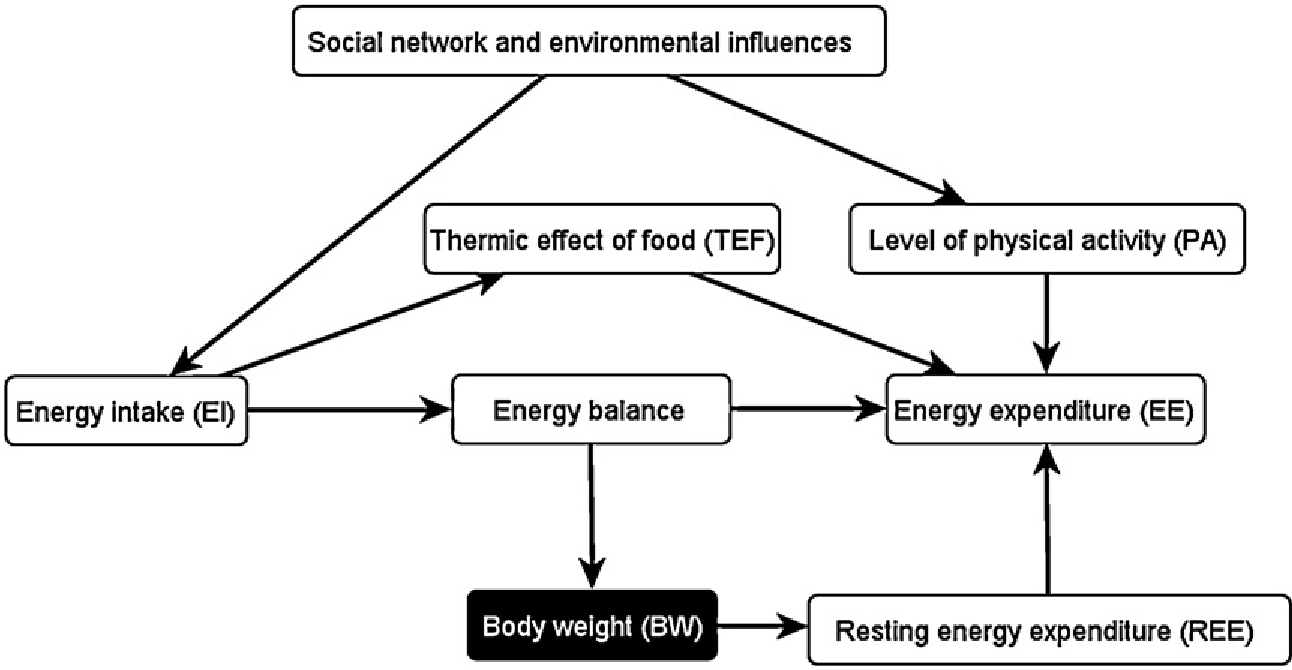 Figure 1: Conceptual overview of the model, linking social influence to energy balance.
Metabolic Specification
The core of the metabolic change is governed by: Where is physical activity and is body weight. Weight change is then derived from the delta between Intake () and Expenditure ().
Experimental Results: Synthetic vs. Real-World
The researchers conducted a factorial analysis to see which factors (topology, environment, or social impact) moved the needle the most.
1. Synthetic "Standard" Networks
In generic small-world or scale-free networks, the environment was the heavyweight champion, explaining roughly 33% of weight variations. This suggests that in loosely structured or "average" populations, external factors like public policy or urban design have a massive impact.
2. The Student Network (Real-World)
When the model was applied to a real network of college students (based on message exchanges), the results shifted dramatically. Here, social factors accounted for two-thirds of the change. The network was "cohesive" enough to buffer against environmental fluctuations.
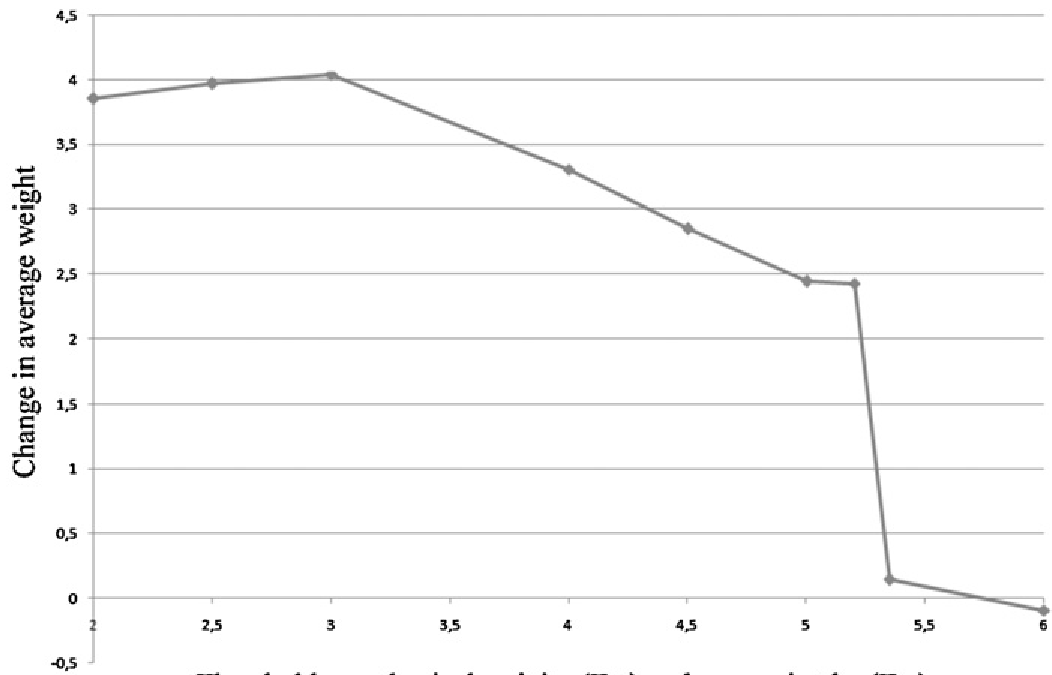 Table 5: Contribution of factors to weight change, highlighting the interplay between environment and network topology.
Critical Insight: The Bistability of Weight
An intriguing finding was the bistability of the system. If the behavioral threshold is too low, the population's weight fluctuates wildly (unrealistic). There is a "critical threshold" where the system stabilizes, suggesting that humans are naturally resistant to minor social "noise," but once a trend is strong enough, it triggers a transition.
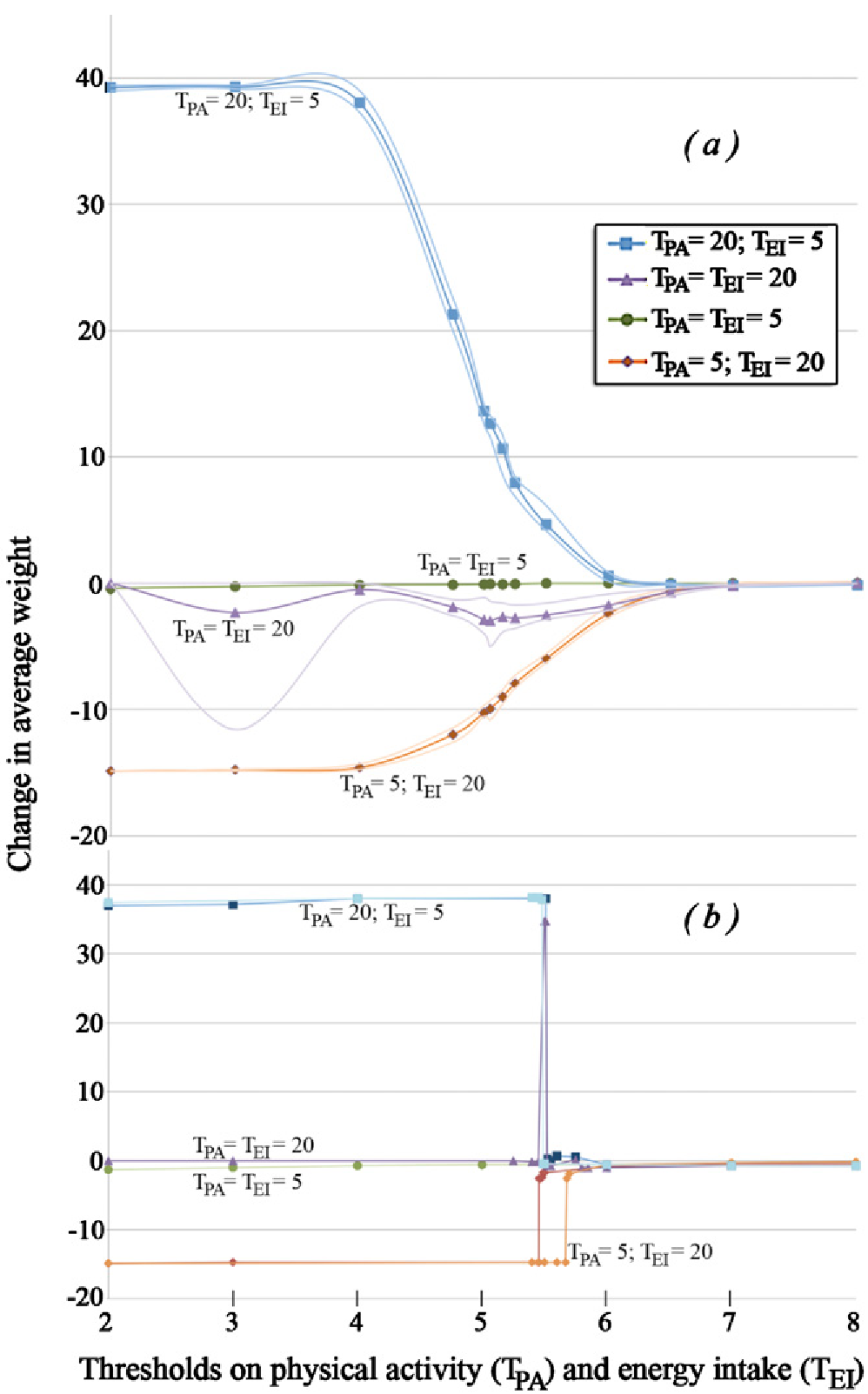 Figure 6: Simulations showing the sharp transition between unrealistic weight gain and stabilized realistic trends.
Conclusion and Future Outlook
The paper proves that the "micro-level" structure of our social circles—who we talk to and how frequently—is a more accurate predictor of health outcomes than macro-level labels like "small-world."
Takeaway for Policy Makers: You cannot ignore the environment, but its effectiveness depends entirely on the social fabric it is applied to. A highly cohesive community might ignore a new park or a new fast-food ban if the internal social norms are strong enough to resist the change.
Limitations: The model currently treats the environment as a single variable (). Future iterations could model the "built environment" as its own network—roads and physical locations—overlapping with the social network to create a truly multi-relational digital twin of urban health.