
Modeling Sports News: Why Timing and Value Rule the Social Arena
Modeling of Sports News Information Dissemination in Social Networks
The paper proposes a specialized information dissemination model for sports news on social networks (specifically Sina-Weibo) based on an improved SEIR epidemic framework. By integrating dynamic node transition probabilities—including information value, popularity, and user interest attenuation—the model accurately simulates the unique rapid-peak and fast-decay characteristics of sports news compared to general information or rumors.
TL;DR
This research moves beyond general rumor-spreading models to create a specialized SEIR-based framework for sports news on Sina-Weibo. By factoring in user "online windows," interest decay, and content value, the model reveals that while "Value" dictates how many people see a post, "Timing" determines how fast it goes viral—usually hitting a saturation point within just 10 hours.
Background & Motivation: Beyond Rumors
Most academic work on social network dissemination focuses on the "Infection" of rumors or "Outbreaks" of public sentiment. However, sports news is a different beast. It is generally positive, narrative-driven, and highly concentrated around authoritative media sources.
The authors observed that sports news typically follows a "One Peak, Fast Decay" pattern. Unlike political scandals that simmer for days, a sports score is "old news" within 24 hours. Existing models didn't account for this rapid interest attenuation or the specific habits of sports fans.
Methodology: The SEIR-Sports Extension
The researchers refined the standard Susceptible-Exposed-Infected-Recovered (SEIR) model to reflect Weibo's ecosystem.
1. Expanded Node States
They introduced 5 distinct states:
- Si (Inactive): Ordinary users unaware of the news.
- Sa (Active): Super-fans likely to repost immediately.
- E (Latent): The "Lurkers" who read but haven't shared.
- I (Spreading): Active sharers.
- R (Invalid): Users who have lost interest or finished sharing.
2. Dynamic Transition Probabilities
The "secret sauce" of this model lies in how users move between states. The probability isn't static; it is a product of:
- Online Probability: A segment function reflecting real-world Weibo usage peaks (maximal at 12:00 and 22:00).
- Forwarding Willingness: A combination of the "Herd Effect" (how popular the post is) and "Information Value."
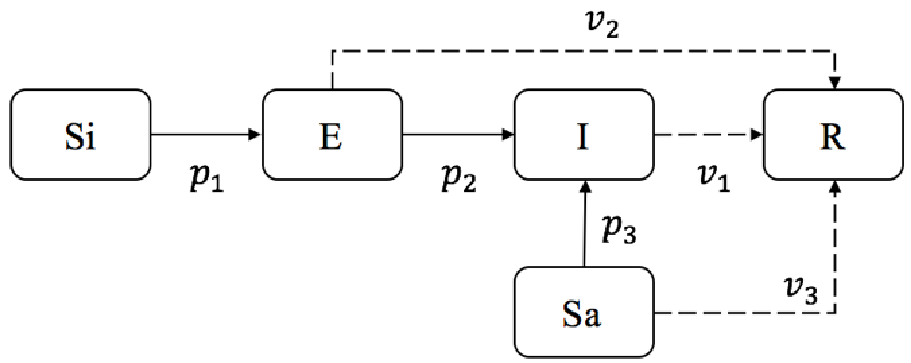 Figure: The state transition logic showing how Si moves to E, and eventually I or R.
Experiments: Topology and Timing
The study compared three network types: BA (Scale-free), WS (Small-world), and a real Weibo dataset.
Key Findings:
- The Weibo Signature: The Weibo network acts as a hybrid, featuring both high clustering (like WS) and hub-centricity (like BA). This allows for a wider, albeit slightly slower, spread compared to pure BA networks.
- The Golden Hour: News published at 20:00 (peak lounging time) hits saturation in nearly half the time (6-7 hours) compared to news published at midnight (15 hours).
- The Value Ceiling: Higher information value significantly raises the total percentage of users "infected," but it doesn't necessarily change the "shelf life" of the news—the interest decay remains a relentless downward slope.
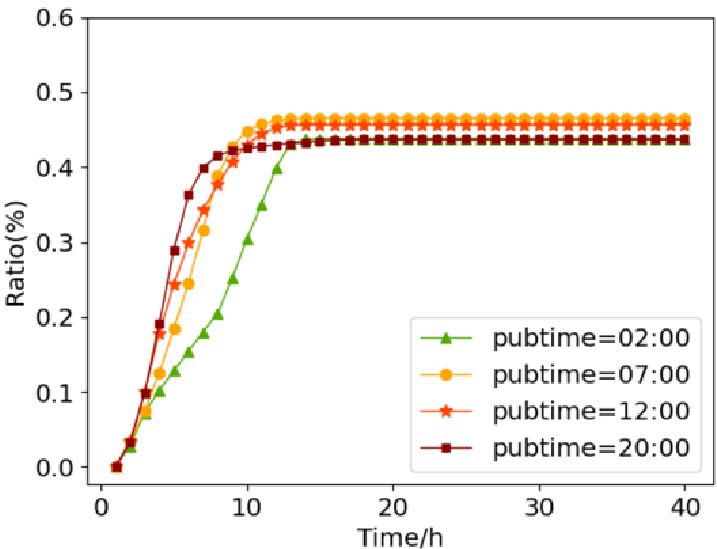 Figure: Comparison of saturation speeds based on different publication times.
Critical Insight & Conclusion
The study proves that general diffusion models are too blunt for specific domains. For sports, the window of opportunity is incredibly narrow.
Takeaways for the Industry:
- Optimize for the Latent (E) State: Since many users "read but don't share," increasing the perceived "Information Value" is the only way to convert these lurkers into spreaders.
- Timing is non-negotiable: Publishing even 4 hours off-peak can result in a 2x delay in information saturation, potentially losing the "breaking news" advantage.
Limitations: The model assumes a "statically closed" network. In the real world, cross-platform sharing (e.g., from Weibo to WeChat) and evolving algorithms may further complicate these dynamics. Future work should look at the "multi-peak" phenomenon caused by secondary news breaks or follow-up commentary.