
Decoding the Pulse of Social Rating Networks: Why Your Friends and Your Ratings Co-Evolve
Modeling the temporal dynamics of social rating networks using bidirectional effects of social relations and rating patterns
This paper introduces a probabilistic generative model to simulate the evolution of Social Rating Networks (SRNs), such as Epinions and Flickr. The core method, termed "FullModel," is the first to simultaneously capture four bidirectional effects: social influence, transitivity, selection, and correlational influence, while modeling their temporal dynamics as power-law functions of network growth.
TL;DR
Understanding how social networks grow is no longer just about who follows whom; it's about how our choices (ratings) and our connections (links) feed into each other over time. This paper introduces a comprehensive generative model that captures the "bidirectional" dance between social interaction and user behavior, proving that as a network matures, the mechanisms driving it are anything but static.
The Missing Dimension in Social Modeling
Most social network models treat users as nodes and friendships as edges. While useful, this "graph-only" approach misses a crucial component: User Activity. On platforms like Epinions or Flickr, users don't just make friends; they rate products or "favorite" photos.
The researchers identified four key effects that govern these networks:
- Social Influence: Your friends' ratings influence yours.
- Transitivity: You befriend the friends of your friends.
- Selection: You befriend people who already have similar tastes.
- Correlational Influence: You are influenced by people with similar rating patterns, even if they aren't your friends.
The real challenge? These effects aren't constant. A new user with zero friends acts differently than a power user with thousands.
Methodology: A Generative View of User Behavior
The authors propose a probabilistic generative model. Instead of a static snapshot, it views the Social Rating Network (SRN) as a chronological sequence of actions.
The Dynamic Engine
The model uses power-law functions to adjust the weights of different behaviors as the system evolves. For instance, the probability of a new user joining the system decreases as the network becomes saturated.

The model captures how an action is determined—starting from user selection to the specific type of action (rating vs. linking).
Mathematical Intuition
The model calculates the likelihood of an action based on the current state of the network . This includes "Preferential Attachment" (the rich-get-richer) but adds layers for similarity and local network structure.
Key Insights from the Data
The researchers tested their model against two massive datasets: Epinions (product ratings) and Flickr (photo favorites).
1. Transitivity > Selection
One of the most surprising findings was that Transitivity is far more powerful than Selection. In both datasets, about 90% of new social links were created through "friends of friends" (transitivity), whereas only a small fraction were driven by users finding strangers with similar ratings (selection).
2. The Power of Social Influence
The "FullModel" significantly outperformed baselines in predicting how users adopt ratings. It accurately simulated "rating adoption influence"—the phenomenon where users align their scores with their social circle.
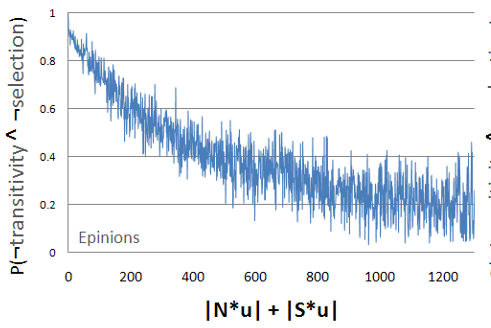
This figure highlights how the strength of transitivity varies as the network scales, a dynamic usually ignored in static models.
Why This Matters
The ability to generate synthetic SRNs is a game-changer for academic research. Because real social data is often locked behind privacy walls, a model that can create "fake" data with "real" properties allows for better algorithm testing without privacy risks.
Furthermore, it provides a roadmap for recommendation engines: don't just look at what a user likes; look at the dynamic trajectory of their social and rating growth.
Conclusion & Limitations
While highly effective, the model currently operates on discrete time steps. The authors suggest that moving toward continuous time modeling could further improve accuracy, especially in capturing the exact "burstiness" of human social interaction.
Takeaway: In the world of SRNs, who you know defines what you like—but what you like also slowly reshapes who you know.