
Excitable Social Media: Modeling Information Propagation as Biological Waves
Modelling of Excitation Propagation for Social Interactions
This paper introduces a nature-inspired cellular automaton (CA) model to simulate excitation information propagation in social interactions. By utilizing a neuron-based agent schema with nonlinear activation functions, the authors successfully model complex social phenomena like novelty diffusion and multi-group cooperation, achieving fast simulation speeds suitable for social and economic research.
TL;DR
Researchers have developed a novel simulation framework that treats social networks as excitable media, similar to cardiac tissue or chemical reactions. By modeling individual social agents as simplified neurons (Perceptrons) that require time to "recover" after being excited by news or trends, the study provides a high-speed method to predict how innovations spread, collide, and survive across different social groups.
Contextual Positioning
This work bridges the gap between Chaos Theory and Social Agent-Based Modeling. While most social simulations focus on "Who talks to Whom," this paper focuses on the physics of the signal itself, positioning social interactions within the universal category of excitable media alongside particle physics and microbiology.
Problem & Motivation: The Human "Refractory Period"
Existing social models often assume that if you hear a piece of news, you can immediately pass it on with perfect fidelity, indefinitely. Real humans don't work that way. We experience:
- Reaction Delay: Time needed to verify or process information.
- Refractory Period: A "tiredness" phase where we ignore repeated stimuli.
The authors argue that these biological constraints are exactly what create the complex, sometimes chaotic patterns we see in viral trends or political campaigns.
Methodology: The Neuron-Agent Architecture
The researchers used a hexagonal 2D grid where each node is a Single Layer Perceptron (SLP).
Core Mechanism:
- Weighted Inputs: Each agent sums signals from six neighbors.
- Nonlinear Activation: If the sum exceeds a threshold , the agent "fires."
- Dynamic Recovery: Critically, the time an agent stays "excited" and the time it takes to "recover" is a nonlinear function of the input strength.
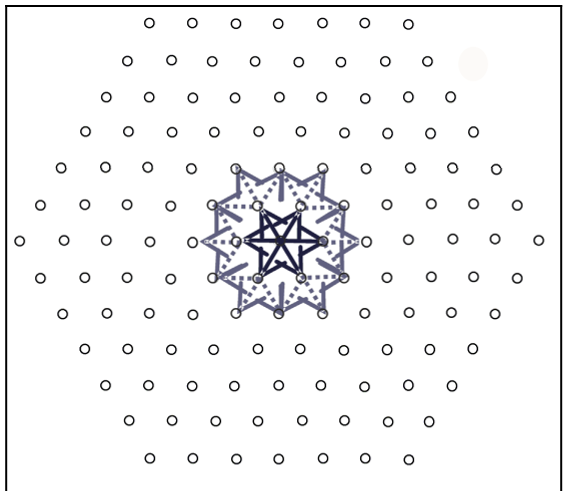 The hexagonal transmission schema: Signals propagate from a central node, influenced by connection weights and local sensitivity.
Experiments & Results: Chaos, Cooperation, and Competition
The study explored three primary scenarios:
1. Pattern Formation
By tweaking noise and weights, the model produced four distinct wave types: regular circular waves, oscillating waves, and chaotic distributions.
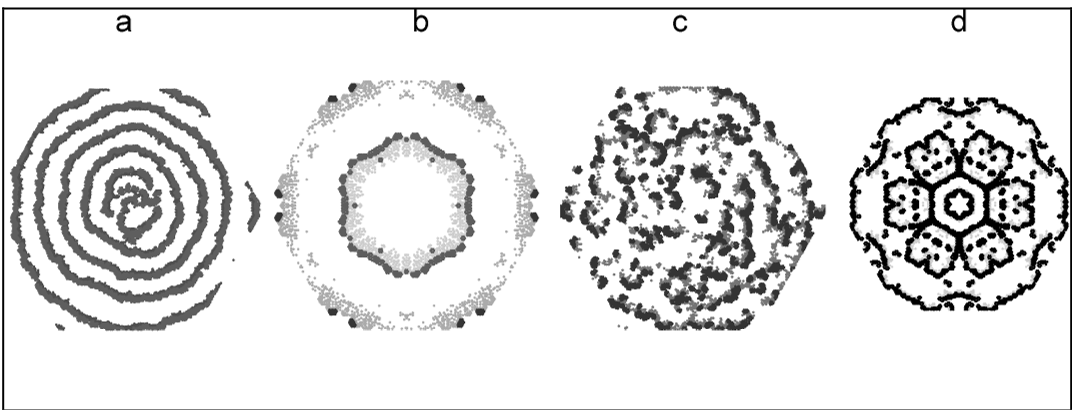 Figure 1: Comparison of wave propagation under different parameters. Note how random noise in node coordinates (1a, 1c) creates more realistic, "messy" social patterns.
2. Competing Novelties
When two "innovation waves" collide, the nodes in the middle enter a refractory period, essentially creating a "dead zone" where neither signal can pass. This explains why two competing political ideologies often reach a stalemate—the "media" (the people) becomes exhausted.
3. Financial Time Series Generation
One of the most impressive applications was simulating financial markets. By measuring the difference in excitation levels between agent groups, the authors generated "synthetic profit/loss" data.
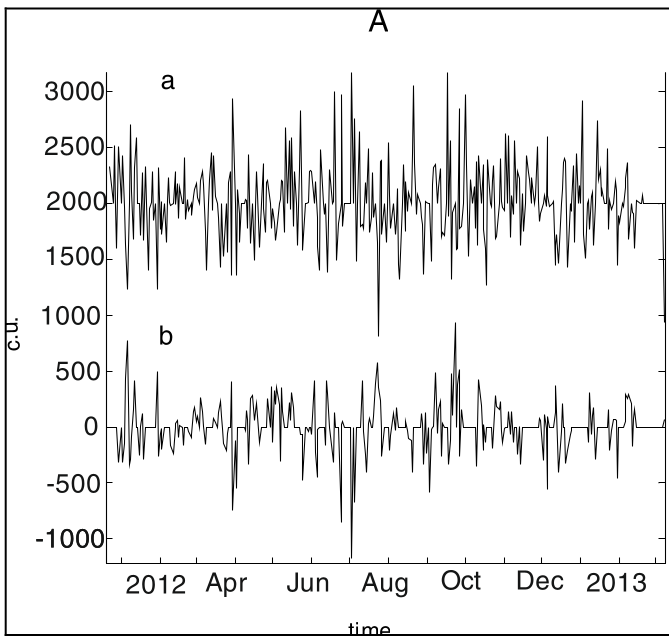 Figure 4: The model (Graph B) successfully mimics the high-frequency "zero-trading" behavior seen in real Automated Trading Systems (Graph A).
Critical Analysis & Conclusion
Takeaway
The study proves that Social Diversity is a Survival Mechanism. In homogeneous groups, information waves tend to hit the "border" and die out. In heterogeneous, grouped populations, the variation in recovery times allows the signal to "hop" between groups, ensuring the long-term survival of ideas.
Limitations
- Spatial Constraints: The 2D hexagonal grid is a simplification. Real social media uses "Scale-Free" networks where agents can be connected to thousands of others globally, not just six local neighbors.
- Simplistic Weights: Connection strengths are largely static in these simulations, whereas real-world trust fluctuates over time.
Future Outlook
The authors plan to extend this to 3D visualizations and more complex hierarchical structures. This "bottom-up" approach could eventually allow policymakers to "vaccinate" social media against harmful disinformation waves by identifying and adjusting the "refractory" properties of key agent groups.