
The Social Trap: Why Your Network Aggregate Distribution is Lying to You
Modelling inter-contact times in social pervasive networks
This paper proposes an analytical framework to model inter-contact times in Social Pervasive Networks (SPNs), utilizing Dunbar’s ego-network hierarchy from anthropology. It establishes a formal mathematical relationship between individual pair distributions and the aggregate distribution, proving that the latter can exhibit a heavy-tailed power law even if individual pairs follow light-tailed exponential distributions.
TL;DR
Researchers from IIT-CNR and the University of Oxford have bridged anthropology and networking to solve a long-standing paradox: Why do aggregate network logs show "scary" power-law delays when individual human interactions don't? By applying the hierarchical "ego-network" model, they prove that social heterogeneity—the fact that we have a few best friends and many acquaintances—mechanically creates heavy-tailed distributions. This work provides a vital analytical tool to prevent "false alarms" regarding protocol divergence in social pervasive networks.
Background: The Ghost in the Machine
In Social Pervasive Networks (SPNs), devices communicate based on the social relationships of their owners. The "inter-contact time"—the gap between two communication events—is the heartbeat of the network. If this gap follows a power law with a shape less than 2, standard "naïve" forwarding protocols (like epidemic routing) can suffer from infinite expected delay.
The problem? Most researchers look at aggregate data (everyone's contacts lumped together) because it's easier to collect and preserves privacy. But is the aggregate a faithful mirror of the individual? This paper argues a resounding "No."
The Insight: Dunbar’s Layers
The authors leverage a fundamental concept from anthropology: Ego Networks. Humans don't interact with everyone equally. Instead, we have concentric layers of intimacy:
- Support Clique (~5 people): Highest contact rate.
- Sympathy Group (~15 people).
- Active Network (~150 people/Dunbar's Number): Lowest contact rate for meaningful ties.
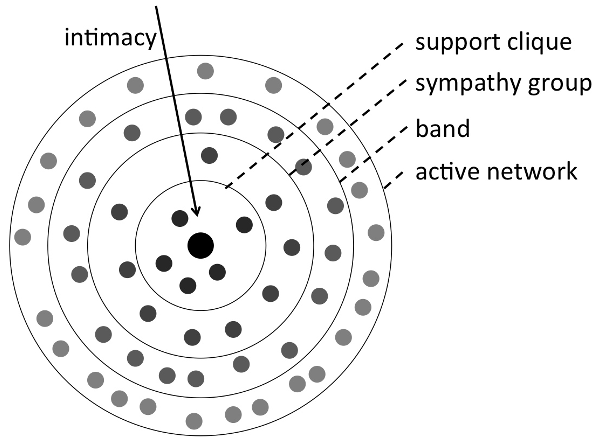
The authors hypothesized that the massive heterogeneity across these layers—from the high-frequency inner circle to the low-frequency outer shell—is what shapes the aggregate distribution.
Methodology: Bridging Math and Society
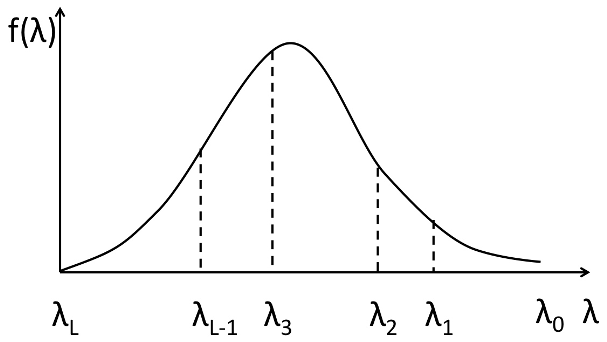
The core of the paper is Theorem 1, which treats the aggregate distribution as a mixture model.
Where is the aggregate inter-contact time distribution within a specific social layer. By using a Gamma Distribution to model the contact rates across these layers, they discovered something fascinating: Even if every single relationship in the network has simple, predictable, exponential inter-contact times, the act of aggregating them across social layers creates a power-law tail.
Key Results: Validating the Theory
The authors tested their model against a dataset of 251 ego networks (over 20,000 samples).
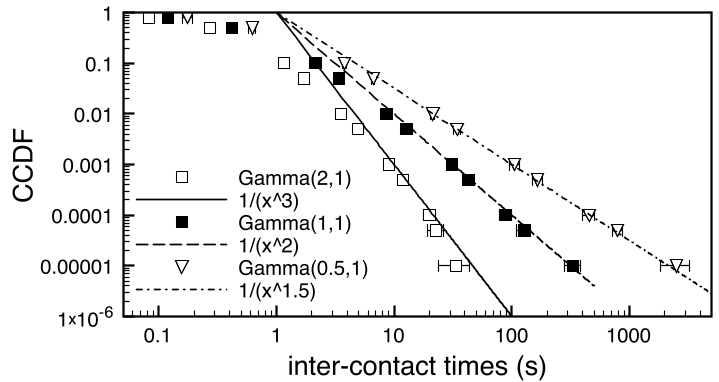
- The Gamma Fit: Human contact rates perfectly fit a Gamma distribution ().
- The Power-Law Illusion: Using this Gamma distribution in their model, the aggregate inter-contact time emerged as a power law of the form .
- Protocol Stability: Because the individual pairs remained exponential, the protocols that seemed likely to fail (based on aggregate power-law analysis) were actually perfectly stable.
Critical Insight & Conclusion
This paper offers a "Sufficient Condition" (Theorem 4) that is a gift to network engineers: If your aggregate data is not heavy-tailed, you can sleep soundly—none of your individual users are causing heavy-tailed delays either.
However, if the aggregate is heavy-tailed, you cannot assume your protocol will diverge. It might just be the "social signature" of human heterogeneity.
Takeaway: Stop trusting aggregate statistics blindly. To understand the future of social pervasive networks, we must model the "Ego" first.
Limitations
The model assumes users are carry devices constantly. In reality, device battery life and "digital detox" periods might add external noise to the "pure" social inter-contact times. Future work should explore how hybrid cyber-physical factors further warp these distributions.