
AMID: Fighting Social Media Rumors via Strategic Influence Injection
Modelling Multiple Influences Diffusion in On-line Social Networks
The paper proposes AMID (Agent-based Multiple Influences Diffusion), a decentralized framework for modeling how coexisting influences—supportive, contradictory, or competitive—interact within online social networks. Using multi-agent simulation, it specifically addresses the undesirable influence minimization problem, achieving superior suppression of harmful content (like rumors) compared to traditional node-blocking methods.
TL;DR
Researchers have developed the Agent-based Multiple Influences Diffusion (AMID) model, a decentralized system that simulates how different opinions compete for our limited attention. Unlike older models that suggest blocking users to stop rumors, AMID proves that injecting "relevant" positive content is a more effective way to drown out undesirable influences without changing the network's structure.
The "Attention Economy" Crisis
Most mathematical models of social media (like the IC or LT models) treat influence like a virus: it spreads from Person A to Person B in a vacuum. But in reality, your Twitter or Facebook feed is a battleground. Multiple topics compete for your limited attention (capacity).
The authors identify a critical gap: existing methods for "influence minimization" (e.g., stopping a rumor) often suggest blocking nodes or links. This is practically impossible for external organizations and ethically dubious for platform owners. The AMID model shifts the perspective from censorship to competition.
Methodology: High-Fidelity Human Simulation
AMID treats every user as an autonomous agent with:
- Finite Capacity: You can only process so many messages before old ones "fade out."
- Topical Interests: Modeled via Fuzzy Sets, allowing for nuanced membership in multiple categories (e.g., a post can be 70% "Tech" and 30% "Finance").
- Dynamic Trust: Calculated using Subjective Logic based on historical interaction.
The "magic" happens in the interaction between influences. Messages that are topically similar and share the same opinion support each other, while those with opposite opinions compete.
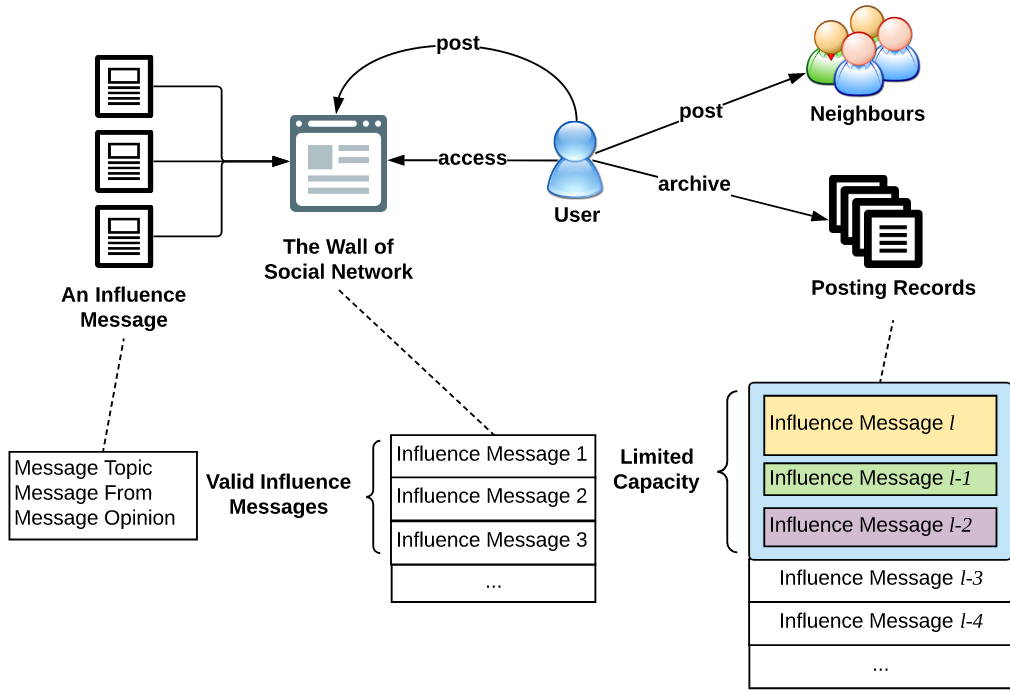 Figure 1: The decentralized architecture of AMID, showing how user agents interact with their "Wall" and posting records.
Experiments: The Power of Context
The researchers tested three injection strategies to suppress an "undesirable" message:
- Irrelevant Influence: New, unrelated "breaking news."
- Opposite Influence: Direct counter-arguments (e.g., "The rumor is false").
- Relevant Influence: Content topically related to existing healthy discussions but not the rumor.
Key Discovery: Don't Always Argue
The results were surprising. Injecting an Opposite Influence (fighting the rumor directly) often required a high "budget" (more initial seeds) and could sometimes backfire by keeping the topic alive.
However, injecting a Relevant Influence that bolstered other positive topics already in the network was the most efficient. By boosting "healthy" topics, the undesirable rumor was naturally pushed out of users' limited attention windows.
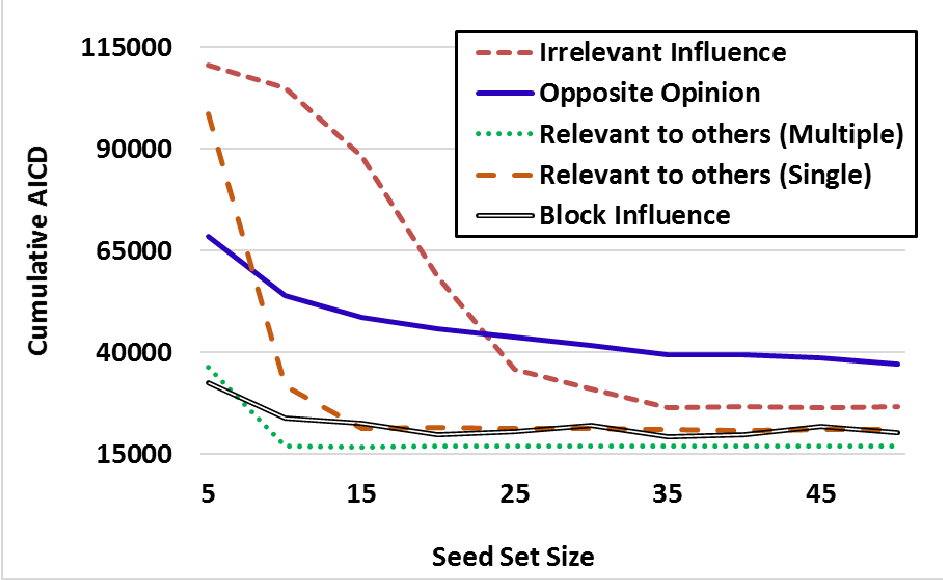 Figure 2: Analysis of Undesirable Influence suppression. Note how 'Relevant' injection (red line) significantly reduces the rumor's reach compared to 'Opposite' opinions.
Critical Insight & Future Outlook
The AMID model provides a sophisticated framework for social engineering in a non-destructive way. By moving away from the "blocking" paradigm, it opens the door for "Influence Maintenance" tools—automated systems that can detect trending misinformation and counter it by subtly promoting positive, related content that appeals to the same user demographic's interests.
Limitations: The model currently assumes users behave rationally according to their trust/interest fuzzy sets. It doesn't yet account for "rage-bait" or the algorithmic amplification built into real-world platforms like TikTok or X, which might override individual "capacity" limits.
Takeaway: If you want to stop a rumor, don't just delete it. Start a more interesting, relevant conversation nearby.