
Decoding the Geometry of Digital Friendships: Predictive Modeling for Disaster Management
On models of ‘having friends’ and SN friends distribution: Information propagation on social networks and disaster modeling
This paper introduces a generalized mathematical framework for modeling friend density and information propagation in Social Networks (SN) based on geographic distance and population density. It synthesizes rank-based and distance-based models to create a "hybrid" approach, specifically designed to predict and monitor SN traffic features during disaster events.
TL;DR
How many friends do you have within 100km? The answer isn't just a social metric—it's a critical variable in disaster response. This paper refines the mathematics of "having friends" by introducing a generalized hybrid model that combines geographic distance, population density, and temporal dynamics. By correcting previous mathematical flaws in Social Network (SN) theory, the author provides a blueprint for using SN traffic to monitor and predict the impact of catastrophes in real-time.
Background & Motivation: The Flaws in the "Small World"
For decades, researchers like Kleinberg have used power-law distributions (e.g., ) to describe how people connect. While these models capture the "Small World" phenomenon, they break down when applied to real-world continuous geography. Specifically, they often fail the normalization condition—the probability of having a friend, when integrated over an infinite plane, shouldn't result in an infinite number of people.
The author identifies that existing models (Distance-based vs. Rank-based) are often counter-intuitive. For instance, in a rank-based model, if you live in a remote area, the model might suggest you have a 100% probability of being friends with everyone in the nearest village 50 miles away, simply because they are the "closest" rank, ignoring the sheer physical barrier of distance.
Methodology: The Hybrid Friendship Equation
The core contribution is a robust, "Hybrid" probability density function. The author suggests that the probability of having a friend at a specific location depends on three distinct factors:
- Direct Distance (): The classic hyperbolic decay.
- Population Rank (): How many people live closer to you than the target friend?
- Background Noise (): The "non-geographic" friends we meet online regardless of location.
The "Exponential" Fix
To ensure the model works at a global scale, the author introduces an exponential decay factor ():
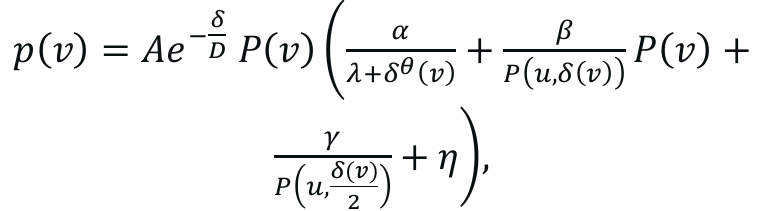 (Formula 15: The Generalized Hybrid Model)
This factor ensures that the probability vanishes fast enough at massive distances (e.g., 10,000 km) to satisfy formal mathematical constraints while remaining "local" enough to capture community structures.
Visualizing the Impact
The paper provides several simulations comparing these models. The primary takeaway is that the inclusion of population density (the and terms) makes the model far more sensitive to the "propensity" of people in specific regions to form connections.
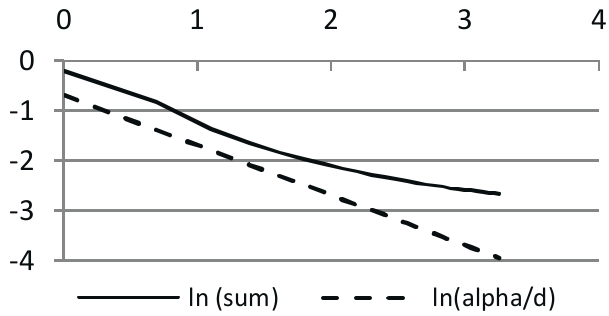 Fig 1: A comparison showing how the hybrid expression (including population terms) deviates from a simple distance-only model.
From Social Connections to Disaster Prediction
Section IV of the paper bridges the gap between theoretical sociology and emergency management. By modeling how a "message" (like a disaster alert) propagates through this friendship geometry, the author derives a response function:
This suggests that the SN response volume grows logarithmically over time. If a disaster strikes, we can watch the "rate of growth" of messages. If the growth deviates from this logarithmic curve, it indicates the "spectacularity" or "un-expectancy" of the event, allowing authorities to quantify the public's panic or need for aid based purely on metadata.
Critical Insight & Future Work
The author's work is an essential bridge between Stochastic Modeling and Sociology. However, it acknowledges a crucial limitation: the "Reflexivity Gap." In current models, if I am likely to be your friend, you are equally likely to be mine. In reality, interest is often asymmetrical.
Key Takeaways for the Future:
- SN as a Sensor: We can determine the "gravity" of a disaster not just by what people say, but by how fast and where the friendship network reacts.
- Scalability: The exponential decay factor makes these models computationally viable for global-scaled social networks like X (Twitter) or Facebook.
Ultimately, this research suggests that our digital social structures are governed by a "physics" of distance and density—one that can be utilized to save lives when the physical world falls into chaos.