
Beyond Chance: Enhancing Animal Social Network Inference with Fuzzy Clustering
A Modified Approach to Inferring Animal Social Networks from Spatiotemporal Data Streams
The paper introduces an improved methodology for inferring animal social networks from spatiotemporal data streams by replacing the traditional "Null Model" filter with a Fuzzy C-Means (FCM) clustering approach. The method aims to distinguish between genuine social interactions and coincident links formed by chance encounter during foraging events.
TL;DR
Inferring who is "friends" with whom in the animal kingdom often relies on tracking spatiotemporal data—if two animals are at the same place at the same time, they might be connected. However, many of these encounters are purely coincidental. This paper proposes a modified approach using Fuzzy C-Means (FCM) to filter these "coincident links." The result? A system that is over 30 times faster and more accurate than the previous SOTA "Null Model" approach.
The "Gambit of the Group" and Its Pitfalls
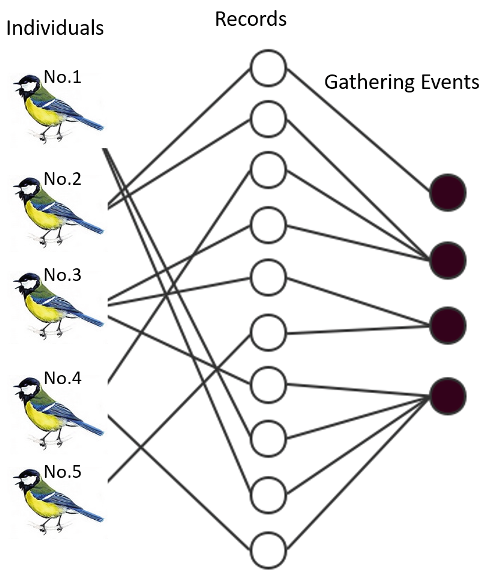
In behavioral ecology, researchers often rely on the Gambit of the Group (GoG) hypothesis: the assumption that individuals found in the same spatial and temporal cluster are socially interacting. The standard pipeline involves:
- Gathering Events: Clustering raw time/location pings into discrete events.
- Link Generation: Connecting individuals who share an event.
- Coincident Filtering: Removing links that likely happened by chance.
The traditional "Null Model" used for step 3 is statistically sound but practically flawed. It relies on thousands of random shuffles to determine a significance threshold, leading to massive computational bottlenecks and a rigid "one-size-fits-all" threshold that fails to capture the nuances of individual behaviors.
Methodology: From Statistical Simulation to Fuzzy Clustering
The core innovation of this paper is replacing the stochastic Null Model with Fuzzy C-Means (FCM).
The Architecture of Inference
The authors first transform raw tracking data into an Individual-to-Preference (IP) matrix. Instead of asking "is this link real?" through thousands of random trials, they ask "to what degree does this link belong to the 'Strong' vs 'Weak' cluster?"
Why Fuzzy?
Unlike K-Means (which assigns a link to exactly one cluster), FCM allows for Membership Degrees. This "fuzziness" is a better physical representation of social interactions, where a link might have some characteristics of a strong bond but still carry the uncertainty of a chance encounter.
The objective function is minimized to update cluster centers () and membership levels () iteratively:
Experimental Results: Speed Meets Accuracy
The authors tested their method on both a controlled dataset (Seeds) and a massive real-world spatiotemporal dataset of Parus major (Great Tits) involving over 1 million records.
1. Performance Gains
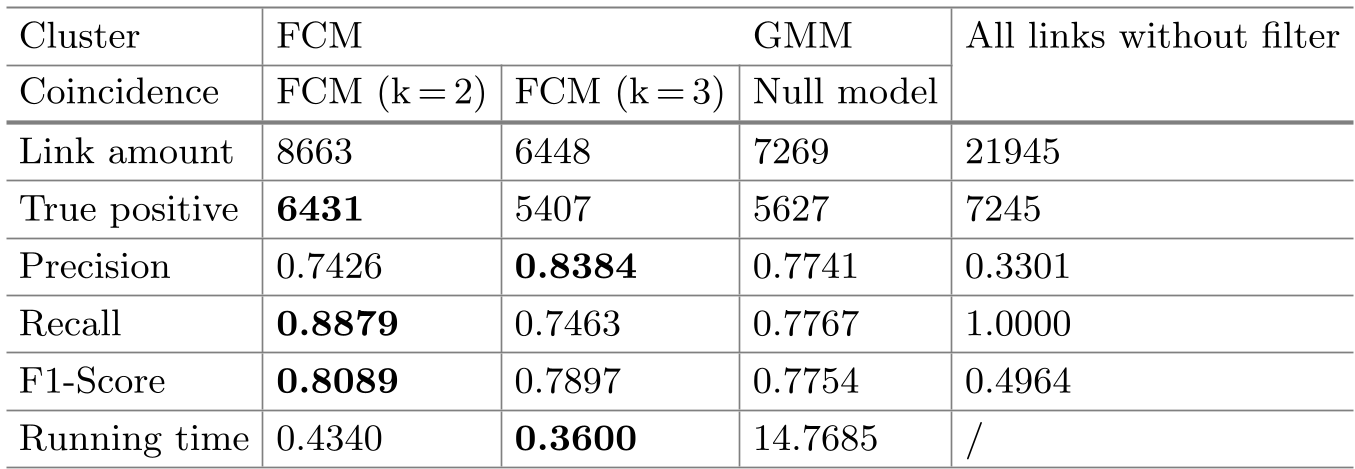
In the controlled Seeds dataset, the FCM (k=2) configuration outperformed the original GMM-based Null Model across almost all metrics, specifically boosting the F1-Score to 0.8089.
2. Computational Efficiency
The most striking result is the efficiency gain. The Null Model's quadratic complexity () makes it crawl on large datasets. FCM () reduced the running time from 14.7 seconds to 0.43 seconds.
3. Real-World Validation
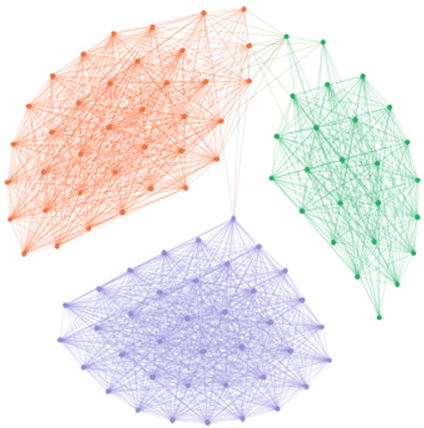
When applied to the Oxford Parus major dataset, the modified method generated a network with 6,637 strong links—90% of which overlapped with the original method's results, proving its reliability on large-scale, unstructured biological data.
Critical Insight & Future Outlook
The shift from shuffling-based significance testing to membership-based clustering represents a paradigm shift in how we handle ecological noise. By treating "coincidence" as a cluster rather than a statistical anomaly, we gain both speed and interpretability.
Limitations: The study primarily focuses on binary links (i-j). However, social groups often involve "triads" or complex motifs. The authors suggest that the next frontier is Link Analysis, inferring missing third-party relationships from known binary interactions.
Conclusion: This work provides a scalable framework for biologists to process massive tracking datasets, turning raw GPS/RFID pings into meaningful social maps in seconds rather than hours.