
MoDisSENSE: Bridging Social Sentiment and Spatio-Temporal Big Data
MoDisSENSE: A distributed platform for social networking services over mobile devices
MoDisSENSE is a distributed analytics platform designed for social networking services that integrates heterogeneous data like GPS traces, social profiles, and textual comments. It utilizes a hybrid PostgreSQL-HBase architecture and distributed computing (Hadoop/Mahout) to provide personalized, sentiment-aware Point of Interest (POI) recommendations in milliseconds.
TL;DR
MoDisSENSE is a distributed platform that transforms raw GPS traces and social media noise into "smart" urban insights. By combining a hybrid storage backend (SQL + NoSQL) with distributed Machine Learning, it allows users to query their social circle's real-time sentiment regarding physical locations, delivering personalized results in milliseconds.
The Motivation: Geography is No Longer Enough
Why do we still get generic restaurant recommendations when our phones know exactly where we are and who we trust? The problem with current Geo-location Services (LBS) is a lack of contextual integration.
Standard systems struggle with three dimensions:
- Scale: The firehose of GPS data from thousands of mobile devices.
- Sentiment: Understanding if a "check-in" was a positive or negative experience.
- Personalization: Filtering the world based on the social graph (what my friends think) rather than global averages.
MoDisSENSE solves this by treating social data not just as text, but as a structured, queryable layer over the physical world.
Methodology: The Hybrid Engine Under the Hood
The core innovation of MoDisSENSE lies in its "Bilingual" storage and processing architecture.
1. Hybrid Storage Strategy
The system acknowledges that no single database can do everything.
- PostgreSQL: Used for "Cold/Structured" data—spatial indices and keyword searches that require complex joins but don't change by the millisecond.
- HBase (NoSQL): Used for "Hot/Unstructured" data—massive streams of GPS traces and social comments. By using HBase Coprocessors, the system pushes the query logic to the data nodes themselves, preventing network bottlenecks.
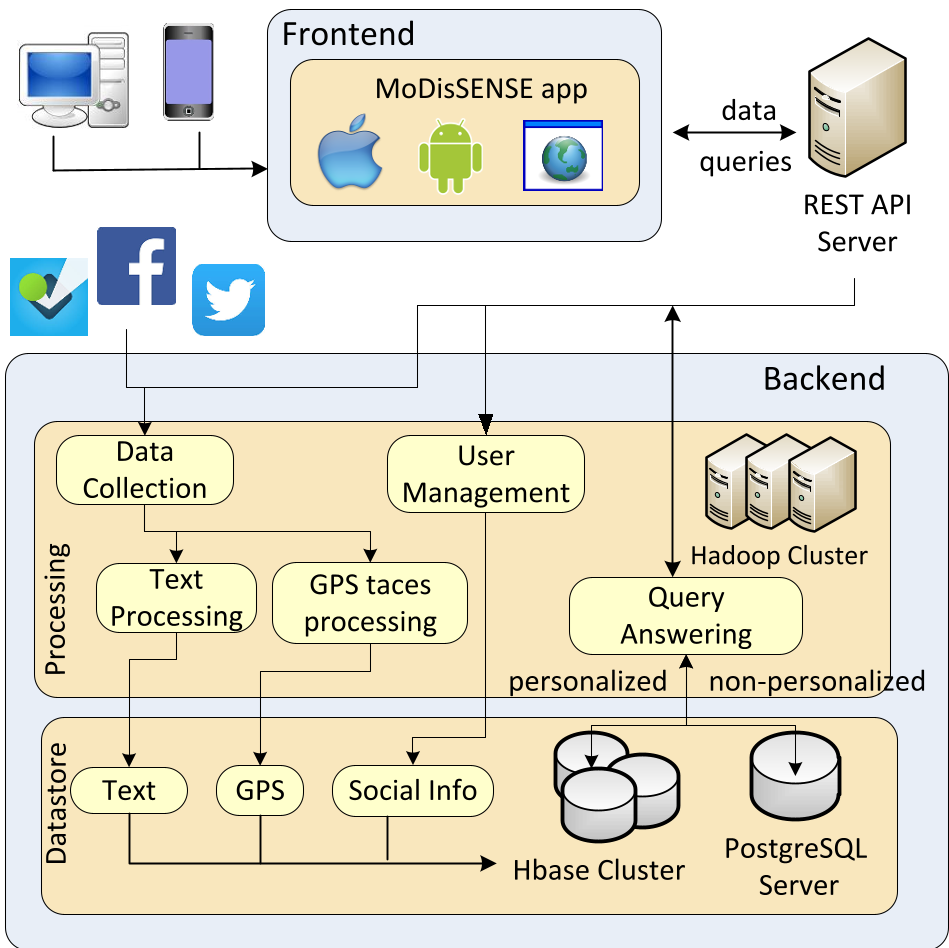
2. Distributed Intelligence
The platform doesn't just store data; it interprets it:
- Sentiment Analysis: Using a Naive Bayes classifier (via Apache Mahout) trained on TripAdvisor datasets, the system achieves >90% accuracy in determining if a social comment is a recommendation or a complaint.
- Semantic Trajectories: By running a distributed DBSCAN (Density-Based Spatial Clustering) on Hadoop, MoDisSENSE identifies "Trending Events" (e.g., a sudden crowd at a stadium) and maps raw GPS points to meaningful human activities.
Experimental Results: Performance at Scale
The authors emphasize the challenge of "Socially Charged Queries." For instance: "Where have my friends eaten lamb near the Acropolis and liked it recently?"
- Vertical Performance: By indexing data by
Friend_IDin HBase, the system parallelizes the search. Each worker node scans only the relevant chronological intervals for specific users. - Speed: Query response times are kept in the millisecond range, even though the system performs real-time sentiment filtering and spatial bounding box checks simultaneously.
Critical Analysis & Conclusion
MoDisSENSE's strongest contribution is its modular hybridity. It recognizes that "Big Data" isn't a monolith—social connections behave like graphs, GPS traces behave like time-series, and reviews behave like natural language.
Limitations: While the MoDisSENSE model is robust, it relies on the OAuth protocol and API access to platforms like Facebook and Twitter. As these platforms "close their gardens" (restrict API access), the platform may need to pivot toward edge-computed data or decentralized social protocols.
Future Outlook: The integration of Semantic Trajectories points toward a future of "Intent Prediction." If MoDisSENSE knows you are on a "meat restaurant" trajectory with friends who have a high sentiment for a specific neighborhood, it can transition from a Search engine to a Proactive Assistant.
Note: This post is based on the paper "MoDisSENSE: A Distributed Platform for Social Networking Services over Mobile Devices."