
MoDisSENSE: Scaling Social Intelligence for Personalized Location Discovery
MoDisSENSE: A Distributed Spatio-Temporal and Textual Processing Platform for Social Networking Services
MoDisSENSE is an open-source distributed platform designed for large-scale spatio-temporal and textual analysis of social networking data. It integrates heterogeneous data from Facebook, Twitter, and Foursquare to provide socially-enhanced Point of Interest (POI) recommendations and automated daily activity blogging.
Executive Summary
TL;DR: MoDisSENSE is a sophisticated distributed platform that bridges the gap between massive social media streams and personalized location services. By combining Hadoop-based analytics with a hybrid NoSQL/RDBMS storage layer, it transforms "digital footprints"—GPS traces, "likes," and comments—into real-time POI recommendations and automated travel blogs.
In the academic landscape, this work represents a robust systems-oriented contribution (SOTA in 2015), moving beyond theoretical recommendation algorithms to provide a production-ready, open-source architecture capable of handling the high-concurrency demands of modern Social Networking Services (SNS).
Problem & Motivation: The Multi-Dimensional Data Deluge
Modern social data is not just "big"; it is heterogeneous. A single user action (like a Foursquare check-in) contains:
- Spatial: Where the user is ().
- Temporal: When the action occurred.
- Textual: Sentiment expressed in the accompanying comment.
- Social: Who in the social graph is influenced by this action.
Prior works often treated these dimensions in isolation or failed to scale. The authors noticed that while Facebook or TripAdvisor suggest places, they rarely synthesize your entire social circle's real-time sentiment with live GPS movement to detect "hot" trending events.
Methodology: The Hybrid Architecture
The technical heart of MoDisSENSE is its modular backend, which balances batch processing (for heavy lifting) and online serving (for user queries).
1. Storage Strategy
The system rejects a "one size fits all" database approach:
- HBase (NoSQL): Handles the "Visits Repository" and "GPS Traces." Because these involve high update rates and require parallel scanning via MapReduce, HBase’s scalability is vital.
- PostgreSQL: Manages "POI Metadata" and "Blogs." These require complex indexing for random-access lookups that NoSQL struggles with.
2. Intelligent Processing Pipelines
- Sentiment Analysis: Using Apache Mahout, the team implemented a Naive Bayes classifier. By fine-tuning with -grams and Bi-Normal Separation, they pushed accuracy to nearly 94%.
- Event Detection: The platform uses a distributed DBSCAN algorithm to identify clusters of GPS traces. If a high density of traces appears where no known POI exists, MoDisSENSE automatically flags it as a new "Trending Event."
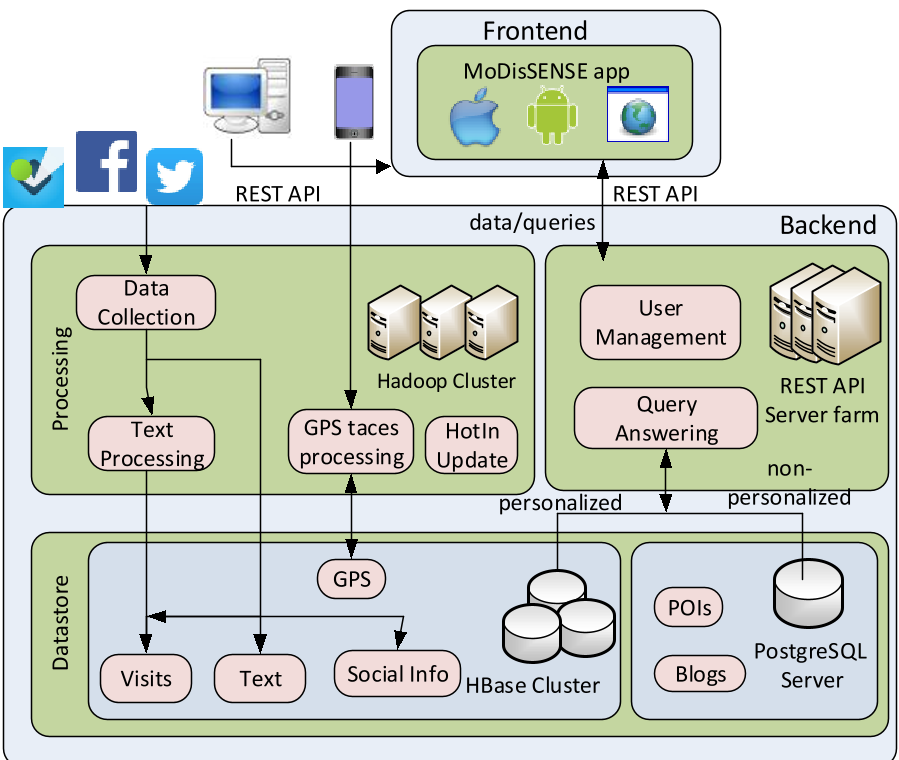 Figure 1: The modular architecture separating Frontend (Web/Mobile) from the Distributed Backend (Hadoop/HBase/PostgreSQL).
Experiments & Performance Reality
The researchers stress-tested the platform with a synthetic dataset of 150k users and 8,500 POIs.
Scalability Under Concurrency
A critical finding was that the number of social friends is the bottleneck for personalized queries. However, by using HBase Coprocessors, MoDisSENSE moves the computation to the data. Instead of pulling thousands of records to the web server, the Coprocessors filter and aggregate visits locally on the storage nodes.
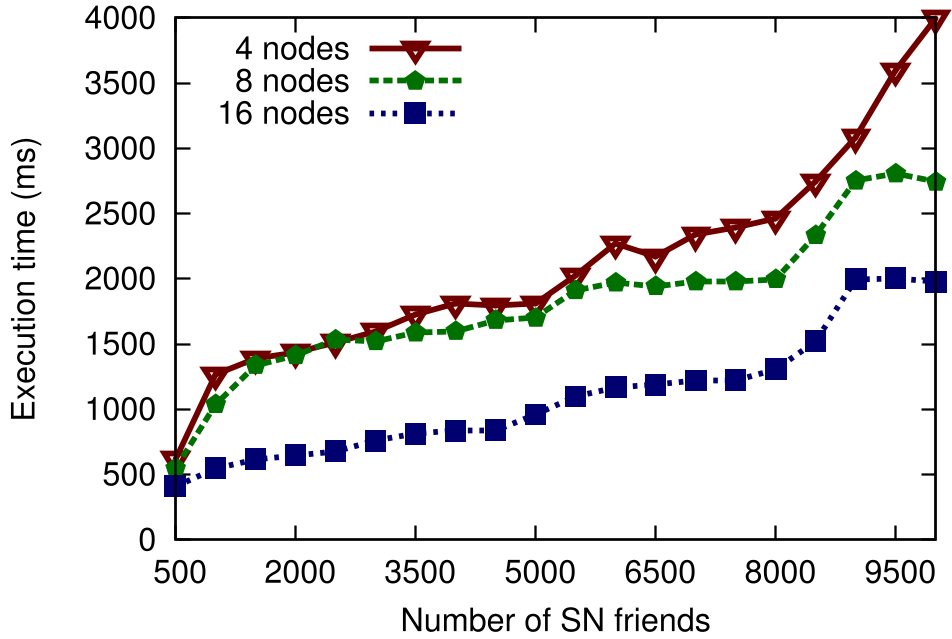 Figure 2: Query latency stays under 1000ms even as the number of queried friends reaches the 5,000 limit common in social networks.
Sentiment Accuracy
The ablation study for sentiment analysis (Figure 4 in the paper) reveals that while more data helps, "overfitting" occurs beyond 500k documents, a classic machine learning trade-off that the authors navigated to achieve their 93.8% SOTA accuracy.
Critical Analysis & Conclusion
MoDisSENSE succeeds in providing a blueprint for Socially-Aware Geo-Services. Its primary strength lies in its data fusion: it doesn't just see a "check-in"; it extracts the emotional valence of that check-in to weight recommendations.
Limitations: As a 2015-era paper, the "Social Graph" relies on API access that has since become much more restricted (e.g., Facebook's Graph API changes). Furthermore, the Naive Bayes approach, while efficient, lacks the deep semantic understanding of modern Transformers (BERT/GPT).
Future Impact: The concept of "Semantic Trajectories"—turning raw GPS coordinates into a narrative blog—remains a highly relevant area in "Digital Twin" and "Smart City" research. MoDisSENSE's hybrid-store approach continues to be a gold standard for developers building high-performance spatial applications.
For those interested in the implementation, the project remains open-source under Apache License 2.0.