
Deciphering the Spectral Signature: How Metastability Defines Social Communities
On Modularity of Social Network Communities: The Spectral Characterization
This paper introduces a novel spectral framework for characterizing social network communities by linking hierarchical modularity to the metastability of a Markov process. Unlike traditional optimization methods, it utilizes the "Spectral Signature" (CQ values) derived from the network's transition matrix eigenvalues to determine the natural number of communities and their structural quality.
TL;DR
Why do communities exist in social networks? This paper moves beyond just "clustering" and explores the fundamental physics of modularity. By treating a network as a landscape for a random walker, the authors prove that communities are metastable states where information (or "the walker") gets trapped. They introduce the Spectral Signature, a method to identify the natural number of communities and their hierarchical depth using only the eigenvalues of the transition matrix.
Background: Beyond the Objective Function
In the study of Social Network Community Mining Problems (SNCMP), we usually ask: "What algorithm can partition this graph best?" Whether it's Newman’s Modularity (Q) or Normalized Cuts, we are essentially optimizing human-defined rules.
The authors of this paper ask a deeper question: Is community structure an intrinsic feature of a network's dynamics? They argue that modularity is essentially a measure of a system's instability. If a social system is perfectly stable, it consists of one unified community; as it becomes unstable, it fractures into metastable sub-groups.
Methodology: The Physics of Local Mixing
The core innovation lies in the use of Large Deviation Theory. Imagine an agent walking randomly across a network. If the network has communities, the agent will spend a long time bouncing around within a community (Local Mixing) before finding a "bridge" to another group (Global Mixing).
1. The Stochastic Landscape
The transition probability is defined by the adjacency matrix and degree matrix : The "speed" at which a community reaches its local equilibrium is governed by the eigenvalues of the Markov generator .
2. Community Quality (CQ)
The authors define Community Quality (CQ_K) as:
- A small CQ (near 0) indicates a strong, well-separated community structure.
- A large CQ (near 1) suggests an ambiguous or non-existent structure.
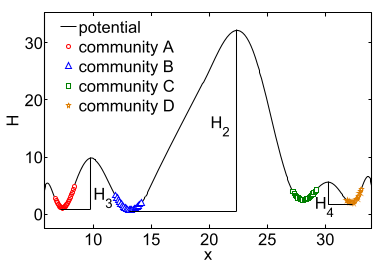 The figure above illustrates a potential function (a) transformed into a network (b). The dynamics (e-h) show how the walker stays within "valleys" (communities) for a long time (metastability) before jumping barriers.
Experimental Insights: Reading the Spectral Signature
By plotting the train of values—the Spectral Signature—we can "see" the network's structure without looking at the graph itself.
- Single Level: A sharp drop at one specific indicates a flat community structure.
- Hierarchical: Multiple local minima in the plot reveal communities within communities.
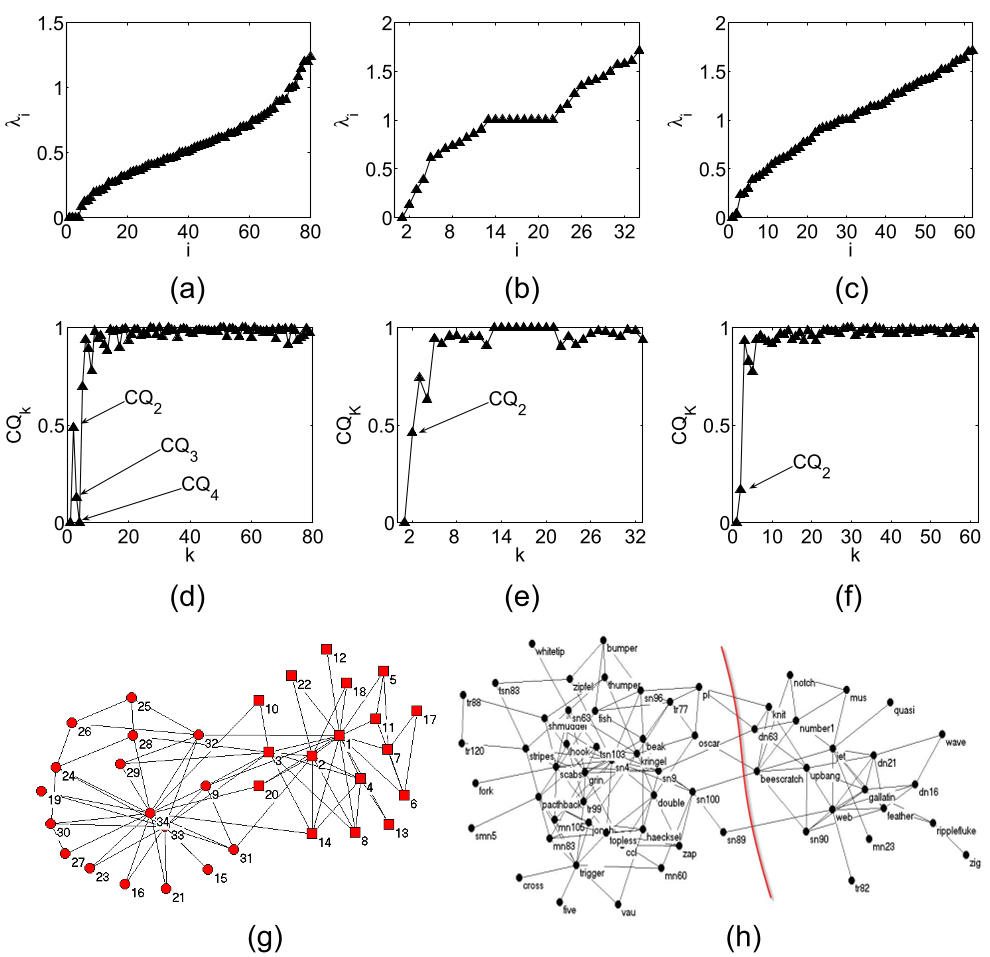 Comparing the Zachary Karate Club and the Dolphin Network: The Dolphin network shows a much lower value, indicating a more distinct and "stable" community separation compared to the Karate club.
Critical Analysis: Why This Matters
The "Spectral Signature" approach is powerful because it addresses a common flaw in community detection: Knowing when to stop. Most algorithms will force a partition even on random noise. By looking at the values, we can objectively state whether a community exists at all based on the spectral gap.
Limitations & Future Work
While theoretically elegant, the calculation of the full spectrum for massive networks (millions of nodes) is computationally expensive ( normally, though sparse methods help). The authors focus on undirected graphs; extending this "metastability" framework to directed networks where the random walk may not be ergodic remains a challenging frontier.
Conclusion
This paper bridges the gap between Topological structure and System dynamics. It suggests that the "communities" we observe in social media or biological systems are not just clusters of links, but "valleys" in a dynamical landscape. As we look toward analyzing large-scale networks like YouTube or CiteSeer, the Spectral Signature provides a mathematically rigorous tool to quantify the "health" and stability of these digital societies.