
The Ghost in the Network: Spectral Signatures and the Metastability of Communities
On Modularity of Social Network Communities: The Spectral Characterization
This paper introduces a novel spectral characterization of social network communities based on the dynamics of a stochastic Markov model. By leveraging large deviation theory, the authors establish a formal link between hierarchical community modularity and the metastability of random walks, providing a way to quantify network structure (CQ metrics) without explicit clustering.
TL;DR
Why do communities exist in social networks? This paper moves beyond simple "cut" heuristics to propose a deep theoretical insight: communities are metastable states of a stochastic process. By analyzing the eigenvalues of a network-based Markov chain, the authors derive a "Spectral Signature" that reveals the number, quality, and hierarchical depth of communities without running a single clustering algorithm.
Background: Beyond Heuristic Clustering
In the world of Graph Theory and Web Intelligence, the Social Network Community Mining Problem (SNCMP) has traditionally been approached via optimization (e.g., maximizing Newman's function) or heuristics (e.g., edge betweenness). While effective, these methods are often "black boxes" regarding the intrinsic physical properties of the network.
The authors ask a fundamental question: Is community structure an inherent dynamic property of a network's topology?
The Core Insight: Metastability and Large Deviation Theory
The authors propose viewing a network through the lens of a random walker. In a network with clear communities, a walker will "get stuck" inside a dense cluster for a long time—locally mixing—before eventually jumping a sparse "bridge" link to another cluster.
This behavior is mathematically described as metastability. Using Large Deviation Theory, the authors show that the time a walker takes to exit a community is tied to "potential barriers."
The Markov Generator
By defining a transition probability matrix , they examine the Markov generator . The eigenvalues of this matrix contain the "DNA" of the network's modularity.
- Hitting Time: How fast a walker reaches a local equilibrium ().
- Exiting Time: How long it takes to escape a community ().
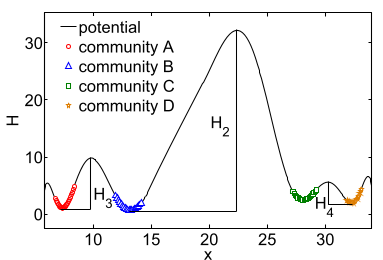 Figure 1: Illustration of how a random walk moves from local mixing within communities () to global mixing ().
Methodology: The CQ (Community Quality) Metric
The authors introduce a breakthrough metric: Community Quality (). Unlike previous metrics that evaluate a specific partition, evaluates the network's predisposition to have communities.
- Small : Indicates a very strong, distinct K-community structure.
- Large : Indicates an ambiguous or non-existent structure.
This allows for an "Eigenvalue Counting" approach to finding the natural number of clusters: find the that minimizes .
Experiments and Results
The framework was tested on classic benchmarks:
- Zachary’s Karate Club: A social network of 34 members. The spectral signature correctly identifies as the most significant structure.
- Dolphin Social Network: The spectral signature not only finds but shows a lower than the Karate club, indicating that dolphin societies are more modularly distinct than human karate clubs.
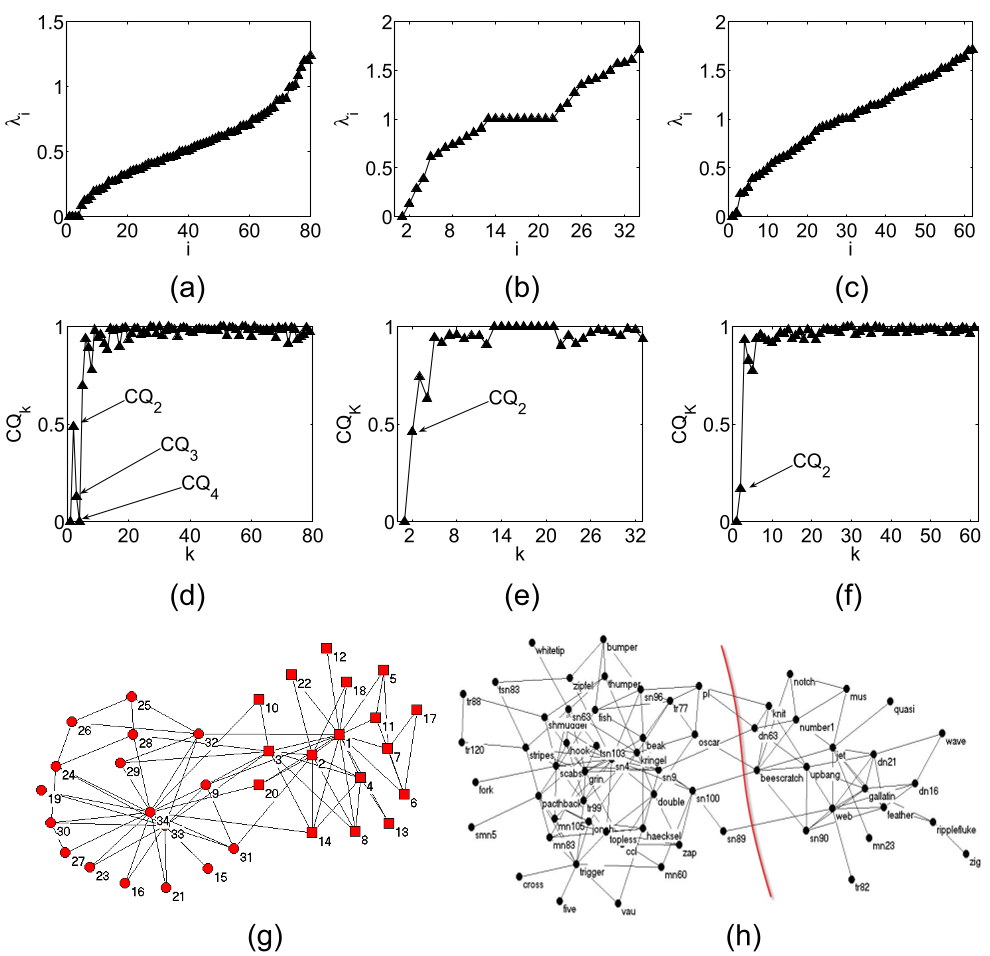 Figure 2: Spectral signatures for Karate (e) and Dolphin (f) networks. Note the clear minimum at .
Hierarchical Discovery
Perhaps the most powerful aspect of this method is its ability to visualize hierarchy. By looking at multiple "dips" in the plot, one can see if a network contains communities within communities (e.g., a university containing departments, which contain research labs).
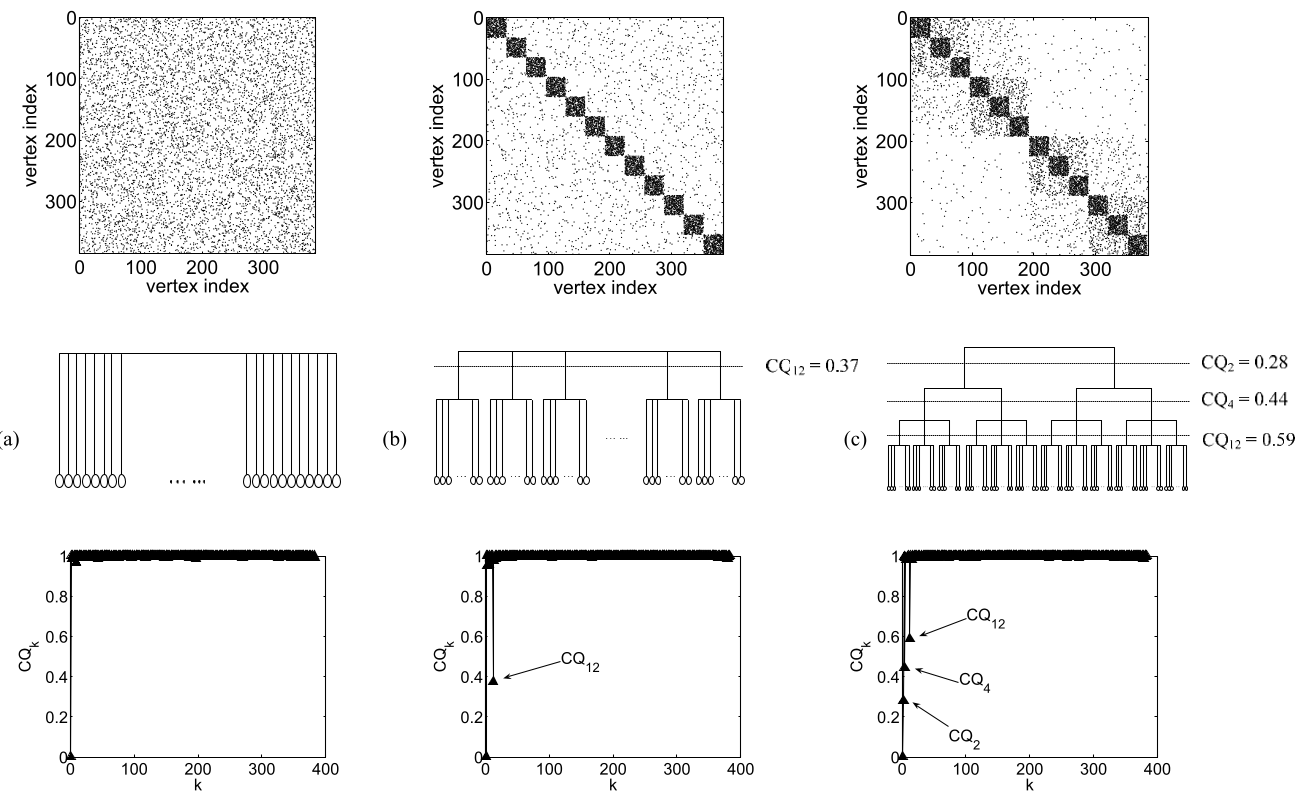 Figure 3: Distinct spectral signatures for (a) no structure, (b) single-level structure, and (c) multi-level hierarchical structure.
Critical Insight: Stability as Modularity
The authors conclude with a profound sociological observation: Modularity is a symptom of instability.
- A perfectly stable social system behaves as a single community.
- An unstable system fragments into metastable communities. The value thus doubles as a "Stability Index" for social organizations.
Conclusion & Future Work
The "Spectral Signature" approach provides a rigorous, objective mathematical framework that moves community detection from the realm of "algorithm-guessing" to "system-physics." Future applications in massive datasets like CiteSeer or YouTube could allow us to predict community trends and splits before they even happen by monitoring the shifting eigenvalues of the network.
Limitations: While theoretically elegant, calculating the full spectrum for massive networks (billions of nodes) remains computationally expensive, suggesting a need for sparse eigenvalue approximation methods in future iterations.