
The GA/GID1/DELLA Hub: Nature’s Master Logic Controller for Adaptive Growth
Molecular GA pathways as conserved integrators for adaptive responses
This review provides a comprehensive molecular analysis of Gibberellin (GA) metabolism and signaling, centered on the GA/GID1/DELLA complex. It identifies this pathway as a primary evolutionary conserved integrator that synchronizes plant growth with complex environmental and endogenous cues.
TL;DR
Gibberellins (GAs) are not just growth hormones; they are the core processing unit of a plant's environmental response system. By modulating the stability of DELLA proteins, GAs integrate signals from light, temperature, and other hormones to determine whether a plant should invest in growth or prioritize survival. This review synthesizes decades of research to position the GA/GID1/DELLA complex as the ultimate evolutionary conserved integration hub.
Problem & Motivation: The Sessile Organism's Dilemma
Unlike animals, plants cannot move to escape heat, salt, or predators. They must "reprogram" their architecture in real-time. Historically, GA research focused on its role in the "Green Revolution" (dwarfing genes like sd-1). However, the major technological and scientific hurdle has been understanding how a single molecule controls processes as diverse as seed germination, stem elongation, and stress tolerance. The authors argue that the answer lies in the DELLA protein, a repressor that acts as a molecular "brake" on growth.
Methodology: The Molecular Architecture of Signaling
The core of GA response is a destruction-based signaling mechanism.
- Perception: Bioactive GA binds to the GID1 receptor.
- Conformational Switch: This binding induces a change in the GID1 N-terminal "lid," creating a surface that specifically attracts DELLA proteins.
- The Tricomplex: The formation of the GA/GID1/DELLA complex changes the DELLA protein's structure from intrinsically disordered to folded.
- Degradation: This folding recruits an SCF E3 ubiquitin ligase (specifically SLY1/GID2), tagging the DELLA "brake" for destruction by the 26S proteasome, thus unleashing growth.
 Fig 1. DELLA protein domains and the molecular mechanisms of sequestration vs. transactivation.
Evolutionary Insights
The review notes a fascinating evolutionary trajectory: while the DELLA growth-repressing function existed in mosses, the ability of GID1 to "sense" GA and trigger DELLA degradation only fully emerged in vascular plants (tracheophytes). This suggests that plants evolved more sophisticated "logic gates" as they colonized more complex terrestrial environments.
Experiments & Results: The Great Integrator
The paper maps out how the GA pathway responds to exogenous stimuli through a complex web of crosstalk:
- Light & Temperature: Phytochromes and cryptochromes regulate GA metabolism. In the shade, GA levels rise to trigger elongation (escape strategy). Conversely, cold stress induces GA-deactivating enzymes (GA2ox), leading to DELLA accumulation and growth arrest.
- Hormonal Crosstalk: GAs do not work alone. They engage in "sequestration" where DELLA proteins physically bind to and inhibit transcription factors from other pathways, such as BZR1 (Brassinosteroids) and ARFs (Auxin).
- Biotic Stress: DELLAs enhance resistance to pathogens like Pseudomonas syringae by modulating the balance between Salicylic Acid and Jasmonic Acid.
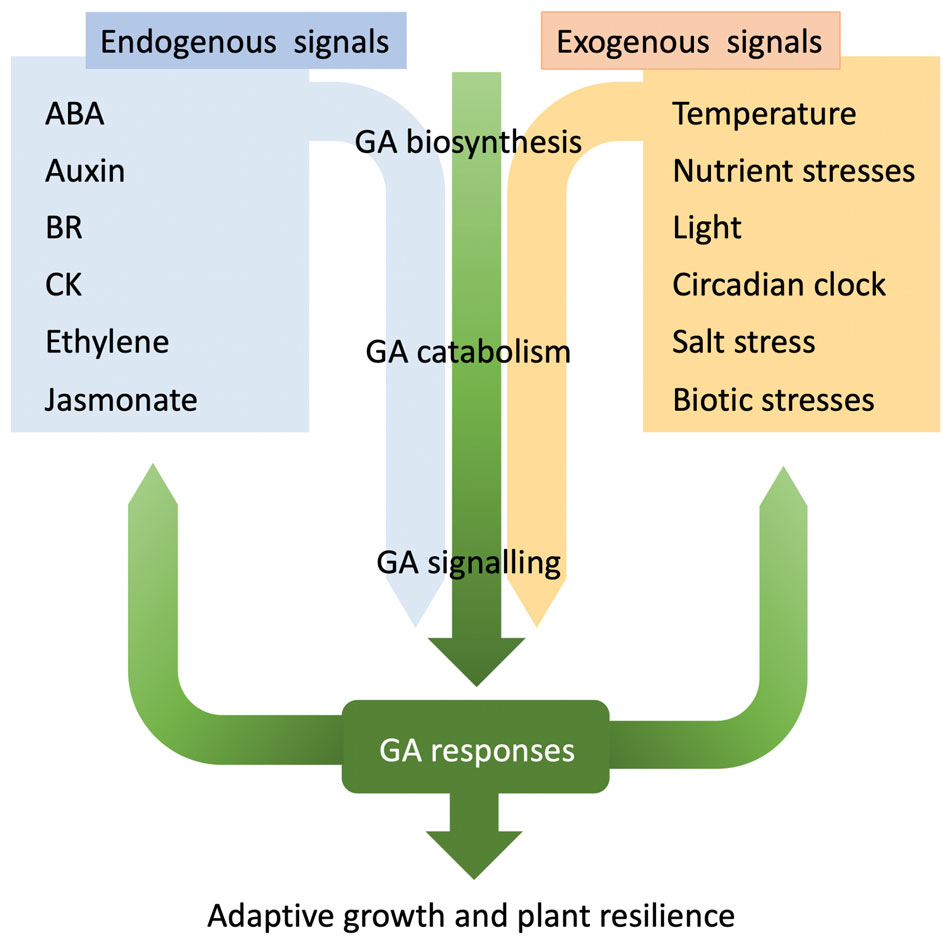 Fig 2. The GA pathway as a integrator of endogenous (hormones) and exogenous (environment) signals.
Critical Analysis & Conclusion: The Future of Plant Engineering
The GA/GID1/DELLA hub is essentially a biological integrator. The review concludes that while we have a strong grasp of the molecular components in model species like Arabidopsis and Rice, the next frontier is non-model species.
Takeaways for the Field:
- Intrinsic Feedback: Bioactive GA levels are self-regulating. The enzymes GA3ox and GA20ox act as gatekeepers, ensuring GA levels don't spiral out of control.
- Non-Proteolytic Control: Recent findings suggest GID1 can sometimes inhibit DELLA function even without degrading it, adding another layer of regulatory nuance.
- Climate Change: Understanding these pathways is the "Key" to engineering crops that can modulate their growth dynamically in response to erratic salt and temperature shifts.
Limitations: The paper notes that while the "Green Revolution" genes successfully manipulated GA to increase yield, we still struggle to decouple growth promotion from stress sensitivity—a trade-off governed by DELLA stability. Solving this will be the hallmark of the next agricultural revolution.