
When the Money Runs Dry: Unmasking the Feedback Loops of Infrastructure Decay
When The Money Runs Dry: A System Dynamics Approach To Critical Infrastructure Investment
This paper introduces a System Dynamics (SD) framework to model the long-term degradation of interdependent Critical Infrastructures (CIs), specifically transportation, utilities, and communications. Unlike traditional models focusing on catastrophic events, this approach quantifies how underinvestment and human migration patterns create dangerous feedback loops that jeopardize infrastructure stability.
TL;DR
While high-profile disasters capture headlines, the true threat to modern civilization may be the slow, invisible process of underinvestment. This paper presents a System Dynamics model that explores how Critical Infrastructures (CIs)—transportation, utilities, and communications—interact with human migration. It reveals that infrastructure failure isn't just a physical event; it’s an economic "death spiral" where the loss of services drives away the very taxpayers needed to fund repairs.
The "Invisible Disaster" of Long-term Degradation
Traditional research in Critical Infrastructure Interdependency (CII) treats failures like a row of falling dominoes: a power plant fails, leading to a water pump failure, leading to a hospital crisis. These are short-term cascading effects.
However, the authors argue that the more insidious threat is chronic underinvestment. When we ignore "wear and tear," we aren't just saving money; we are accumulating "risk debt." The difficulty lies in the fact that infrastructure, economics, and human behavior are tightly coupled. Existing tools like REMI or N-ABLE capture firm-level economics but often ignore the socio-behavioral consequences of policy decisions.
Methodology: Coupling Social Systems with Physical Stocks
The paper utilizes a System Dynamics (SD) approach to model the feedback loops between three CIs and the populations they serve.
The Core Intuition: The Migration Feedback Loop
The model hinges on two key populations:
- High-Mobility / High-Income: Quick to leave when service quality drops.
- Low-Mobility / Low-Income: Slower to leave due to resource constraints, but more vulnerable to the resulting service collapse.
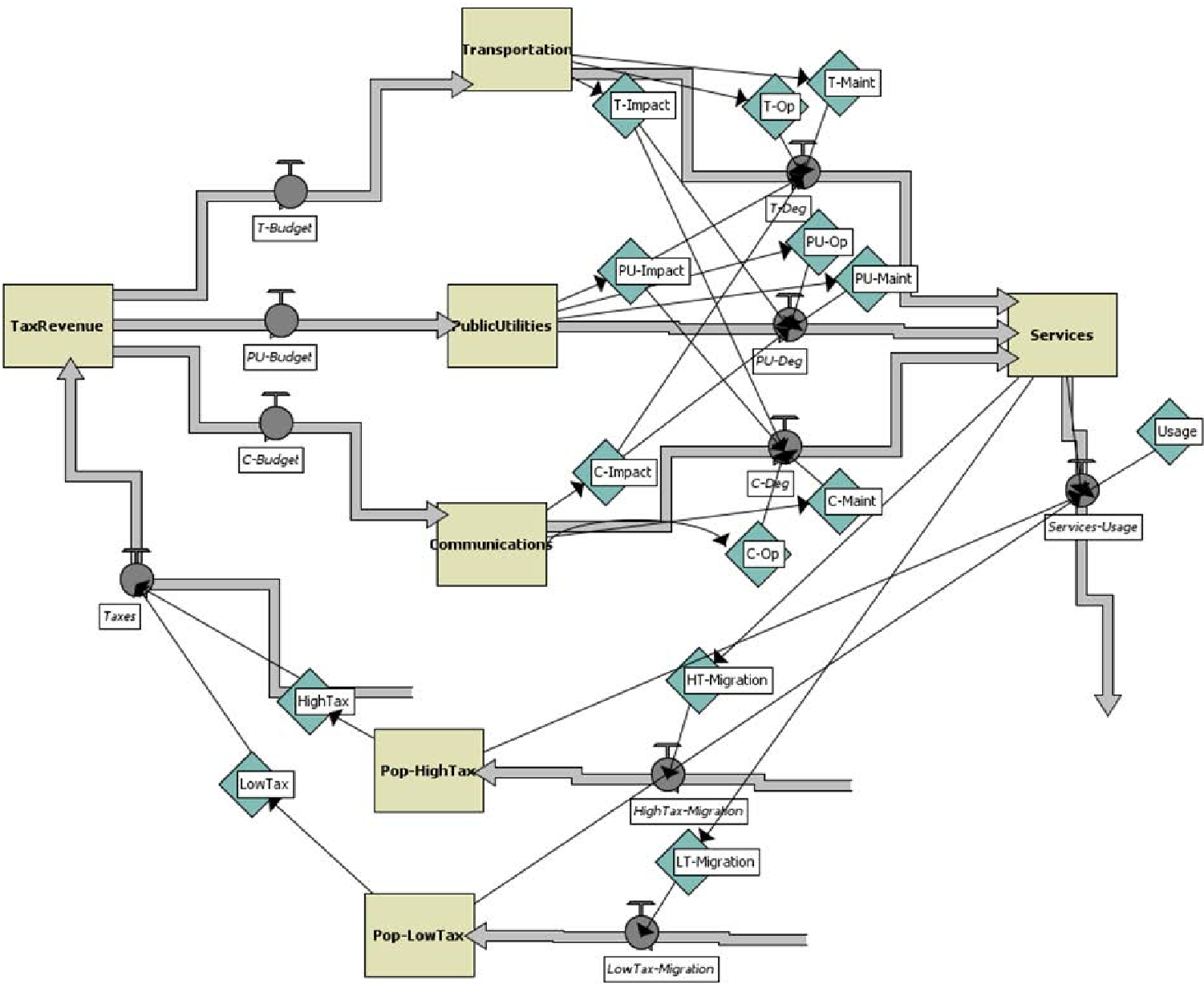
As shown in the Stock and Flow diagram above, the Tax Revenue is the lifeblood of the system. This revenue is proportional to the population. If CIs degrade, the "Service Quality" drops, prompting the high-income "tax base" to migrate out. This reduces the budget for maintenance, leading to a secondary "dependency degradation" where one failing infrastructure (like a road) accelerates the decay of others (like buried utility lines).
Experimental Results: The Illusion of Stability
The researchers tested various "usage rates" to see how the system behaves over time. The results were startling: the system often presents a false sense of security.
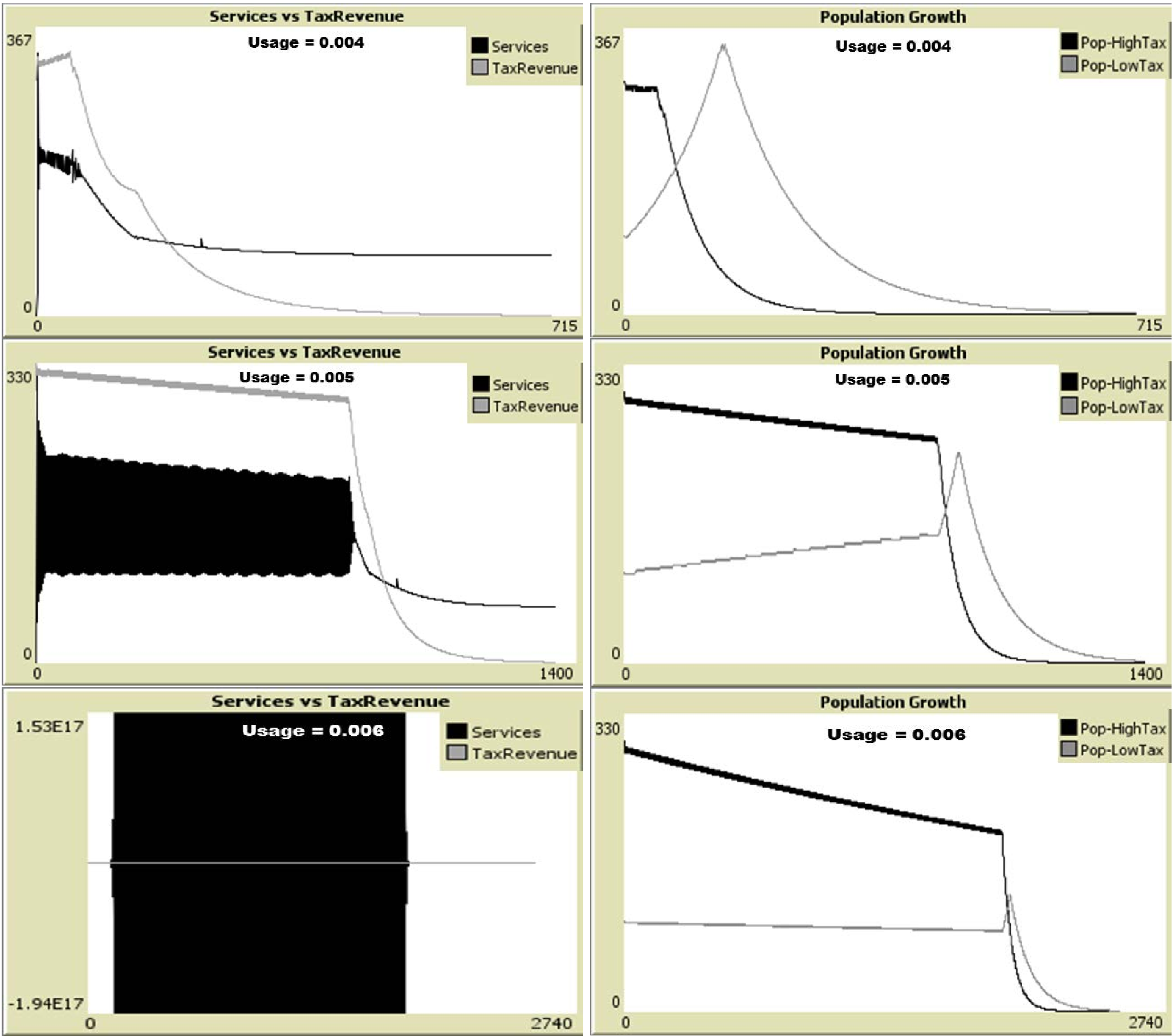
- At a usage rate of 0.005: The system maintains an "illusion of stability" for a significantly longer period. However, once a tipping point is reached, the decline is catastrophic and irreversible.
- The In-migration Paradox: Interestingly, the model shows periods where lower-income residents move in as high-income residents leave. This is due to the "excess services" left behind that temporarily support a less demanding population—before the lack of tax revenue inevitably leads to a total system wash-out.
Critical Insights & Future Outlook
This work shifts the focus from technocratic solutions (just building a better bridge) to adaptive capacity (ensuring the community can manage the bridge).
Key Takeaways:
- Social Memory matters: The authors suggest that how a community "remembers" and responds to past failures is as critical as the physical repair.
- Marginalized Communities bear the brunt: Because they lack the mobility to "vote with their feet," socio-economically disadvantaged populations are trapped in the late-stage feedback loops of infrastructure decay.
Limitations & Future Work:
The current model uses "stand-in" values rather than real-world data. To move from a theoretical framework to a predictive tool, the authors propose mining social media data. By analyzing how people talk about service interruptions in real-time, we can calibrate the "Migration Rate" and "Social Resilience" variables, creating a bottom-up view of urban survival.
Conclusion
"When the Money Runs Dry" is a wake-up call for infrastructure management. It proves that a city’s resilience is not determined by its concrete and steel alone, but by the healthy circulation of capital and people that keep those structures alive.