
Monitoring Collective Intelligence: Inside the Lithuanian Civic Tech Ecosystem
Monitoring Collective Intelligence: A Survey of Lithuanian Civic Tech
The paper presents a systematic survey of 50 Civic Tech platforms in Lithuania using the Collective Intelligence Potential Index (CIPI) methodology. It measures the socio-technological capacity of these platforms to foster "civic intelligence" for addressing societal problems, achieving an overall performance baseline for a post-Soviet context.
TL;DR
Is "Civic Tech" just a digital megaphone for complaints, or can it actually solve societal problems? This survey of 50 Lithuanian platforms uses a rigorous Collective Intelligence Potential Index (CIPI) to find out. While the country responds quickly to social issues, it struggles with the deep decentralization and stakeholder feedback required for true "Civic Intelligence."
The "Untapped Potential" of Civic Technology
Lithuania ranks well in the Digital Economy and Society Index (DESI), yet it faces a paradox: a high level of ICT infrastructure but a low capacity to use those tools for collective social innovation. The author argues that most citizen initiatives are fragmented. We lack a standardized way to measure if a platform is actually "intelligent"—that is, if it can self-organize, create new knowledge, and influence policy.
The research intuition here is that Civic Intelligence (CI) isn't just about having an app; it’s a socio-technological property that emerges only when specific conditions of diversity, interdependence, and decentralization are met.
Methodology: High-Resolution CI Monitoring
To move beyond "enthusiastic optimism," the study employs the CIPI methodology. This isn't a simple user-count metric; it is a structural analysis of how these systems are built.
The CIPI breaks down into four critical dimensions:
- Capacity for Creativity & Knowledge: Does the platform aggregate diverse ideas?
- Emergence of Outcomes: Can the community self-organize without a central leader?
- Social Responsiveness: How quickly and sustainably does the group react to crises?
- Social Technologies: Are the actual software tools (voting, ranking, structuring) sufficient?
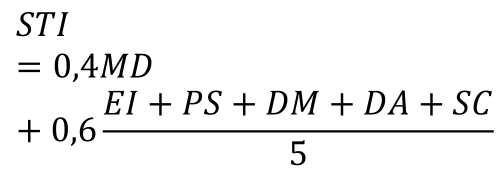 The mathematical logic behind the index, balancing qualitative weights with quantitative performance.
Key Results: Speed vs. Sustainability
The survey revealed a striking dichotomy in the Lithuanian ecosystem.
The Strengths:
The Social Responsiveness Index was a standout. Lithuanian platforms are exceptionally fast at reacting to immediate social issues (scoring 68/100). This suggests a highly sensitive and motivated digital citizenry.
The Weaknesses:
- Decentralization (20/100): Platforms are often dominated by a few initiators rather than being truly community-led.
- Stakeholder Feedback (20/100): There is a critical "black hole" where community input is generated but government feedback is absent.
- Sustainability (38/100): Many projects are short-lived "pilot" bursts rather than long-term pillars of democracy.
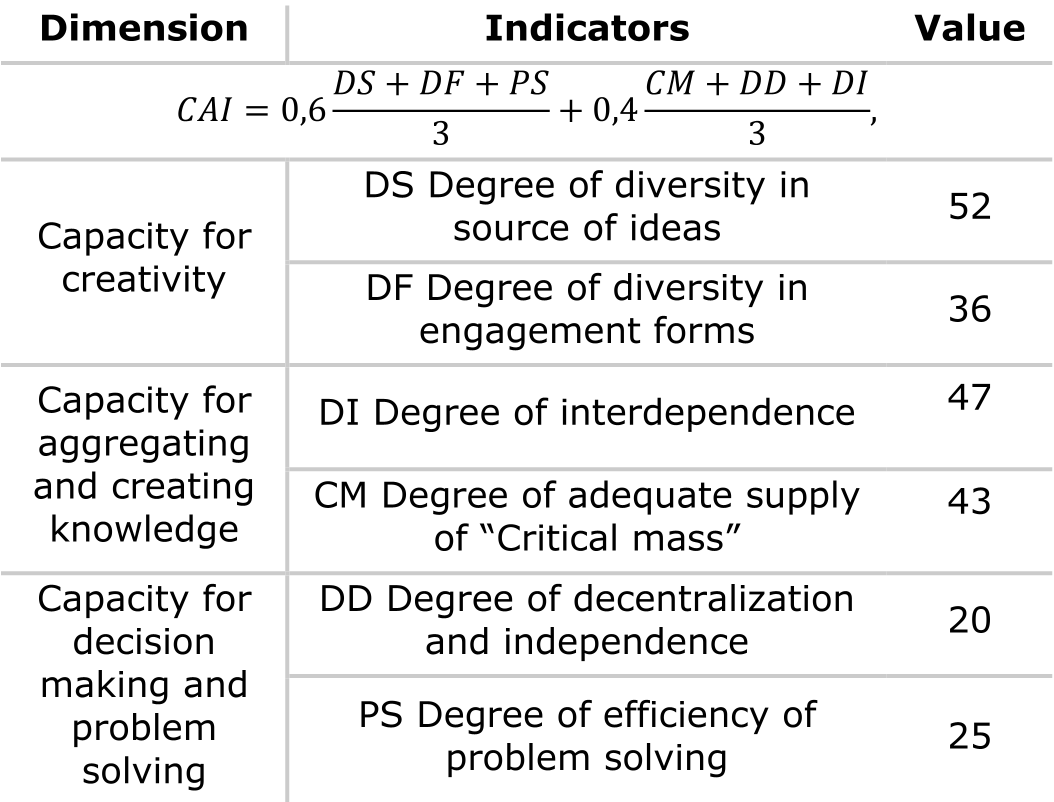 Notice the low scores in 'Degree of decentralization' and 'Efficiency of problem solving', highlighting the structural bottleneck.
Critical Insight: From Information to Action
The author identifies that most platforms currently function as information silos. Users can air their opinions, but the "technological solutions for voting, ranking, and structuring" are largely absent or underutilized. Without these, a community cannot reach a consensus or "emerge" into an intelligent collective agent.
For developers and policy makers, the takeaway is clear: Success is not about the number of users, but the "Degree of Interdependence" between them.
Conclusion & Future Outlook
This paper provides a vital baseline for Civic Tech in post-soviet contexts. It moves the needle from "ICT as a tool" to "ICT as a socio-technological system."
- Limitations: The study is localized to Lithuania, making it difficult to generalize these specific scores globally without further comparative data.
- The Future: The future of Civic Tech lies in improving the Emergence Index. We need platforms that don't just "inform" the government, but provide the structured, decentralized intelligence that makes government response inevitable.
Explore more data at www.collective-intelligence.lt