
Smart Surveillance: Why Monitoring "Key Players" is Wasting Law Enforcement Resources
16965_Monitoring individuals in drug trafficking organizations a social network analysis.
This paper introduces a novel methodology for monitoring Drug Trafficking Organizations (DTOs) using the mathematical framework of Identifying Codes. By optimizing the selection of individuals for surveillance, the authors demonstrate that law enforcement can uniquely identify any "active" suspect in a network while significantly reducing the number of nodes requiring direct monitoring.
TL;DR
In the fight against drug trafficking, law enforcement often focuses on the most "central" individuals. This paper proves that this strategy is inefficient. By applying the mathematical concept of Identifying Codes, the authors show that you can uniquely monitor an entire criminal organization by watching only a fraction of its members—achieving up to a 56% reduction in resources while outperforming traditional centrality-based metrics.
Academic Positioning: This work bridges Social Network Analysis (SNA) and Discrete Mathematics (Graph Theory), specifically applying Minimum Identifying Code Sets (MICS) to the domain of law enforcement intelligence for the first time.
The Flaw in Traditional Centrality
Current strategies in Drug Trafficking Organization (DTO) disruption rely on identifying "important" individuals using measures like Degree Centrality or Betweenness Centrality. While these metrics identify hubs, they have two fatal flaws for long-term monitoring:
- Redundancy: They often select clusters of individuals who provide overlapping information.
- Ambiguity: They don't guarantee that an activity by a non-monitored suspect can be uniquely traced back to them based on who witnessed the event.
The authors argue that surveillance is a "coverage" problem, not just a "popularity" contest.
Methodology: The Logic of Identifying Codes
The core innovation lies in treating the network as a system of "codes."
1. Identifying Codes (ICS)
A subset of nodes is an Identifying Code Set if, for every node in the graph, the set of its neighbors that are in is unique.
- The Intuition: Imagine if every criminal's "active" behavior is noticed by their direct associates. If we monitor a specific subset of associates (), the "alarm" triggered by a specific set of agents creates a unique signature (a code) for the person who actually committed the act.
2. Graph Coloring with Seepage (GCS)
The authors propose a visual intuition called "Seepage." When you "color" (monitor) a node, that color seeps into all its neighbors. The goal is to color the fewest nodes such that every node in the graph ends up with a unique composite color (combination of seeps).
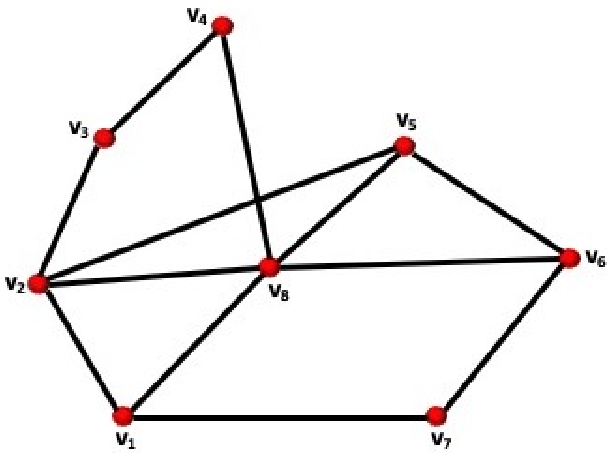 Figure 1: An undirected graph where the nodes {v4, v6, v7, v8} form a Minimum Identifying Code Set. Every node in V has a unique intersection with this set.
The Integer Linear Program (ILP) Formulation
To solve this for real-world DTOs, the authors use ILP. The constraints ensure:
- Minimum Cardinality: Minimize the number of agents deployed.
- Coloring Constraint: Every suspect must be adjacent to at least one monitored agent.
- Unique Coloring Constraint: For any two suspects and , the set of monitored neighbors must differ by at least one node (using the Exclusive-OR of their neighborhoods).
Experimental Results: Theory vs. Reality
The authors tested their approach against several real-world datasets, including "Operation Juanes" (a Colombian drug network) and "Montreal Street Gangs."
Key Findings:
- Efficiency: In "Operation Juanes," only 22 out of 50 nodes needed monitoring (56% resource reduction).
- Superiority over Centrality: Using standard SNA metrics required 45 nodes to achieve the same unique identification. Relying on "important" people resulted in a 104.54% resource wastage.
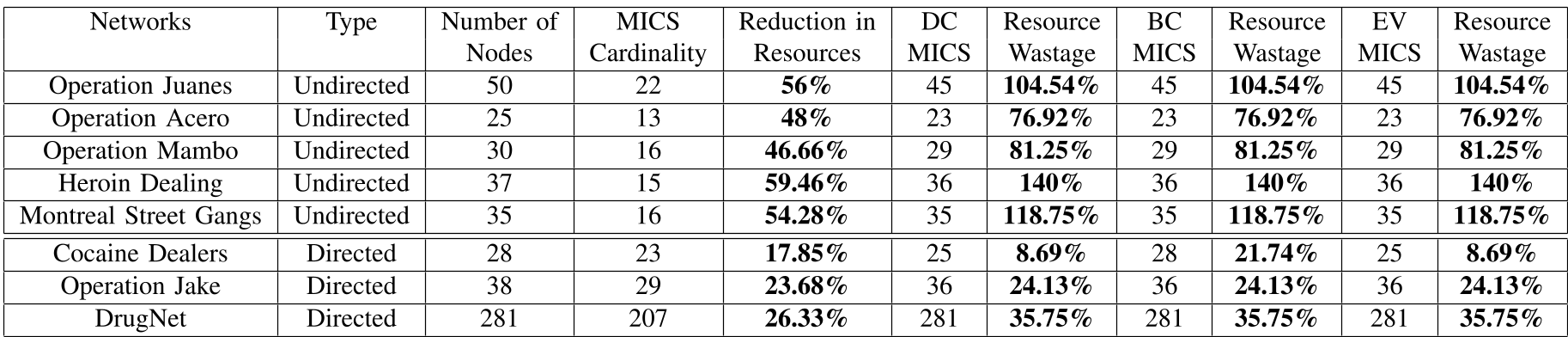 Table 1: Performance comparison across different drug organizations. The MICS approach consistently requires fewer resources than centrality-based (DC, BC, EV) methods.
Critical Insight: The "Twin" Problem
A limitation of this approach is the existence of "Twins"—nodes that have identical neighborhoods. In a graph with twins, an Identifying Code cannot exist because the two nodes will always share the same "signature." The authors propose "super-nodes" to handle this, but it highlights a reality of covert networks: some members are so closely linked that they are indistinguishable from an external monitoring perspective.
Conclusion & Future Outlook
This paper provides a mathematically rigorous foundation for "Selective Surveillance." By moving beyond local importance and looking at global unique identification, law enforcement can manage the growing list of suspects without an exponential increase in budget.
Future Work: The next step in this research line should involve Dynamic Identifying Codes—how do the monitored sets change as the DTO evolves, or as criminals realize they are being shadowed and change their associates?