
Monitoring or Trust? The Paradox of Location-Based Social Networking
Monitoring people using location-based social networking and its negative impact on trust: an exploratory contextual analysis of five types of "friend" relationships
This paper explores the socio-technical implications of Location-Based Social Networking (LBSN) on human relationships, utilizing a Social Informatics framework. Through qualitative focus group analysis, the study identifies how real-time location sharing affects trust across family, friend, work, and governmental contexts.
TL;DR
In the era of "anytime, anywhere" connectivity, Location-Based Social Networking (LBSN) applications allow us to track friends and family with pinpoint accuracy. This study investigates whether this capability strengthens our bonds or erodes the very foundation of social trust. Using a Social Informatics lens, the research highlights a critical paradox: if we are constantly monitoring someone, do we actually trust them at all?
Positioning: This work is an exploratory qualitative study that moves beyond technical "privacy settings" to analyze the deeper sociological impact of surveillance in personal relationships.
The Problem: The Erosion of Vulnerability
Standard definitions of trust involve a willingness to be vulnerable under conditions of risk. However, LBSN tools like Google Latitude (and by extension modern equivalents like Life360) provide a "security blanket" of data. The researchers argue that when a parent tracks a child's every move, they aren't "building trust"—they are removing the need for trust.
The motivation behind the study was to see if technology literacy translates to an acceptance of surveillance, or if the "creep factor" of Being Watched (Overt vs. Covert monitoring) creates a new kind of social friction.
Methodology: The Socio-Technical Context
The study utilized a Social Informatics approach, which posits that technology and society shape each other bidirectionally. By conducting five focus groups with tech-literate university students, the authors mapped out a taxonomy of trust across different relationship spheres.
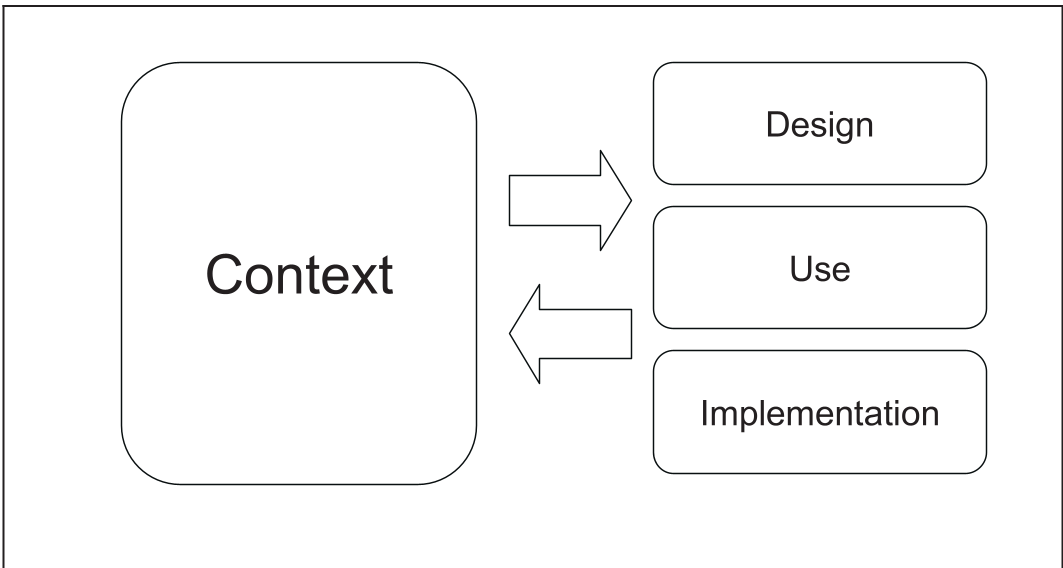 Figure 1: The bidirectional relationship between social context and ICT design.
The research categorized relationships into five distinct "friend" types to see where the boundaries of "willingness to share" are drawn:
- Family: Parent-child, Partner, Sibling.
- Friends: Close friends vs. Acquaintances.
- Work: Employer-Employee, Co-workers.
- Commercial/Government: Entities and Agencies.
Core Insights: The "Trust-Distance" Gradient
The results from the focus groups were visually strikingly: trust is not a binary state but a gradient that decreases as social distance increases.
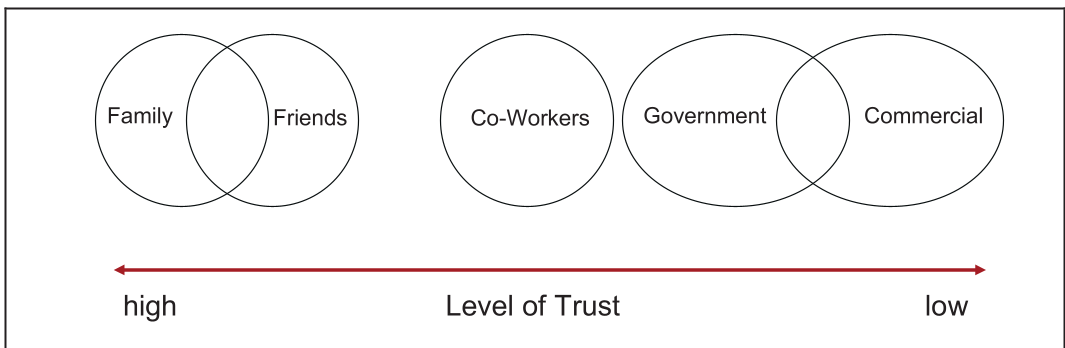 Figure 2: Relative trust levels of participants towards various entities.
1. The Parent-Child Dilemma
While parents view LBSN as a tool for "safety and care," children often perceive it as a "barrier to building trust." One participant noted that if a child is tracked from a young age, they never learn how to prove themselves trustworthy. The technology replaces the dialogue of "Where were you?" with the silent verification of "I saw you were at the pub."
2. The Professional Boundary
In the workplace, LBSN was viewed purely through the lens of utility. Tracking a delivery driver is "justified," but tracking an office worker is "micro-monitoring." Participants were firm on the "On-the-Clock" rule: tracking must end when the shift does.
3. The Negative Feedback Loop
Strikingly, participants did not believe LBSN could add trust to a relationship. They argued that trust must exist before the app is used. If used in a low-trust relationship, it only serves as "ammunition" for arguments and emotional manipulation (e.g., "Why were you at Cairo?").
Critical Analysis: Reflections on Digital Surveillance
The paper concludes that LBSN introduces a form of implicit control. If you know you are being watched, you act differently. This "Panopticon effect" leads to:
- Obfuscation: Users providing "fuzzy" locations (nearest city) to regain privacy.
- Social Friction: Rejection of a location-sharing request becoming a "social event" that requires explanation.
- Gossip: In certain cultural contexts (ethnicity being a noted variable), location data serves as fuel for social surveillance and gossip rather than safety.
Takeaway and Future Outlook
The industry value of this research lies in its critique of default feature sets. The authors advocate for reciprocal awareness: a user should know who is looking at them and how often.
Limitations: The study was conducted on university students (a convenience sample), meaning it might not fully capture the perspective of parents (the "trustors") or the elderly. However, the qualitative depth provides a roadmap for Phase 2: observing real-world LBSN usage over 48-hour periods to see if participants' predicted fears match their actual behaviors.
In summary, LBSN is a powerful utility, but without careful design that prioritizes mutual transparency, it risks transforming our most intimate relationships into nodes of social surveillance.