
Beyond Linear Cascades: A Fuzzy-Logic Approach to Viral Monopoly Pricing
Development of a monopoly pricing model for diffusion maximization in fuzzy weighted social networks with negative externalities of heterogeneous nodes using a case study
The paper introduces a novel mathematical monopoly pricing model designed to maximize product diffusion within a fuzzy-weighted social network. Utilizing a Genetic Algorithm (GA) to navigate its NP-hard complexity, the method accounts for node heterogeneity and negative externalities to determine optimal seed sets and referral bonuses.
TL;DR
This research moves beyond simplistic "Independent Cascade" models to address the messy reality of social commerce. By combining Fuzzy Logic, Node Heterogeneity, and Negative Externalities, the authors propose a monopoly pricing framework that identifies "high-value" influencers and calculates the exact price-to-cost ratio needed to fund viral referral bonuses.
Background & Positioning
In the landscape of social network analysis, most models assume all "friends" are equal. This paper treats social networks as Fuzzy Weighted graphs where the "strength" of a connection is as vital as the connection itself. It shifts the objective from simple revenue maximization to Diffusion Maximization, positing that long-term market share is driven by complex multi-criteria decisions (Price vs. Quality vs. Social Pressure).
The Problem: The Asymmetry of Negative Influence
Existing SOTA methods often overlook a harsh reality of market psychology: Negative experiences travel faster. While a positive review might reach 8 people, a negative one reaches 22. Most models also struggle with:
- Node Homogeneity: Treating every customer as having the same "buy" threshold.
- Binary Edges: Assuming all social ties have the same persuasive power.
Methodology: Tiered Influence & Fuzzy Logic
The authors propose a model where nodes are categorized into five classes: Very Positive Influential, Positive Influential, Without Influence, Negative Influential, and Very Negative Influential.
1. Fuzzy Weights
Relationship intensity is measured using trapezoidal fuzzy numbers for linguistic variables:
- Weak: [0.05, 0.05, 0.1, 0.2]
- Mediocre: [0.1, 0.25, 0.25, 0.4]
- Strong: [0.3, 0.45, 0.5, 0.5]
2. The Pricing & Bonus Mechanism
The model introduces a Referral Bonus (). When a customer persuades others to buy, they receive a refund. The objective function seeks to maximize the number of buyers () subject to financial constraints ensuring the seller doesn't lose money.
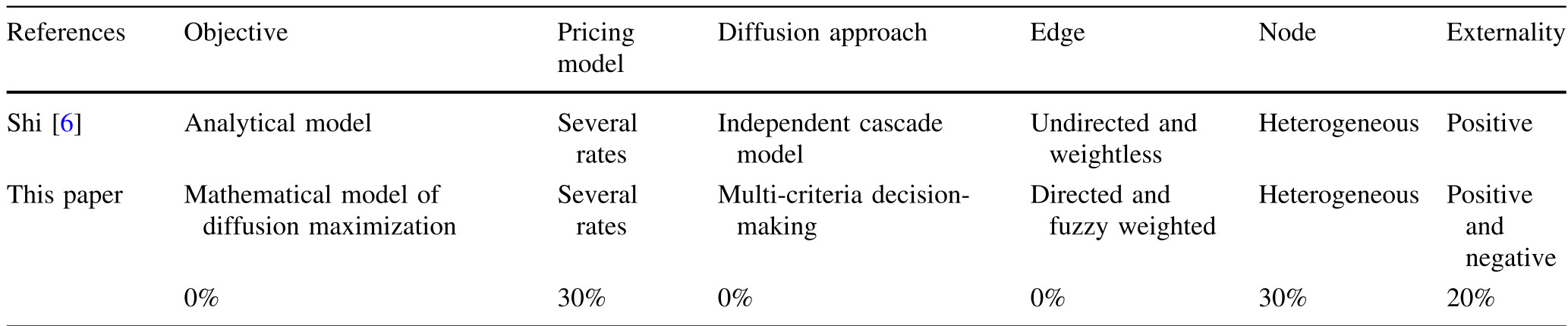 Table 1: Comparison showing the novelty of integrating heterogeneous nodes with negative externalities.
Experiments and Results
Testing on a real-world dataset of 1,055 nodes and 15,087 edges, the problem was proven to be NP-hard. The solving time for an exact solution grows exponentially beyond a subset size of 3, necessitating a Genetic Algorithm (GA).
Key Numerical Insights:
- The 7.35x Rule: To achieve maximum diffusion without incurring a loss, the seller must set a sales price at least 7.35 times higher than the unit cost.
- Single Node Efficiency: Surprisingly, a subset with just a single high-influence member often yields the highest "added value" per agent, though larger subsets further increase total diffusion.
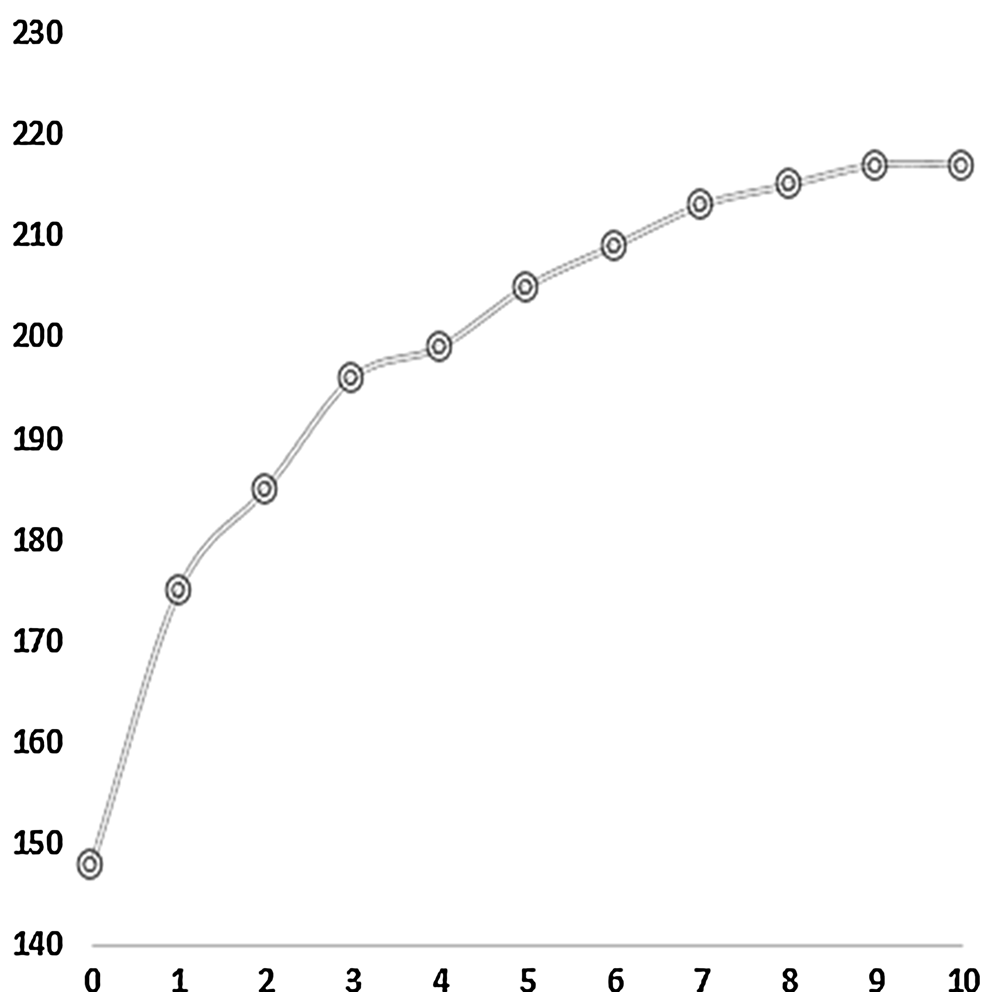 Figure 7: Total buyers vs. initial subset size, showing diminishing returns as more seed nodes are added.
Critical Insight & Conclusion
The true value of this work lies in its referral bonus calculation. By weighting influence qualitatively, the model prevents "gaming" the system; bonuses are only meaningful for nodes that actually drive conversion.
Limitations: The model assumes a monopoly. In a real-world competitive market, the presence of a rival would likely drive the required ratio down, potentially making the referral bonus strategy more financially risky.
Future Work: The next frontier involves applying this fuzzy-weighted logic to Competitive Diffusion, where two sellers compete for the same influential nodes in real-time.