
Monopoly Pricing and the Rhythms of Social Network Diffusion
Monopoly pricing and diffusion of social network goods
The paper develops a dynamic model for monopoly pricing of subscription social network goods. It characterizes a unique steady state using mean-field approximation and proves that optimal pricing strategies oscillate around this steady state to balance current profits with future network-driven demand.
TL;DR
In the world of social network goods—think Skype, WhatsApp, or any subscription-based community—your value is determined by who else is there. This paper by Euncheol Shin provides a rigorous mathematical framework to determine how a monopolist should price these services over time. The core finding? Optimal pricing isn't a steady climb; it’s an oscillation that carefully balances today's revenue against tomorrow's "friendship effect."
The Core Tension: Profit vs. Friendship
Traditional monopoly models operate on a simple "price vs. quantity" axis. However, for a social network good, the Demand Curve shifts every period based on the previous period's success.
The monopolist faces a fundamental trade-off:
- The Profit Effect: Charging a high price today to capture maximum value from current subscribers.
- The Friendship Effect: Lowering the price today to entice more users to join, which increases the "degree" of connectivity and allows for much higher prices (and profits) in the next period.
Methodology: Mapping the Network to the Market
The paper utilizes the Degree Distribution () of a social network to account for consumer heterogeneity. A user with more friends (higher degree) is naturally willing to pay more because their probability of interacting with other subscribers is higher.
The "IHRP" Breakthrough
A critical technical contribution of the paper is the application of the Increasing Hazard Rate Property (IHRP) to social networks. If a network follows IHRP, it means that as a user's degree increases, the conditional probability of them having an even higher degree increases. This mathematical constraint ensures that the market reaches a unique and stable steady state.
 Figure 1: The model assumes consumers are myopic, responding to the subscription rates of the previous period, while the monopolist is forward-looking.
Why Prices Oscillate
Unlike durable goods (where you buy a car once and leave the market), subscription goods require users to stay. Shin proves that the optimal pricing plan oscillates around the steady state.
- When the network is "under-populated," the monopolist slashes prices to trigger diffusion.
- Once the network effect is strong, the monopolist "harvests" profit by raising prices.
- This price hike eventually slows growth, prompting another strategic price dip to maintain the network's momentum.
Critical Insights: Density and Efficiency
The paper investigates how the "thickness" of a social network affects the economy.
1. The Paradox of Monopoly Power
Counter-intuitively, if a government wants to minimize Deadweight Loss (the social cost of monopoly), it might be better to grant a stronger and longer monopoly. Why? Because a monopolist with a high discount factor () values the future highly. They will keep prices lower for longer to ensure maximum diffusion, which actually increases social welfare compared to a "short-term" monopolist who gouges prices immediately.
2. Network Density Drives Prices
Using the Monotone Likelihood Ratio Property (MLRP), the paper demonstrates that in denser networks (where people have more connections on average), the steady-state price and total profit are significantly higher.
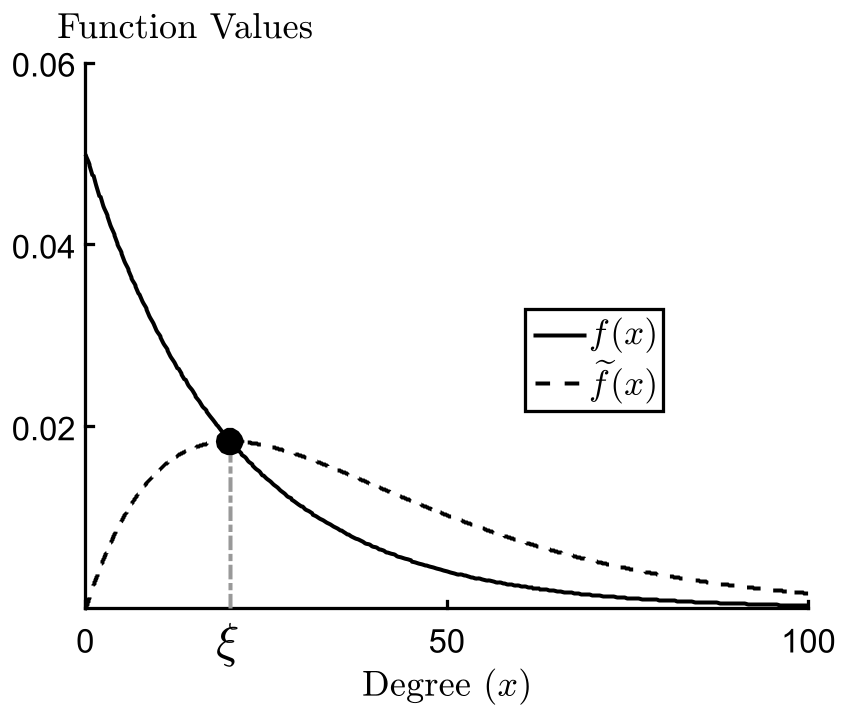 Figure 2: Analysis of hazard rate functions for different degree distributions, proving the dominance relationship required for steady-state stability.
Conclusion and Future Outlook
Euncheol Shin’s work moves beyond simple "tipping point" models of the past. By showing that prices should oscillate, it provides a strategic playbook for platform growth.
Limitations: The model assumes consumers are "myopic" (they don't anticipate future price drops). In a world where savvy users might wait for a "sale" or a subscription discount, the monopolist’s strategy would need to become even more complex to combat "strategic waiting."
The Takeaway for Tech Leaders: Don't aim for a flat pricing strategy. If your product relies on social interaction, your price is a lever to manipulate the network's density. Sometimes, the most profitable move for next year is a "loss-leading" subscription price today.