
Beyond Keywords: Enhancing YouTube Spam Detection via Mood Analysis
A Mood Analysis on Youtube Comments and a Method for Improved Social Spam Detection
2018-01-01
Summary
Problem
Method
Results
Takeaways
Abstract
The paper proposes a novel social spam detection method for YouTube comments by incorporating Mood Analysis as a content-based feature. By leveraging the emotional state (upset vs. happy) of a comment, the authors enhance traditional Bayesian classifiers to more accurately distinguish between legitimate users and spammers.
## TL;DR
Social media spam is evolving beyond simple link-blasting. This paper introduces **Mood Analysis**—measuring the "happiness" or "upset" level of a comment—as a secret weapon to filter YouTube spam. By adding mood as a feature, the researchers reduced False Positives by up to **21.35%** in certain classifiers, making spam filters not just smarter, but more "human-aware."
## Problem & Motivation
While Online Social Networks (OSNs) like YouTube have billions of users, they are also prime targets for malicious campaigns. Existing filters often struggle with "False Positives"—blocking legitimate users who might just be enthusiastic or angry.
The authors noticed a unique pattern: **Spam is not emotionally neutral.** Whether it's the overly "happy" tone of a promotional bot or the aggressive "upset" tone of a troll, the "mood" of a message serves as a fingerprint. Most prior work focused on *Sentiment* (is this a good or bad review?), but this study explores *Mood* (what is the temporary state of mind of the writer?).
## Methodology: The Core
The research workflow followed a rigorous two-step process:
1. **Baseline Selection**: The authors tested 392 combinations of classifiers and settings on a massive YouTube dataset to find the "Top 10" performers (primarily variations of Naive Bayes).
2. **Mood Augmentation**: Each comment was processed through a Mood Analyzer to generate a score from 0.0 (Upset) to 1.0 (Happy). This score was merged with traditional text features.
### The Architecture
As shown in the logic below, the transition from raw text to a "mood-aware" vector is the key innovation:
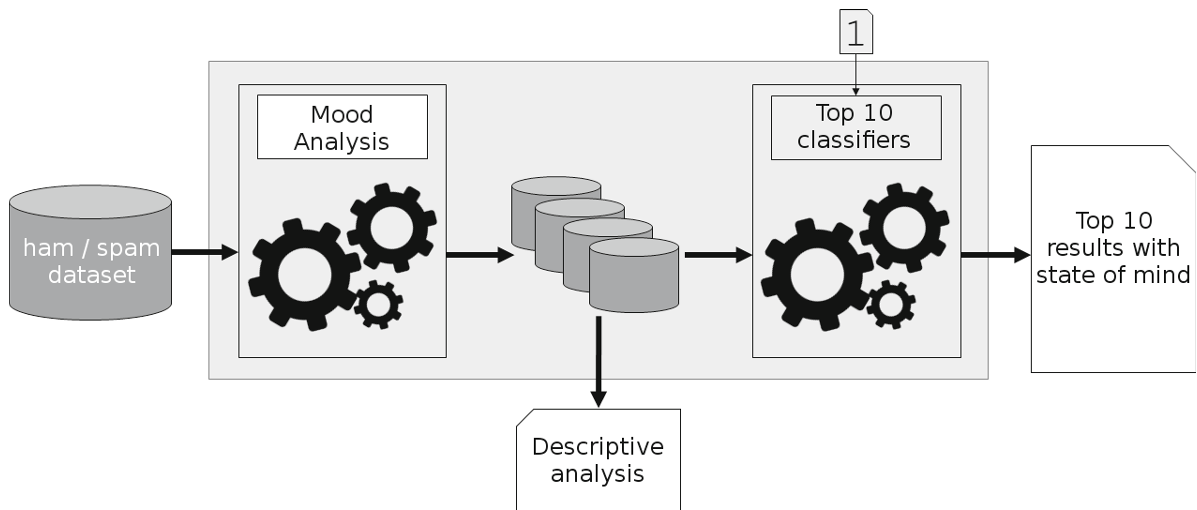
The research employed several **Naive Bayes Multinomial (NBM)** and **Complement Naive Bayes (CNB)** variants, which are known for their efficiency in high-dimensional text classification.
## Experimental Results
The team used two datasets: a large-scale crawling dataset (6.4M comments) and the specialized "TubeSpam" collection.
### Key Findings:
* **False Positive Reduction**: In the YouTube Comments Dataset, the average reduction in False Positives was **13.76%**. This is crucial for user experience—fewer legitimate comments get caught in the spam folder.
* **Accuracy Boost**: On the TubeSpam dataset, accuracy climbed from 93.97% to **94.38%**.
The visual evidence in Figure 3 highlights the "Mood gap" between real comments (Ham) and Spam:
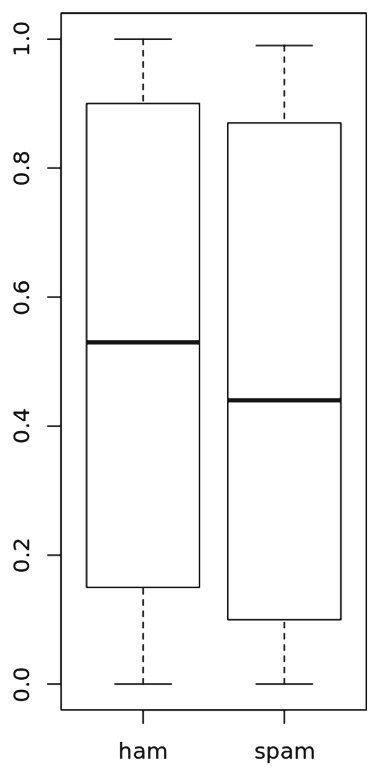
The Box Plots show that legitimate comments often have a wider, more varied emotional range compared to the more predictable, clustered mood profile of spam messages. This variation is exactly what the classifiers exploited.
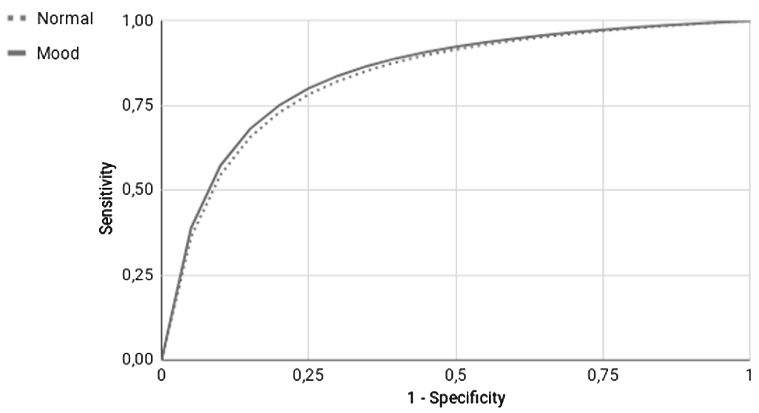
### ROC Curve Comparison
The performance improvement is most visible in the ROC curves, where the "Mood-enriched" models consistently cover more area (AUC), indicating a better trade-off between sensitivity and specificity.
## Critical Analysis & Conclusion
### Takeaway
The study proves that **Mood** is a highly discriminative feature for social media security. Spammers can change their keywords, but mimicking the authentic emotional flow of a human conversation is significantly harder.
### Limitations
* **Context Dependency**: Mood analysis was performed using a general-purpose SaaS. A mood analyzer specifically trained on "Internet Slang" or "YouTube-specific lingo" might yield even higher gains.
* **Language**: The detailed experiment focused primarily on English comments. Multilingual mood analysis remains a challenge due to cultural nuances in expressing "upset" or "happiness."
### Future Work
The authors suggest that this approach could be adapted for other platforms like Twitter or Facebook. Furthermore, integrating temporal analysis (how a user's mood changes over a series of comments) could help identify compromised accounts (COMPA) more effectively.