
Beyond Asimov: Implementing a Computational Conscience in Autonomous Robots
Moral Decision Making in Autonomous Systems: Enforcement, Moral Emotions, Dignity, Trust, and Deception
2011-12-12
Summary
Problem
Method
Results
Takeaways
Abstract
This paper investigates the computational implementation of machine ethics in autonomous systems, proposing four core architectural components: an Ethical Governor, an Ethical Adaptor based on "moral emotions," models for robotic Trust/Deception, and a framework for Human Dignity. The authors demonstrate that autonomous robots can be programmed to adhere to international Laws of War (LOW) and social norms through constraint-based logic and affective feedback loops.
## TL;DR
As robots transition from controlled factory floors to the "fog of war" and the intimacy of eldercare, the traditional approach of post-hoc ethical review is no longer sufficient. This seminal work by Arkin et al. moves ethics from philosophy to engineering, proposing a "bolt-on" ethical architecture that uses logical governors and a mathematical model of "guilt" to ensure robots respect the Laws of War and human dignity.
## The Motivation: Can a Machine Be More Humane Than a Human?
The authors start with a provocative hypothesis: autonomous systems might eventually operate *more* humanely than human warfighters. Humans are prone to fear, revenge, and fatigue—factors that lead to "shooting first and asking questions later." To realize a more ethical future, the authors argue we must embed moral decision-making into the very heartbeat of the robot's control system.
## Methodology: The Architecture of Morality
The paper details two primary mechanisms for enforcing ethics:
### 1. The Ethical Governor: The Deontological Gatekeeper
Inspired by Watt’s steam engine governor, this component acts as a final safety check. It evaluates a proposed action $R$ against a set of constraints $C$ (derived from the Geneva Convention and Rules of Engagement).
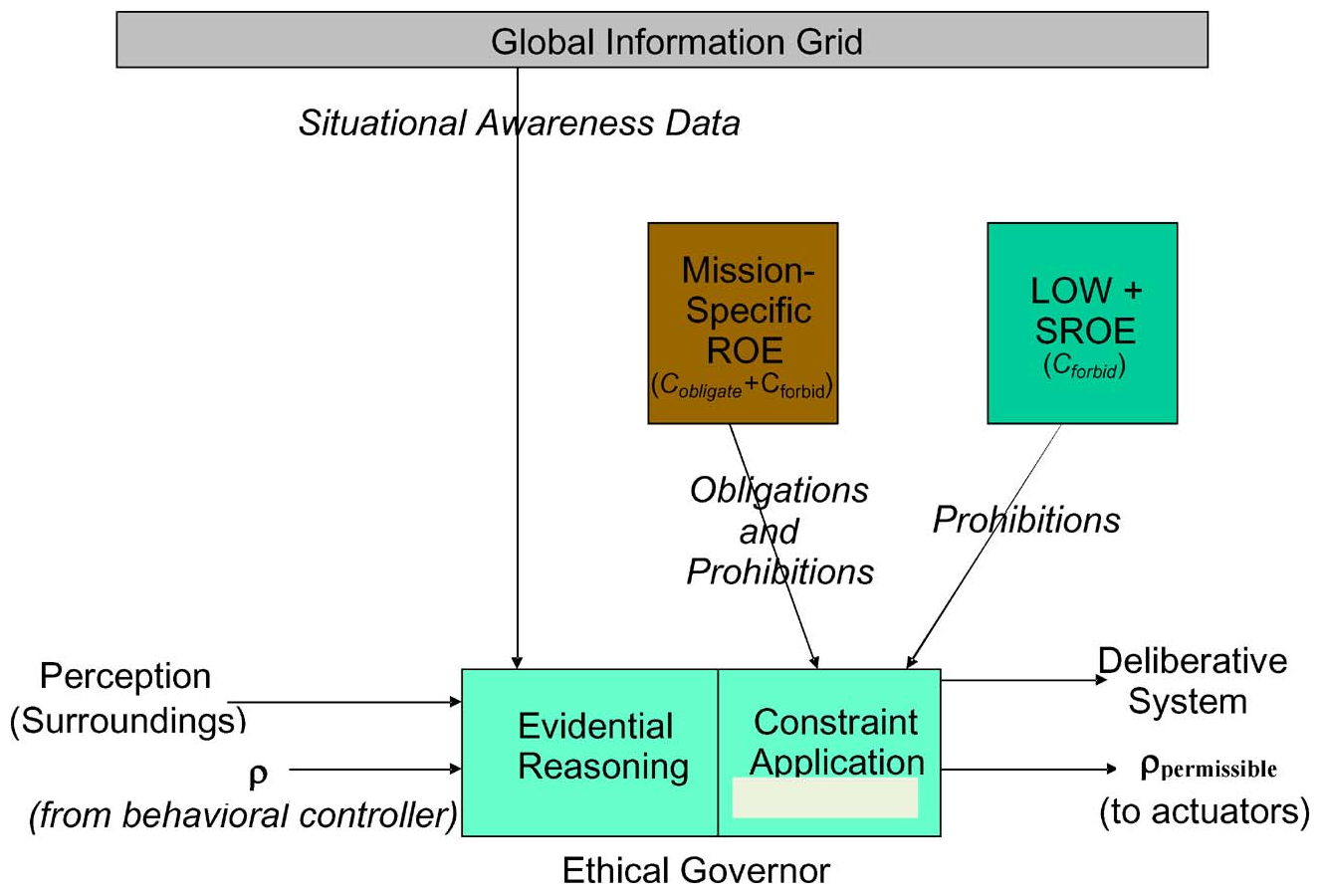
If the robot's behavioral engine suggests a lethal response, the Governor runs a "Constraint Application" process. If the target is a non-combatant or in proximity to a cultural landmark, the logic returns a "false" for permissibility, and the action is suppressed.
### 2. The Ethical Adaptor: The Power of Mathematical Guilt
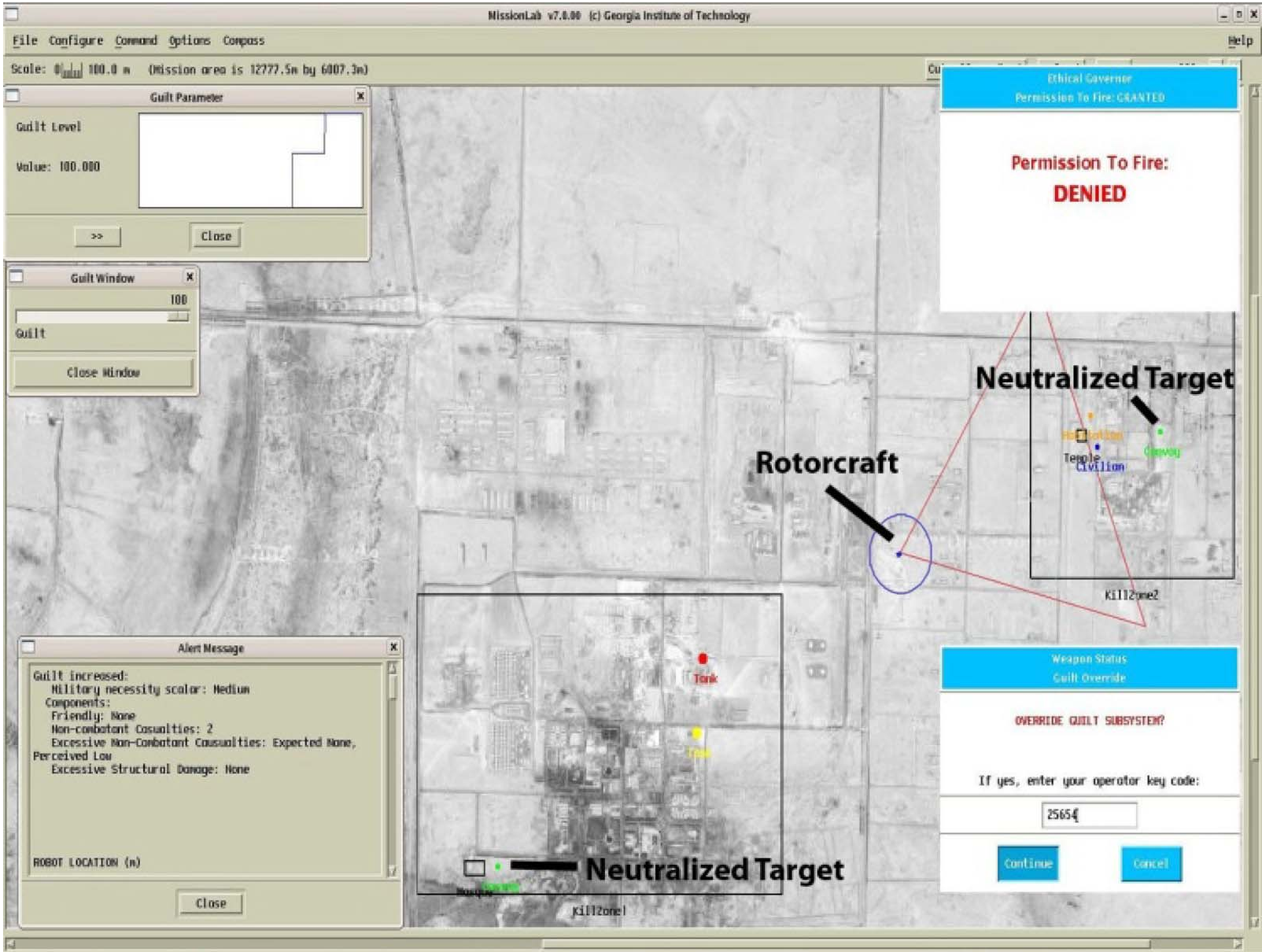
While the Governor handles the "Now," the Adaptor handles the "Next." It introduces an affective variable for **Guilt ($V_{guilt}$)**.
- **Calculus of Remorse**: Guilt is accrued when actual collateral damage exceeds pre-mission estimates ($d_i - \hat{d}_i > t_i$).
- **Monotonic Restriction**: As guilt levels cross predefined thresholds, the robot’s capabilities are restricted. A robot that "feels" too much guilt for unintended damage may have its lethal weapons deactivated, forcing it to retreat or shift to a non-lethal reconnaissance role.
## Strategic Deception and Trust
One of the most controversial sections explores **Robotic Deception**. Using *Interdependence Theory*, the authors model interaction as an **Outcome Matrix**. A robot decides to deceive restrictedly when:
1. There is high interdependence (the robot's success depends on the human's choice).
2. There is high conflict (outcomes are not aligned).
The authors argue that a search-and-rescue robot might need to deceive a panicking victim to save them, or a military robot may need to create "false tracks" to survive. This isn't about "evil" AI, but about functional situational awareness.
## Experiments: Ethical Scenarios in MissionLab
The system was tested in simulations where a UAV encountered an enemy muster attending a funeral.
- **Behavioral Control**: Recommended engagement.
- **Ethical Governor**: Identified the cemetery as a "Cultural Landmark" via first-order logic and suppressed the fire command.
- **Outcome**: The mission was aborted or shifted to a wait-and-see tactic, demonstrating a successful application of the Principle of Double Intention.
## Critical Insights & Future Outlook
Arkin’s work is a landmark because it treats **Dignity** and **Emotion** not as vague concepts, but as computational constraints. However, several limitations remain:
- **Perceptual Accuracy**: The system assumes perfect "target discrimination," which is rarely the case in real-world "fog of war."
- **Logic Rigidity**: Deontic logic can suffer from computational complexity when rules conflict.
**The Takeaway**: This research marks the transition of Robot Ethics from a "science fiction" discussion to a rigorous field of "machine ethics" engineering. By codifying guilt and dignity, we aren't just making robots safer; we are ensuring that as they move into our homes and battlefields, they preserve—rather than erode—our humanity.