
Moral Paradoxes of the Digital Age: Why Bullies Feel Bad and Victims Feel Good
I Do It Because I Feel that…Moral Disengagement and Emotions in Cyberbullying and Cybervictimisation
This study investigates the interplay between moral disengagement, Big Five personality traits, and emotional valences in the context of cyberbullying and cybervictimisation among 655 Italian high school students. Using Structural Equation Modeling (SEM) and the PANAS scale, it establishes that moral disengagement acts as a significant predictor for both bullying and victimization roles.
TL;DR
A study of 655 students reveals that cyberbullying isn't just about "mean kids"—it's a complex cognitive game. Using Moral Disengagement (mental gymnastics to ignore ethics), bullies actually end up feeling more negative emotions due to poor impulse control, while victims use those same mental tricks to feel better and stop blaming themselves for their own suffering.
Background Positioning
In the landscape of social psychology, this paper moves beyond simply counting "how many" kids are bullied. It identifies Moral Disengagement as the bridge between personality (who we are) and behavior (what we do online). It refines the Meter and Bauman (2018) model by proving that these cognitive shortcuts apply to both the hunter and the hunted.
The "Thinking Styles" of Cyberbullying
Why can a "nice" person be a jerk online? The authors point to four specific cognitive mechanisms:
- Justifying behavior: "It’s for a higher cause."
- Shifting responsibility: "I was just following the group."
- Minimizing harm: "It was just a joke."
- Blaming the victim: "They acted like a jerk first."
The study found that Agreeableness (or rather, the lack of it) is the primary personality trait linked to these mechanisms. If you aren't naturally friendly/sympathetic, you are more likely to use these mental excuses to act out.
Methodology: Mapping the Mind
The researchers used Structural Equation Modeling (SEM) to map how traits lead to thoughts, and thoughts lead to actions.
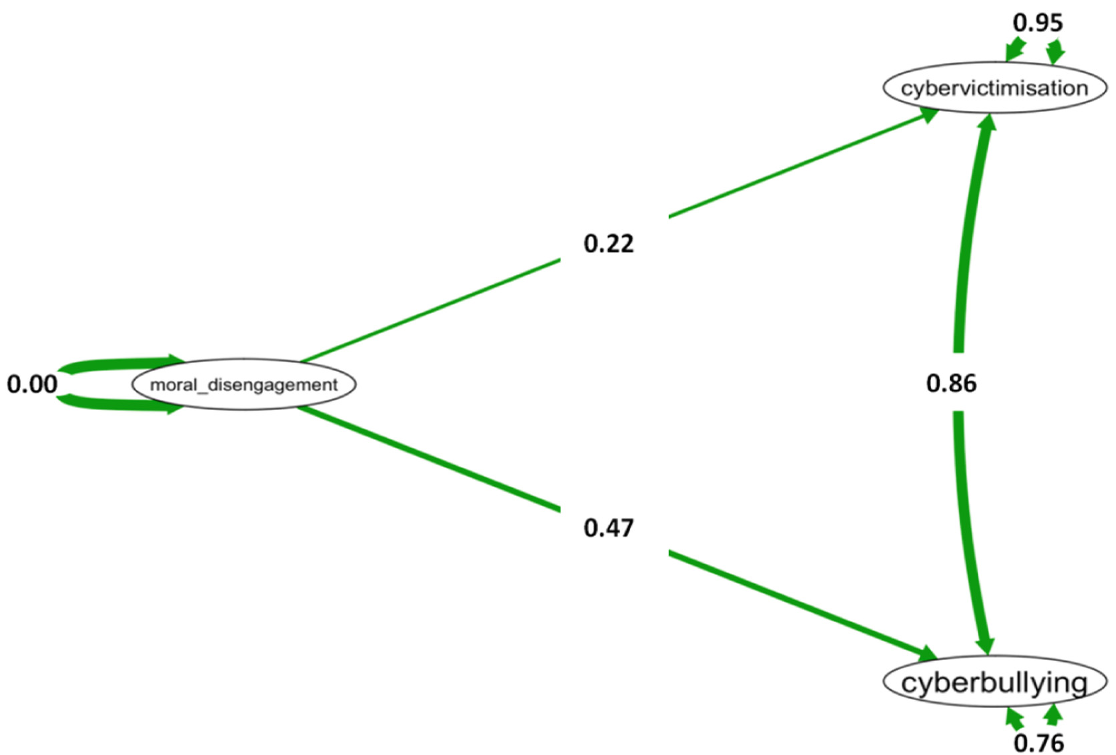
In this model (Figure 4), we see that Moral Disengagement is a powerhouse variable, significantly pushing individuals toward both bullying and being victimized.
The Emotional Reversal (Core Insight)
The most fascinating part of the results is the Emotional Paradox. Typically, bullies feel a "rush" (positive) and victims feel "pain" (negative). However, when we account for Moral Disengagement, the roles flip:
- The Neurotic Bully: Bullies who use high moral disengagement actually report higher negative emotions. This suggests they aren't "cool and calculated" but are likely struggling with Neuroticism—they feel the world is hostile, lash out because of it, and then use moral disengagement as a failed attempt to soothe their own guilt.
- The Protected Victim: Victims who use moral disengagement report higher positive emotions. This is a defense mechanism. By minimizing the attack ("it's just a game") or justifying it, they prevent themselves from falling into a spiral of self-blame.
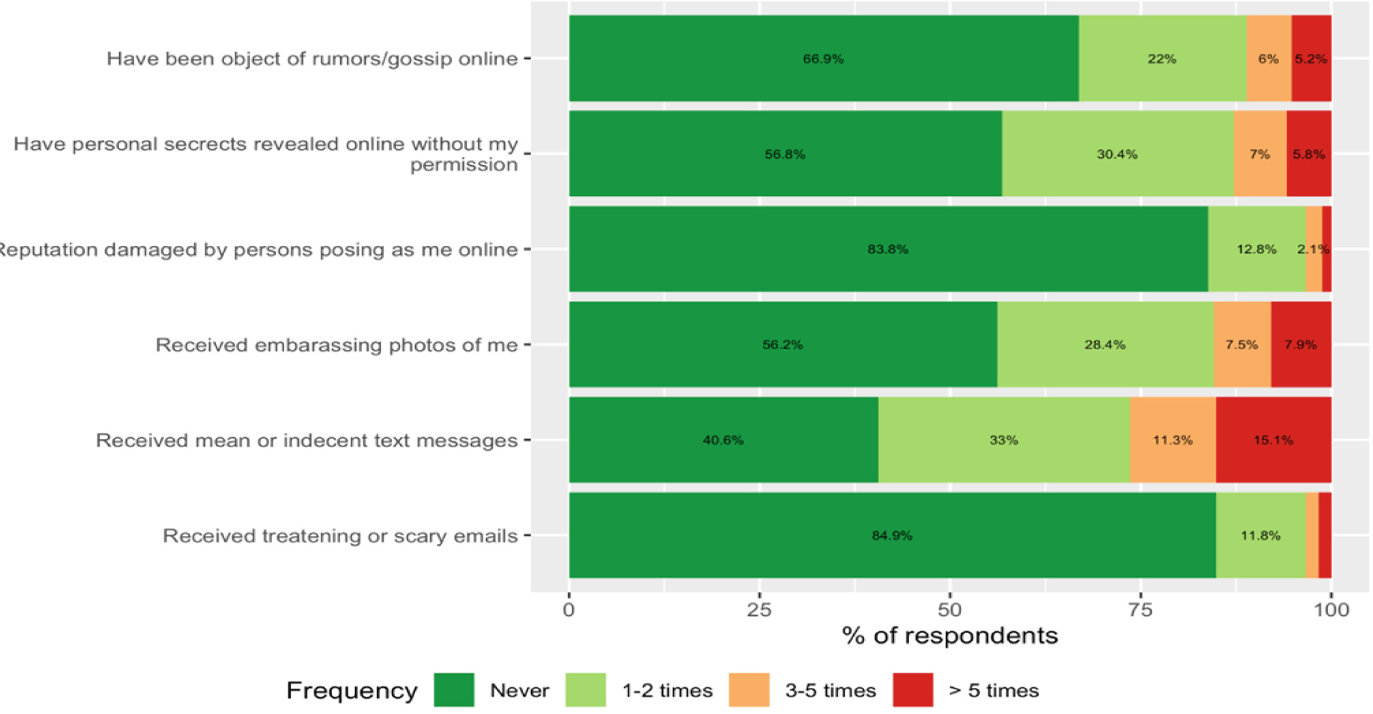
Figure 1 highlights the distribution: while many are "never" involved, a significant chunk of the student body exists in the 1-2 times category, making it a widespread cultural issue rather than an isolated criminal one.
Conclusion & Future "Design for Reflection"
The paper concludes that since time spent online (context) and moral disengagement (cognition) are the drivers, we cannot just "teach empathy." Instead, we need Design for Reflection.
Takeaways:
- For Educators: Focus on "Emotional Awareness." Bullies often lash out because they can't manage their own negative internal states.
- For Tech Developers: Create interfaces that force users to "stop and think" before posting—disrupting the automatic process of moral disengagement.
- Limitations: The study relies on self-reporting; many students might hide their actual behavior due to "social desirability" bias.
Ultimately, cyberbullying is a cognitive strategy used to navigate emotional distress. Whether you are the bully or the victim, the "lies we tell ourselves" are what keep the cycle spinning.