
Morality as the New Currency: Solving the Privacy-Cooperation Paradox in Mobile Social Networks
Morality-Driven Data Forwarding With Privacy Preservation in Mobile Social Networks
This paper introduces a morality-driven data forwarding protocol for Mobile Social Networks (MSNs) that balances high-efficiency cooperation with strict user privacy. By integrating a novel route-based authentication scheme and a game-theoretic "guilt" model, the system achieves near-optimal performance in opportunistic data delivery while protecting identity and location privacy.
TL;DR
In the decentralized world of Mobile Social Networks (MSNs), privacy and efficiency are typically at odds. Strict anonymity (pseudonyms) hides "free-riders," causing cooperation to fail. This paper introduces a groundbreaking framework that uses Social Morality—specifically a "Guilt Model"—to incentivize data forwarding. It proves that we don't need to know who you are to know you'll help, effectively achieving SOTA delivery rates without compromising a single bit of location privacy.
The Collision of Anonymity and Utility
Mobile Social Networks are essentially "Pocket Switched Networks" where human mobility provides the "links." Effective routing usually requires knowing a user’s social circle and history. However, current privacy standards use multiple-pseudonyms to ensure users are unrecognizable.
The Problem: If I don't know who you are, I can't punish you for being selfish. If everyone acts rationally and selfishly (The Prisoner's Dilemma), the network dies. Previous works focused on "What" (the data) or "Where" (the location), but ignored the "Why" (the human psychological incentive).
Methodology: The Three-Step Protocol
The authors solve this by bridging social theory with hard cryptography through a three-stage suite.
1. Privacy-Preserving Route-Based Authentication
Users need to prove they are going somewhere useful for a packet without revealing their exact path. The authors use a Bilinear Pairing-based tree structure.
- The Insight: Instead of saying "I am going to Point A," a user proves via a routing tree: "I will visit some spots that satisfy this Boolean logic (e.g., Spot 2 AND (Spot 3 OR Spot 4))." This provides fuzzy mobility—enough for routing logic, too vague for tracking.
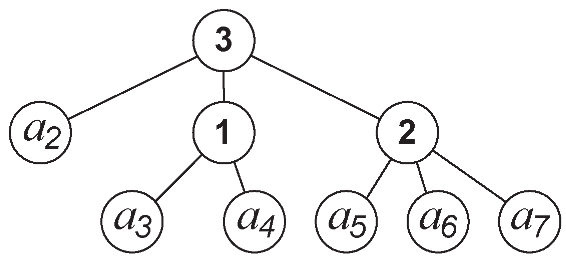 Figure 1: Tree structure of a user's route, allowing for anonymized mobility proof.
2. Proximity Measurement
Once a neighbor's "fuzzy" route is authenticated, the sender calculates a Proximity Score (e). This score estimates how close the relay user will get to the packet's destination hotspot. This is critical because, in this model, guilt is proportional to capability. If you are perfectly positioned to help and you refuse, you feel "more guilty."
3. The Morality-Driven Game
The core of the paper is the transition from a Basic Game (Rational selfishness) to a Social Cooperation Game (S-Game).
- Morality Factor (g): Modeled as a Markov Chain, where your "Morality State" improves with cooperation and decays with defection.
- The Utility Function: .
- By incorporating guilt as a cost in the payoff matrix, the Nash Equilibrium shifts from "Always Defect" to "Cooperate when Guilt > Forwarding Cost."
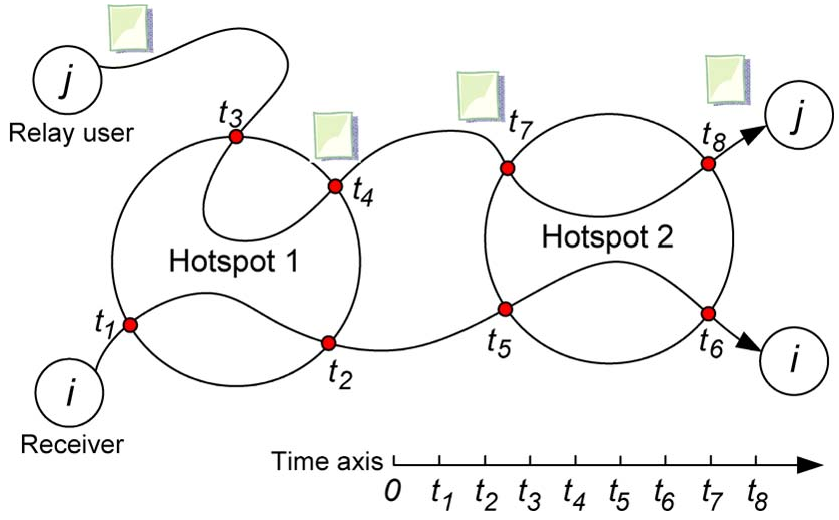 Figure 2: The Markov Chain model for internal morality states (Guilty vs. High-minded).
Experimental Insights: Does Guilt Work?
The authors used real-world pedestrian traces (100 users) to test their logic.
- B-Game (No Morality): Delivery ratio hovered at a dismal 30%, as users only delivered their own packets.
- S-Game (Proposed): Even with moderate "Sociality Strength" and forwarding costs, the delivery ratio jumped to 74%+, approaching the theoretically "Full Cooperation" ceiling.
- Incomplete Information: Perhaps most impressively, even when users didn't know the exact morality state of their neighbors (relying on a probability distribution), the "Guilt incentive" remained robust.
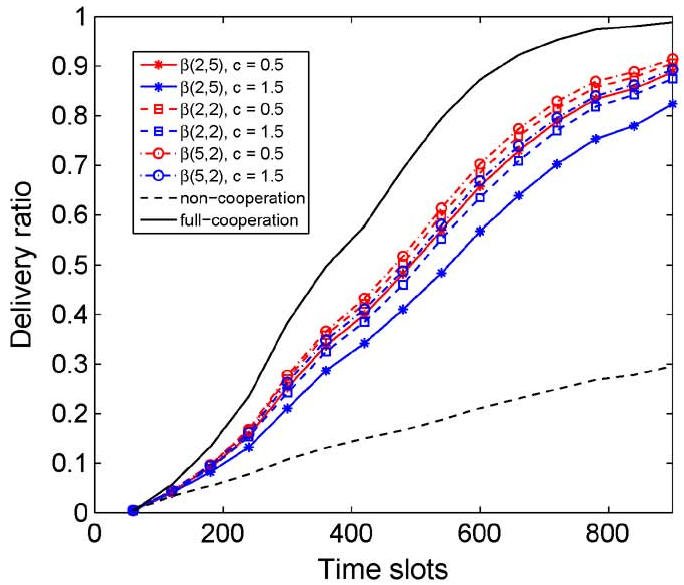 Figure 3: Delivery ratio comparison. Notice how S-Game (Proposed) significantly outperforms the non-cooperative baseline.
Critical Analysis & Future Outlook
The primary contribution here is the quantification of social norms. By turning "guilt" into a mathematical variable within a game-theoretic payoff, the authors bypass the need for centralized reputation servers or identity-linked blacklists.
Limitations: The model assumes users are "self-punishing" through an internalized Markov state. In a real-world adversarial scenario, a truly malicious user could simply "reset" their software to clear their "Guilt State."
Future Work: Bridging this with Trusted Execution Environments (TEEs) could make the "Morality State" tamper-proof, creating a hardware-enforced conscience for anonymous devices.
Final Takeaway
This work shifts the MSN paradigm from "How do we track users to make them behave?" to "How do we share just enough information so their internal incentives align with the network's health?" It’s a masterclass in using social physics to solve technical constraints.