
MHSV: Elevating Action Recognition with 3D Skeletal Motion Histories
Motion History of Skeletal Volumes for Human Action Recognition
The paper introduces Motion History of Skeletal Volumes (MHSV), a novel 3D space-time representation for view-independent human action recognition. By combining skeletonization with motion history, it achieves SOTA-level accuracy (83.61% on IXMAS) using Fourier transforms and LDA for robust feature classification.
TL;DR
Recognizing human actions from any angle remains a hurdle for computer vision. This paper proposes Motion History of Skeletal Volumes (MHSV)—a technique that strips away the bulk of 3D voxel data to focus on the "bones" of the movement. By applying skeletonization to 3D motion volumes, the authors achieved an massive accuracy leap (up to 30%+) over standard volumetric methods on benchmark datasets like i3DPost and IXMAS.
The Core Challenge: The Viewpoint Trap
Traditionally, Action Recognition relied on 2D templates (MHI/MEI). These work fine if the actor is always facing the camera, but they fail the moment the perspective shifts. While Motion History Volumes (MHV) extended this to 3D, they often capture too much "surface noise"—extra voxels from clothing or body shape that don't contribute to the underlying action logic.
The authors' insight is simple yet profound: Skeletons are the purest representation of motion. By focusing on the movement of the topology rather than the movement of the surface, they create a feature set that is inherently more robust to different body types and camera positions.
Methodology: From Voxels to Skeletal History
The MHSV pipeline is a rigorous multi-stage engineering feat:
- Skeletonization: Starting with "visual hulls" (binary 3D blobs), the system calculates the Euclidean distance transform. Skeletons are defined as singularities (peaks) in this field.
- Temporal Encoding: The MHSV function tracks how recently motion occurred at these skeletal points over a duration .
- Invariance Processing: To handle rotation, the MHSV is projected into cylindrical coordinates . A 3D Fourier Transform is then applied; since rotation in Cartesian space becomes translation in cylindrical space, the magnitude of the Fourier coefficients provides a rotation-invariant signature.
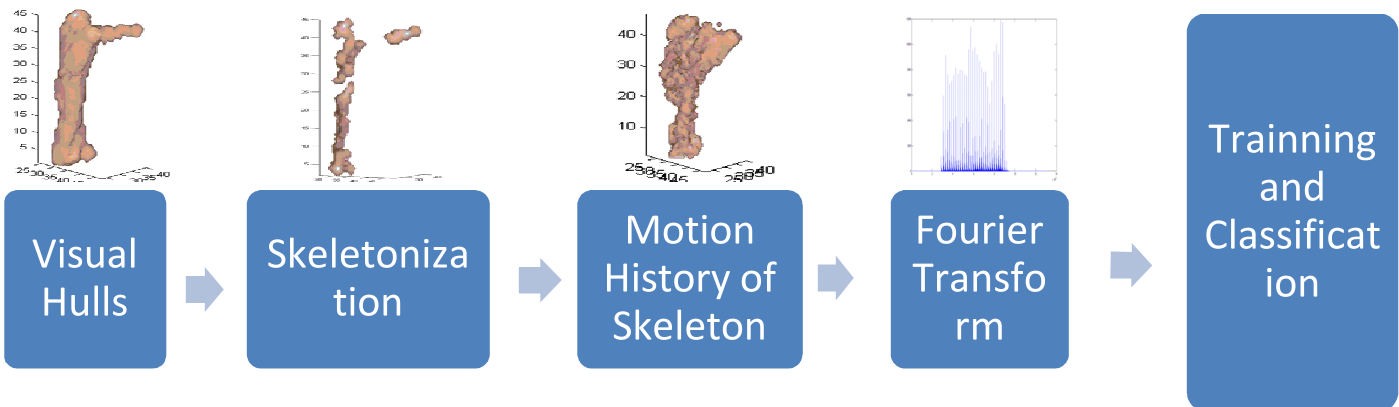 Figure 1: The MHSV conceptual framework, from visual hulls to LDA classification.
Experimental Breakthroughs
The paper puts MHSV head-to-head with the standard MHV across three classification metrics: Linear Discriminant Analysis (LDA), Euclidean distance, and Mahalanobis distance.
Key Results:
- i3DPost Dataset: MHSV reached 83.6% accuracy (LDA) vs. MHV's mediocre 50.9%.
- IXMAS Dataset: MHSV hit 83.61% for 12 complex actions, outperforming several state-of-the-art methods from the late 2000s and early 2010s.
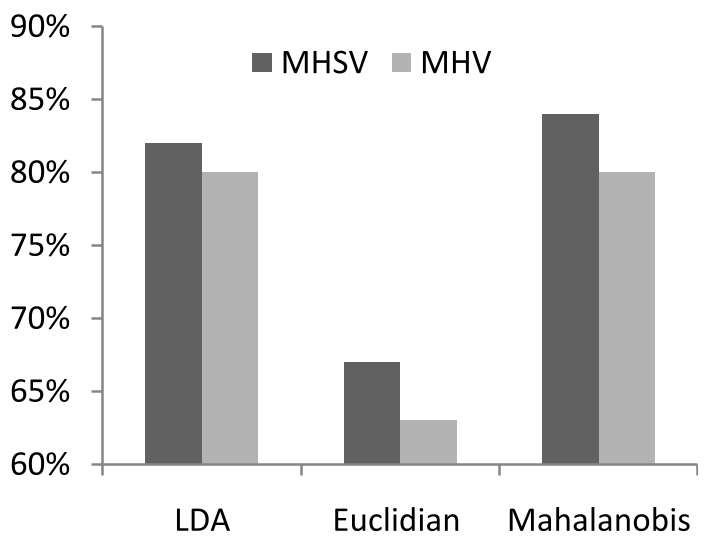 Figure 2: MHSV vs MHV performance across different datasets and distance metrics. The skeletal bias consistently provides higher discriminative power.
Critical Analysis & Conclusion
Why does MHSV work so much better? It’s about the Signal-to-Noise ratio. In standard MHVs, the movement of a baggy shirt might be logged as "human motion." MHSV ignores these periphery voxels and concentrates on the central "medial surface."
Takeaway: This work demonstrates that "less is more" in 3D computer vision. By reducing a 64x64x64 volume to its skeletal core, we gain better generalization and view invariance.
Limitations: The method relies heavily on the quality of the "Visual Hull." If the initial 3D reconstruction is poor (due to occlusions or few camera angles), the skeletonization will produce artifacts that degrade the feature vector. Future iterations might integrate Deep Learning to "infer" skeletons in occluded scenes before applying the MHSV temporal logic.