
MPURank: Unifying Messages, Paths, and Users for Advanced Social Hotspot Tracking
MPURank: A Social Hotspot Tracking Scheme Based on Tripartite Graph and Multimessages Iterative Driven
The paper introduces MPURank, a social hotspot tracking scheme that utilizes a Tripartite Graph and a multi-message iterative driving mechanism to identify key messages, propagation paths, and influential users simultaneously. Validated on real-world Sina Microblog data, it achieves superior node coverage (top 5% users reaching ~90% coverage) compared to traditional centrality measures.
TL;DR
In the chaotic landscape of social media, a single "hotspot" isn't a single post; it is a flurry of concurrent messages, divergent paths, and overlapping users. MPURank moves past simple centrality metrics (like Degree or PageRank) by introducing a Tripartite Graph framework. By iteratively scoring the relationships between Messages (M), Paths (P), and Users (U), it identifies the true catalysts of a social event with significantly higher coverage and accuracy than traditional methods.
The Problem: The Complexity of Concurrent Participation
Modern information tracking faces two major bottlenecks:
- User Concurrence: A single user often retweets multiple messages within a topic, yet most models treat these interactions as independent events.
- Structural Blind Spots: Traditional models focus on "who" (the user) but neglect "how" (the specific path) and "what" (the message popularity interaction).
To solve this, the authors argue that we must view a topic as a tripartite entity where the influence of a node is derived from the structural importance of the paths it occupies and the popularity of the messages it carries.
Methodology: The "Message-Path-User" Tripartite Graph
The core innovation lies in the G_TR = {M ∪ P ∪ U, A ∪ B} structure.
1. Propagation Path Extraction
Instead of a flat network, the authors build a Message Retweeting Relationship Tree. A path () is defined as a specific link from an initiator (root) to an edge node (leaf). The influence of a node is calculated by its "driving ability" across two layers (breadth and depth):
2. The Cyclic Iterative Driving Mechanism
Inspired by the HITS (Hyperlink-Induced Topic Search) algorithm, MPURank uses a mutually reinforcing scoring system.
- Forward Iteration: Initial message scores influence Path importance, which in turn updates User criticality.
- Reverse Iteration: User scores flow back to update Path importance and finally refine Message popularity.
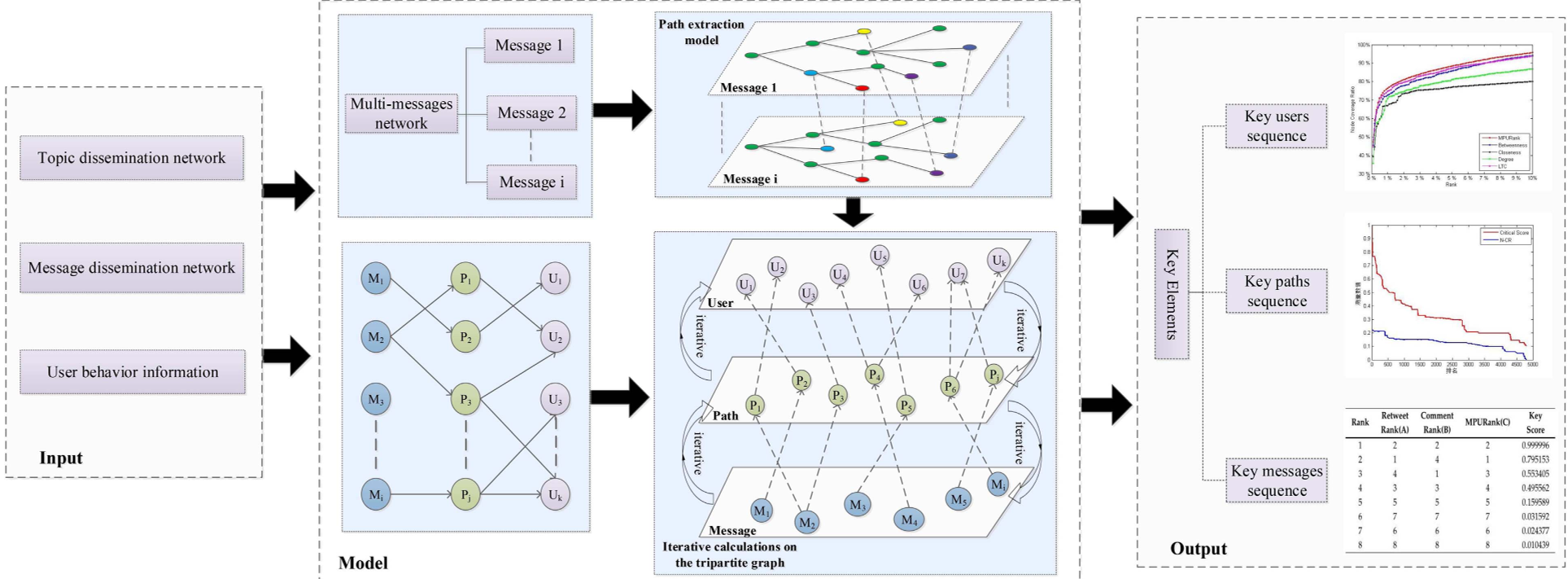 Fig 1: The MPURank Framework showing the data extraction, tripartite graph construction, and iterative scoring.
Experimental Insights: Better Coverage, Superior Tracing
The authors tested MPURank against a real-world dataset from Sina Microblog regarding a high-profile celebrity event.
Key Findings:
- High Performance: MPURank's top 5% of identified users achieved nearly 90% node coverage, far outstripping Degree or Betweenness centrality.
- Structural Validity: The correlation between Node Coverage (N_CR) and Path Coverage (P_CR) remained consistently high (>0.8), proving that influential users are indeed those who "control" the most propagation paths.
- Path Importance: Unlike simpler models, MPURank shows that the importance of a path is not merely the number of nodes it contains, but the weight of the users and messages associated with it.
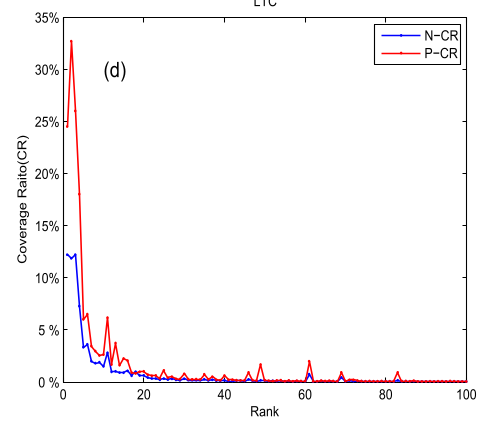 Fig 2: Relation between Node Coverage (N_CR) and node ranks. MPURank (red line) shows a significantly steeper gain in coverage compared to baseline centralities.
Critical Analysis & Conclusion
MPURank's primary strength is its holistic view. By acknowledging that a user’s influence is context-dependent (based on the path and message), it provides a more nuanced tool for public opinion mining and false information control.
Limitations: While the algorithm is efficient (), it relies on high-quality retweet metadata which can be difficult to crawl in real-time due to platform API restrictions. Furthermore, the model currently assumes a static snapshot of the topic; future work integrating temporal dynamics (time-decaying influence) would further enhance its predictive power.
Final Takeaway: In the era of "Information Overload," tracking a hotspot requires tracing the interwoven threads of a tripartite graph rather than hunting for isolated influential nodes.