
MR-Runner: Bridging the Gap Between Batch Processing and Iterative Machine Learning
MR-runner: a modularized map-reduce job management tool
MR-Runner is a modularized job management tool designed to extend the capabilities of Map-Reduce frameworks like Hadoop. It introduces a "client-side" driver approach to enable iterative processing and non-parallelizable task execution without modifying the underlying cluster framework.
TL;DR
MR-Runner is a modular management tool that retrofits iterative capabilities and sequential processing onto standard Map-Reduce frameworks. By using a client-side DAG (Directed Acyclic Graph) executor, it allows developers to run complex machine learning algorithms (like Gradient Descent and K-Means) on clusters like Hadoop without modifying the framework's core source code.
Background & Positioning
In the landscape of big data (circa 2013), Map-Reduce was the dominant paradigm. However, it faced a "rigidity wall": it was designed for one-pass batch processing. While frameworks like Spark and HaLoop emerged to solve iteration, many enterprises were locked into stable Hadoop ecosystems. MR-Runner positions itself as a non-intrusive middleware—a portable client that orchestrates complex workflows rather than a new distributed engine.
The "Parallelism Paradox": Why Map-Reduce Fails at ML
The authors identify two fundamental architectural bottlenecks in traditional Map-Reduce:
- Lack of Iteration: ML algorithms are inherently iterative (looping until convergence). Standard Map-Reduce requires manual job re-submission, which is error-prone and hard to manage.
- The Global Optimum Problem: Map-Reduce is "absolutely parallel." In algorithms like Gradient Descent, a model needs to see all records to make a global update. Since data is partitioned, individual nodes only achieve local optima.
Methodology: The Modular Architecture
MR-Runner solves these issues through a 4-layer architecture that separates logic from execution:
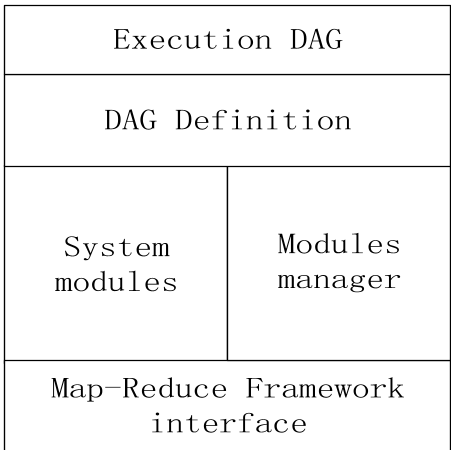
1. The Modular DAG
The core innovation is treating every task—whether it's a Map-Reduce job, a local shell script, or a data transfer—as a Module. Users define the dependency flow using a DAG.
- Constant Loops: The tool unrolls the iteration into 'n' sub-jobs.
- Conditional Loops: The tool evaluates a "stop condition module" after each run to decide whether to continue.
2. Solving Non-Parallel Parts (De-parallelization)
To solve the "global optimum" problem, MR-Runner implements a "Local Run" module. It automatically:
- Downloads intermediate results from the cluster to the local machine (the client).
- Executes a sequential algorithm on the aggregated data.
- Uploads the refined parameters/results back to the cluster for the next parallel phase.
Experimental Validation
The authors validated the tool by implementing several algorithms that were previously "incompatible" with vanilla Map-Reduce.
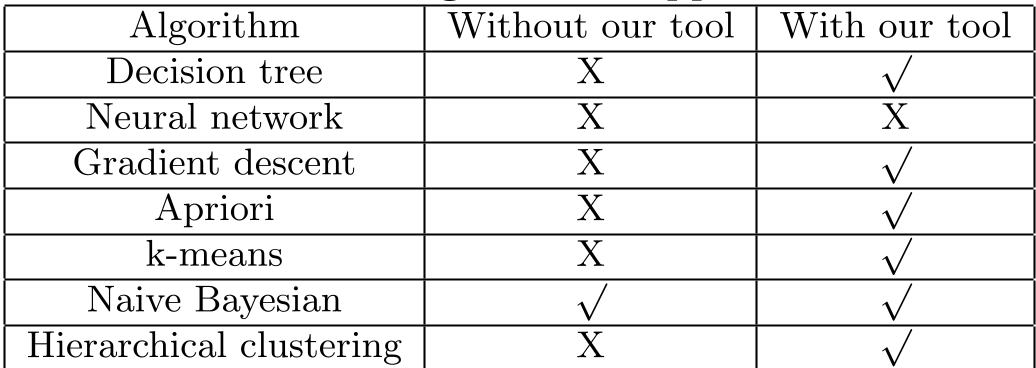
As shown in the table, MR-Runner transformed the Map-Reduce framework from a simple "Decision Tree/Naive Bayesian" engine into a versatile platform capable of Gradient Descent, Apriori, and Hierarchical Clustering.
Critical Analysis & Conclusion
Strengths:
- Portability: Because it acts as a client, it can switch from Hadoop to Spark by simply changing the API layer.
- Flexibility: Supports any programming language for local tasks, as long as it can be called via command line.
Limitations:
- Performance Bottlenecks: Unlike HaLoop, which optimizes data caching in memory across iterations, MR-Runner relies on HDFS/Disk I/O and network transfers to the local client. This makes it "functional" but not necessarily "high-performance" for massive state transfers.
- Client Reliability: The client machine becomes a single point of failure for the orchestration of the DAG.
Final Takeaway
MR-Runner represents a pragmatic era of software engineering where modular orchestration was used to extend the life of legacy "Big Data" infrastructure. It reminds us that sometimes the best way to solve a framework limitation is not to rebuild the cluster, but to build a smarter driver.