
MSIoT: Unifying Mobility and Sociality into a New IoT Paradigm
MSIoT: Mobile Social Internet of Things, A New Paradigm
The paper introduces MSIoT (Mobile Social Internet of Things), a novel paradigm that integrates Social IoT (SIoT), Social Internet of Vehicles (SIoV), and Mobile Social Networks (MSN). By introducing specialized Mobility Management (MM) and Service Forwarder (SF) components, it establishes a unified architecture to handle the continuous mobility of smart objects.
TL;DR
The Mobile Social Internet of Things (MSIoT) is a transformative framework designed to bridge the gap between static IoT and highly dynamic mobile networks (like SIoV). By introducing a Service Forwarder and Mobility Management layer, it turns "unpredictable movement" into a structured "social chain," significantly boosting service discovery efficiency in large-scale smart cities.
Problem & Motivation: The Mobility Paradox
In the traditional Internet of Things (IoT), objects were mostly stationary sensors. As we moved toward the Social Internet of Things (SIoT), the focus shifted to how objects could "befriend" each other to share resources. However, real-world objects—cars, smartphones, and wearables—are constantly moving.
Current architectures face three critical "pain points":
- Relationship Fragility: Moving objects break existing social chains, leading to service failure.
- Navigability Chaos: High dynamics make it nearly impossible for a service request to find a stable path to a provider.
- Siloed Paradigms: SIoT (social), SIoV (vehicles), and MSN (mobile social) operate as isolated structures despite sharing the same goal of connectivity.
The authors' insight is profound: Mobility should not be treated as a bug to be fixed, but as a feature to be harnessed. Mobility allows objects to explore new areas, update information across regions, and act as physical data carriers.
Methodology: The MSIoT Architecture
The core of the MSIoT paradigm lies in its ability to categorize objects and define how they interact when in motion.
1. Object Taxonomy
The paper simplifies the heterogeneous world of IoT into a 2x2 matrix:
- Smart vs. Non-Smart: Based on computing/processing power.
- Mobile vs. Fixed: Based on physical portability.
2. New Social Relationship Types
To handle mobility, MSIoT introduces four "mobility-friendly" ties:
- SPOR (Service Provider Object Relationship): Connects similar providers to allow service forwarding if one is overloaded.
- SROR (Service Requester Object Relationship): Connects seekers of the same service to share discovery info.
- EOR (Explorer Object Relationship): A temporary "handshake" between any objects in range to discover local services.
- MOR (Mobile Object Relationship): Based on shared trajectories (e.g., a passenger's phone and the bus it's on).
3. Key Architectural Components
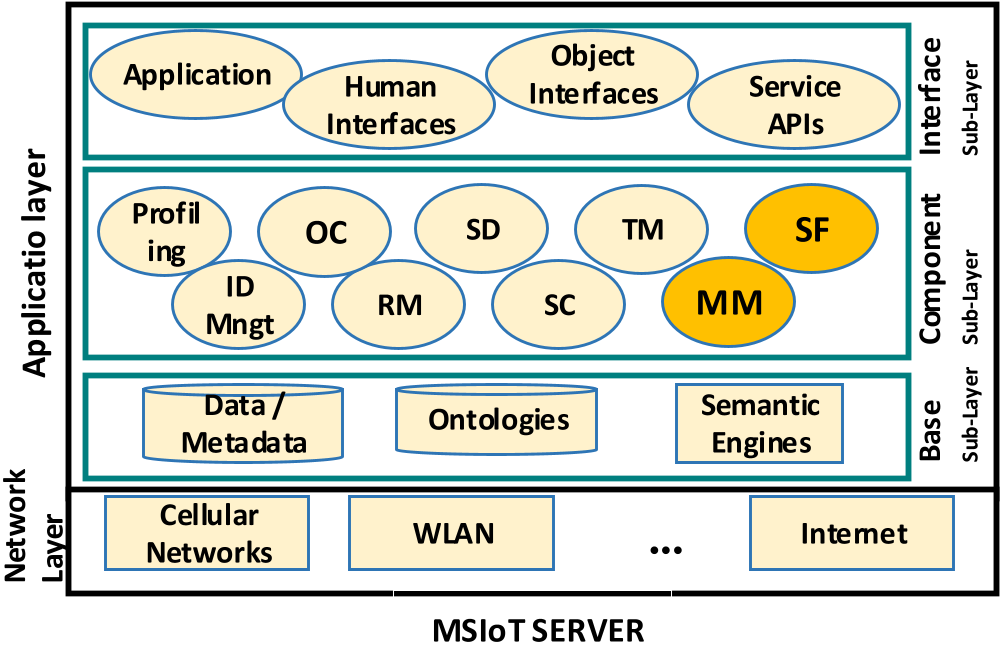 The MSIoT architecture adds (MM) and (SF) layers.
- Mobility Management (MM): This component tracks speed, location, and distance. It predicts when a social tie will break and proactively creates long-term links from short-term encounters.
- Service Forwarder (SF): This is the "traffic controller" of services. If a police car (an Explorer) sees a heart attack alert but can't help, the SF directs the request through the SPOR chain to the nearest ambulance.
Experiments & Results: Performance at Scale
The authors conducted an analytical comparison across four paradigms: IoT, SIoT, SIoV, and MSIoT.
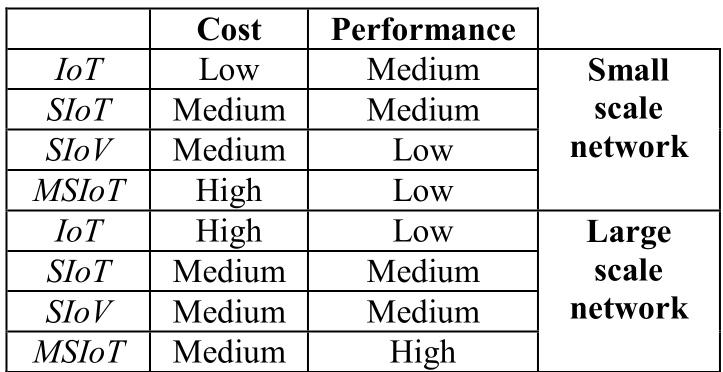
The findings reveal a critical trade-off:
- Small Scale: MSIoT has higher "cost" (computational overhead) and lower relative performance because the complex social management isn't yet paying dividends.
- Large Scale: MSIoT outperforms all others. While standard IoT collapses under the weight of billions of requests and SIoV struggles with navigability, MSIoT's social forwarding keeps success rates high and costs manageable.
Deep Insight: Why This Matters
The real value of MSIoT is its Unification. By creating a common language for a smartphone, a smart streetlight, and an autonomous ambulance, it provides a blueprint for a truly "Integrated Smart City."
Takeaway: The "Service Forwarder" concept is a game-changer. It bridges the Cyber World (finding a service via the cloud) and the Physical World (directing an actual vehicle through traffic lights). This dual-space optimization is exactly what the next generation of autonomous infrastructure needs.
Limitations & Future Work
While theoretically robust, the paradigm assumes a high level of interoperability and standardization that doesn't yet exist in the hardware market. Future research must address the Trustworthiness Management—how do we ensure that a "Service Forwarder" isn't a malicious node providing false location data?
Final Conclusion: MSIoT transitions us from a world of "connected devices" to a world of "socially aware mobile agents," setting the stage for 2026's smart city deployments.