
Decentralized-P*: Mining Social Communities via Multi-Agent Self-Organization
A Multi-Agent Based Decentralized Algorithm for Social Network Community Mining
This paper introduces Decentralized-P*, a multi-agent decentralized algorithm for community mining in social networks. By reformulating the community detection problem into a graph coloring task on a supplementary graph, it utilizes autonomous mobile agents to achieve self-organized clustering without requiring a global view of the network.
TL;DR
Traditional community mining is a "top-down" affair, requiring a god-like view of the entire network. Decentralized-P* flips the script. By treating community detection as a distributed graph-coloring problem, this paper enables a swarm of autonomous mobile agents to "feel" their way through a network, self-organizing into clusters through purely local interactions. It’s an approach designed not for a static server, but for the messy, distributed reality of P2P and ad-hoc networks.
The "Centralization" Bottleneck
In network science, we define a community as a group where internal links are dense and external links are sparse. Classic algorithms like the Girvan-Newman heuristic or Spectral Clustering have defined the state-of-the-art for years. However, they share a fatal flaw: they need the whole graph.
In the age of the World Wide Web, massive sensor networks, and privacy-first P2P systems, obtaining a global adjacency matrix is often impossible. The authors argue that we need a method that respects the decentralized nature of these systems—where nodes only know their immediate neighbors.
Methodology: From Clustering to Coloring
The stroke of genius in this paper is the mathematical transformation of the optimization objective.
1. The Supplementary Graph
The authors define an evaluation function that counts the "missing" edges needed to turn a community into a clique. Minimizing this is equivalent to solving a Graph Coloring Problem on a supplementary graph (where edges exist only where they don't exist in the original graph). In this framework, nodes with the same "color" belong to the same community.
2. The Multi-Agent Swarm
Instead of a central processor iterating over the matrix, the authors deploy mobile agents.
- Movement: Agents move to nodes with the highest "local stress" (high ).
- Action: When an agent lands on a node, it changes the node's color to minimize conflicts with neighbors.
- Stochasticity: By using probabilities and , the agents avoid local optima, similar to simulated annealing.
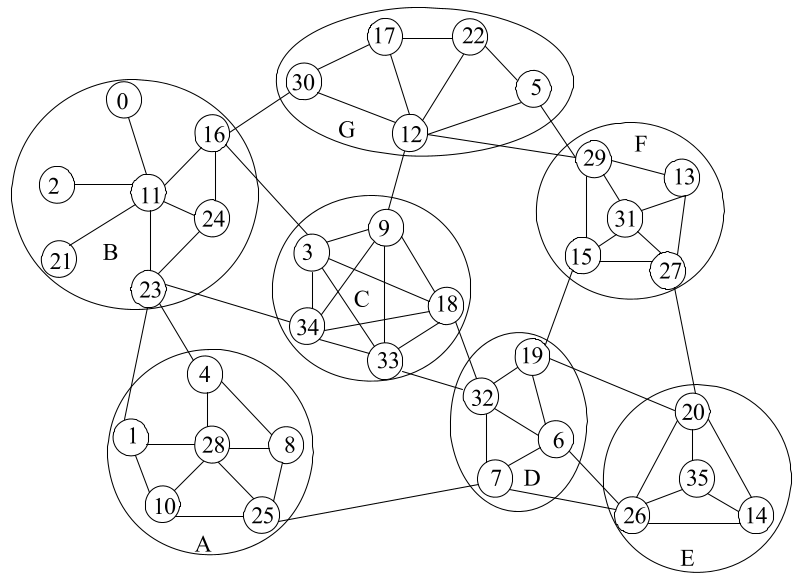 Figure 1: (a) A 32-node test network. (b) and (c) demonstrate how local and global evaluation functions converge rapidly as agents move.
Experimental Validation
The authors put their "decentralized swarm" to the test against classic benchmarks:
- Zachary’s Karate Club: A gold standard for community detection. The algorithm correctly identified the two factions, misclassifying only Node 10—a known "bridge" node with ambiguous loyalties.
- US College Football: Analyzing 115 teams. The algorithm successfully reconstructed the 12-conference structure. The "errors" occurred only where teams played more games outside their conference than inside—a case where the data itself is noisy.
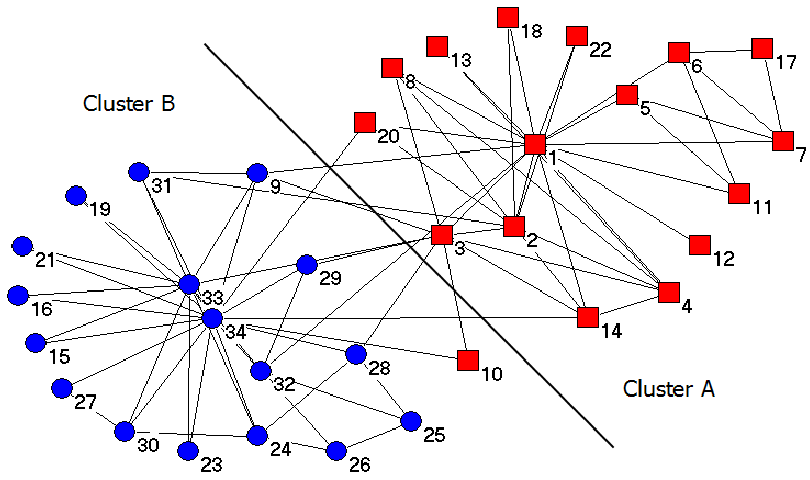 Figure 3: (a) Original messy matrix; (b) Transformed matrix after agent-based clustering, showing clear diagonal blocks (communities).
Deep Insight: Why This Matters
The power of Decentralized-P* lies in its asynchronous execution. Unlike parallel algorithms that require a "global clock" or synchronization barriers, these agents are truly independent. This makes the system robust: if some agents fail or some nodes go offline, the rest of the swarm continues the optimization.
Limitations & Future Work
The primary hurdle is the requirement of (the number of communities) as a predefined parameter. In real-world discovery, we often don't know how many clusters exist. The authors suggest that a hierarchical, k-free version of the algorithm is the natural next step.
Conclusion
This paper shifts the paradigm from "computing on a network" to "computing by the network." By leveraging Autonomy Oriented Computing (AOC), the authors show that complex global structures like social communities can be mined using nothing more than local search and agent mobility. It is a vital step toward scalable, privacy-preserving social network analysis.