
A Multi-Agent Recommender System: Bridging Social Networks and P2P Architectures
A Multi-Agent Recommender System Using Social Networks
The paper proposes a decentralized Multi-Agent Recommender System (MARS) that integrates social network data via implicit feedback. It utilizes a hybrid approach combining collaborative and content-based filtering within a peer-to-peer (P2P) architecture.
TL;DR
This paper introduces a decentralized recommender system that leverages Multi-Agent Systems (MAS) and Social Network data to provide personalized suggestions. By moving away from centralized servers to a Peer-to-Peer (P2P) architecture, the author addresses critical issues of privacy, scalability, and the "cold start" problem via implicit social data mining.
Background: The Limits of Centralization
Modern recommendation engines (like those used by Amazon or Netflix) typically rely on massive central servers. While effective, they face three major hurdles:
- Bottlenecks: As user bases grow, the cost of computing and bandwidth scales exponentially.
- Privacy: Users must surrender their data to a central entity, raising security risks.
- Information Silos: Centralized systems often miss the dynamic, real-time social context of a user's life.
The author, Fatma Siala, argues that the solution lies in decentralized autonomy.
Methodology: Socially-Aware Reactive Agents
The proposed approach is bifurcated into social profile enhancement and a distributed architectural execution.
1. The Social Profile Agent
Instead of asking users to rate items manually (explicit feedback), the system utilizes a specialized Profile Agent. This agent crawls the user's social network accounts to gather implicit feedback. By analyzing interaction patterns and social circles, the agent creates a "rich profile" that evolves as the user’s tastes change.
2. Peer-to-Peer (P2P) Interaction
The core of the system is a decentralized network where every user is represented by an autonomous reactive agent.
- Decentralized Storage: Data is stored locally on the user's machine, preserving privacy.
- Self-Organization: Agents communicate with one another to form "groups" based on similarity.
- Trust Contextualization: Rather than treating all recommendations equally, agents aggregate info based on the "reliability" of the source agent.
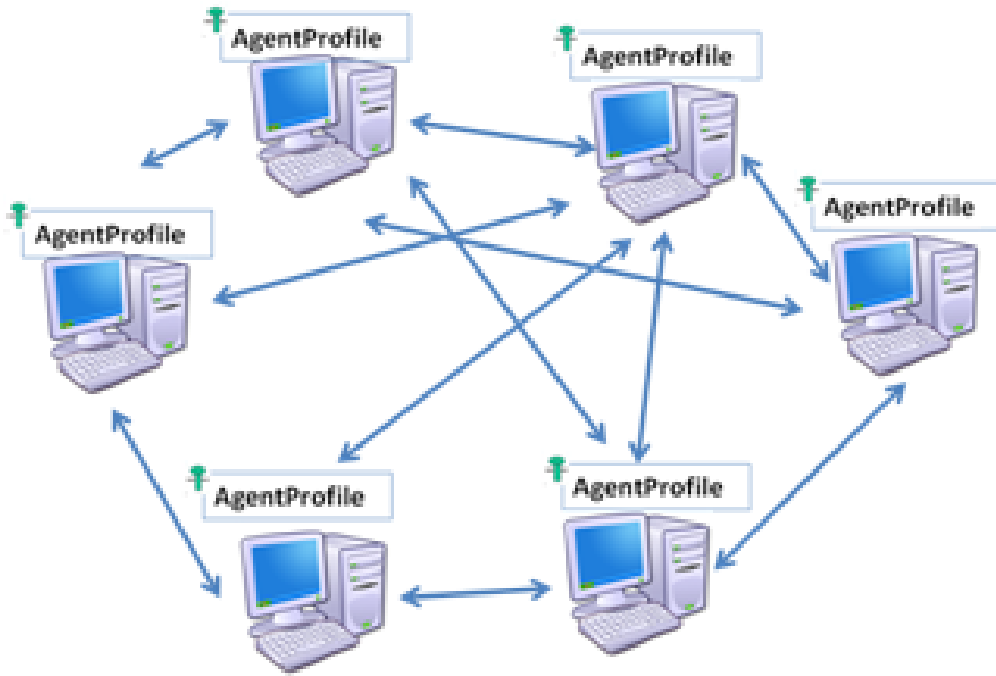 Figure 1: The proposed hybrid architecture showing the interaction between Profile Agents and the P2P network.
Key Innovations: Neighbor Discrimination
A standout feature of this research is the use of a discrimination algorithm. In a P2P network, not all "neighbors" are helpful. The system identifies peers whose interests are at the "extremes" (highly similar or highly dissimilar) to filter out noise, ensuring that the collaborative filtering process remains high-quality even without a central supervisor.
Experiments and Results
The research concludes that the multi-agent approach:
- Reduces Information Overload: By leveraging social context, the system narrows down choices more effectively than standard search engines.
- Enhances Robustness: The P2P nature prevents "Denial of Service" (DoS) issues common in centralized systems—if one node goes down, the rest of the system persists.
- Privacy Preservation: Because the "Aggregation" and "Trust calculation" happen at the user level, sensitive profile data never needs to leave the local environment in a raw state.
Critical Analysis & Conclusion
The Takeaway
The transition from "User-to-Server" to "Agent-to-Agent" represents a paradigm shift. By treating recommendation as an emergent behavior of interacting agents, Siala demonstrates that we can achieve high accuracy without sacrificing privacy.
Limitations & Future Work
While the framework is theoretically sound, the paper's 2-page poster format leaves out specific hardware performance metrics regarding battery/CPU usage on local devices—a critical factor for P2P systems. Future iterations would benefit from exploring how State Space Models (SSMs) or Transformer-Lite architectures could be embedded within these local agents to further refine content-based filtering.
Keywords: Recommender Systems, Multi-Agent Systems, P2P, Social Networks, Collaborative Filtering.