
OSNRS: Tracking the Pulse of Social Networks via Multi-Agent Systems
Multi Agent System for Historical Information Retrieval from Online Social Networks
The paper introduces OSNRS (Online Social Network Retrieval System), a Multi-Agent System (MAS) designed for real-time tracking of historical changes in social media profiles. Built on the JADE framework, it utilizes autonomous "grabber agents" to monitor individual profiles continuously and record temporal data shifts in a local repository.
TL;DR
Most web crawlers take a "snapshot" of a profile and move on. OSNRS (Online Social Network Retrieval System) changes the game by assigning dedicated, autonomous agents to "sit" on user profiles and record every heartbeat of change. Using the JADE framework, this system provides a high-resolution historical ledger of social dynamics, revealing that while our broad social circles are chaotic, our "inner circles" remain remarkably static.
The Static Trap: Why Traditional Crawling Fails
In the realm of Online Social Networks (OSNs), data is highly perishable. Current SOTA (State-of-the-Art) retrieval methods often focus on scale—crawling millions of profiles once—but ignore the temporal dimension.
The authors argue that a single visit to a profile is insufficient for:
- Security Personnel: Monitoring suspicious activities requires a timeline, not a photo.
- Sociologists: Understanding how social influence evolves over time.
- Safety: Guardians tracking the online presence of minors for protection.
The core challenge is the Inductive Bias of current tools: they assume the web is a library of books, whereas it is actually a flowing river.
Methodology: The "Grabber" and the "Master"
The researchers leverage Multi-Agent Systems (MAS) because they possess three critical traits: Autonomy, Reactivity, and Parallelism.
The Architecture
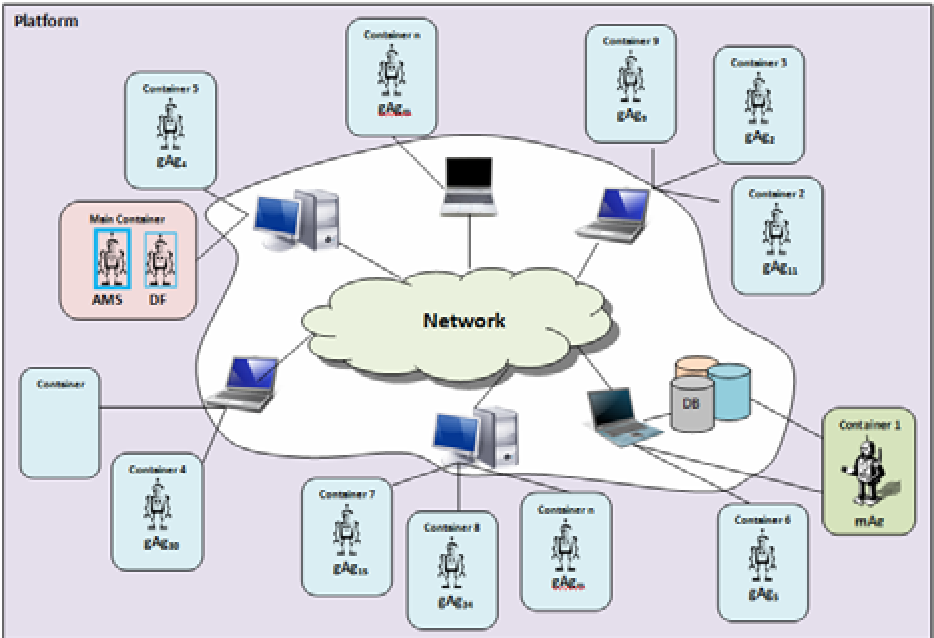
The system is built on JADE (Java Agent DEvelopment framework). The logic is split between two primary roles:
- Master Agent (mAg): The brain. It manages the local repository (PostgreSQL), assigns tasks, and handles inter-agent communication.
- Grabber Agents (gAg): The boots on the ground. Each agent is allocated to a unique URL. It doesn't just scrape; it monitors. If the current profile state differs from the last saved state, it triggers an update to the Master.
The Algorithm
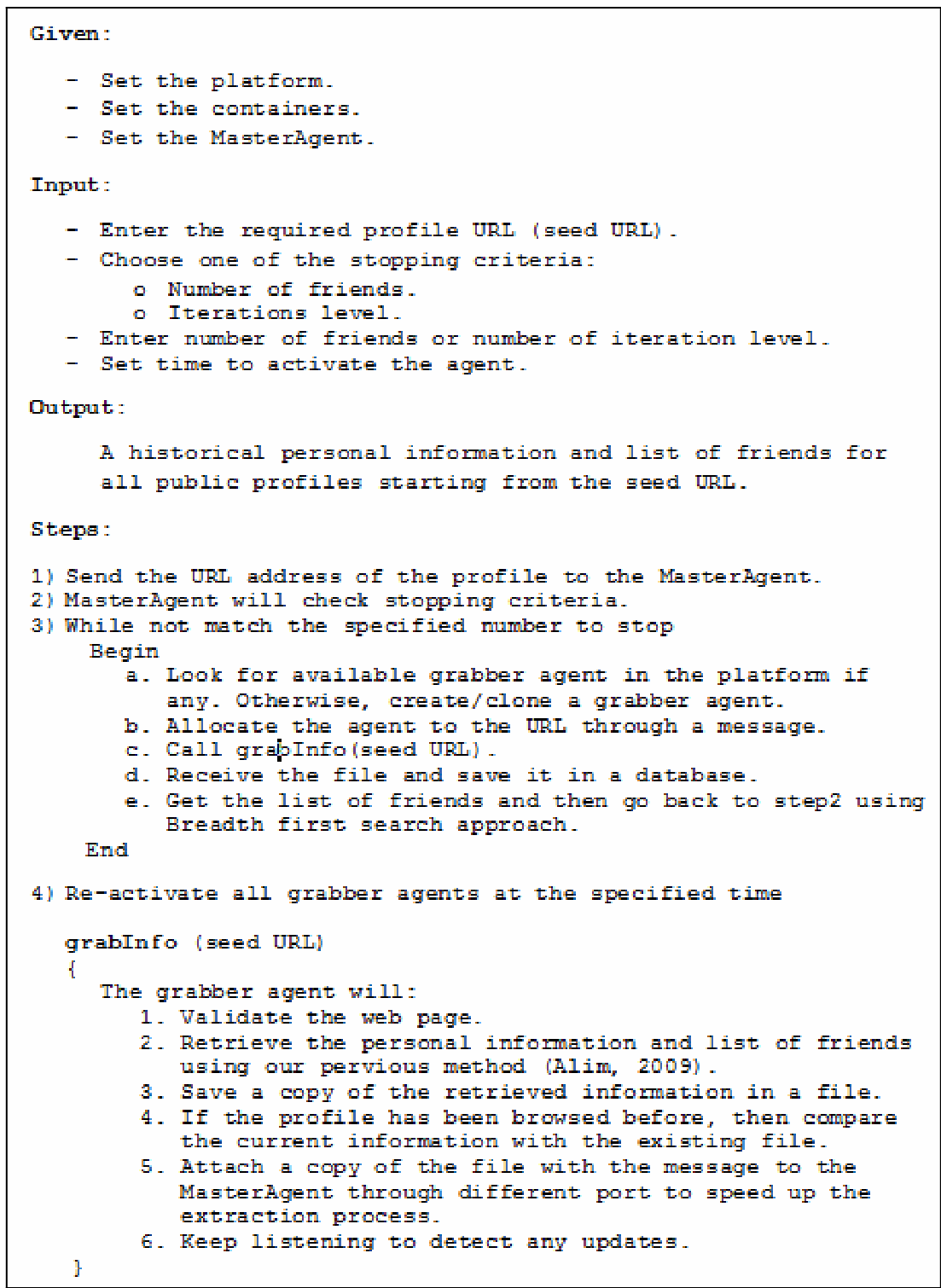
Using a Breadth-First Search (BFS) approach, the agents navigate the friendship graph. A key innovation here is the use of distinct communication ports: one for agent-to-agent negotiation and another dedicated to high-speed file transfers, preventing synchronization bottlenecks.
Experimental Insights: Who Are Your Real Friends?
The researchers deployed OSNRS on MySpace, focusing on two groups: random public profiles and a connected sub-network (ego-networks).
Key Findings
- The Stability of Inner Circles: In a 14-day window, less than 3% of users changed their "Top Friends" list.
- Volatility of the Masses: Conversely, up to 42% of users saw changes in their total friend count.
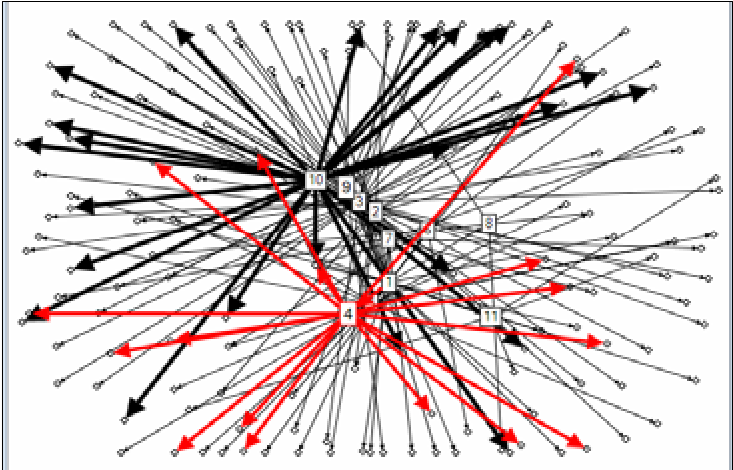
- Visualizing Decay: By tracking profiles daily, the researchers could visualize "node disappearance"—identifying exactly when a user unfriended someone or closed an account.

The visualization below shows a sub-network evolve from Week 1 to Week 2. Note how the removal of a single central node (Node 4) results in the collapse of several associated branches—a level of detail impossible to capture with single-pass crawling.
Critical Analysis & Future Directions
The OSNRS framework represents a shift toward Longitudinal Information Retrieval. However, there are inherent limitations:
- Privacy Walls: The study relies on public profiles. As OSNs tighten privacy settings (e.g., Facebook's "Friends Only" locks), the reach of autonomous agents is curtailed.
- Scalability: Assigning a thread/agent per URL is resource-intensive compared to vectorized scraping.
- API Evolution: The authors acknowledge that moving forward, these agents must interface directly with APIs rather than relying on HTML parsing to maintain stability.
Conclusion: This paper proves that MAS is the ideal paradigm for "listening" to the social web. By treating agents as persistent observers rather than temporary visitors, we can finally begin to map the dynamic history of our digital lives.