
MAC: Precision Community Search Under Uncertain Preferences
Multi-attributed Community Search in Road-social Networks
This paper introduces the Multi-attributed Community (MAC) model for road-social networks, combining k-core structural cohesiveness, spatial constraints, and multi-criteria decision-making. It enables finding top-ranked communities when user preference weights are uncertain, ensuring results are not "r-dominated" within a specified preference region.
TL;DR
Researchers have developed a new community search model called Multi-attributed Community (MAC). Unlike previous models that require exact weights for different attributes (like "how much do I value a user's influence vs. their activity?"), MAC allows users to provide an "uncertainty range." It then finds all communities that are mathematically "best" (not dominated) for any possible weight setting within that range.
Background & Motivation: The "exact weight" Trap
In modern Location-Based Social Networks (LBSN), we don't just care about who knows whom. We care about their attributes (influence, activity, expertise) and their physical location.
Previous SOTA (State-of-the-Art) methods faced two major hurdles:
- Weight Sensitivity: If you set your preference weight for "Influence" at 0.2 and "Activity" at 0.8, a tiny shift to 0.19 might completely change your search results. In reality, no human can specify their preferences with such absolute precision.
- Multi-Criteria Trade-offs: Skyline community models exist, but they often return too many results because they cannot incorporate user-specific preferences to prune the search space.
Methodology: High-Dimensional Geometry Meets Graph Theory
The authors bridge the gap by defining a community as a (k, t)-core: a structure that is both socially dense (minimum degree ) and spatially close to the query user (distance threshold ).
1. The r-Dominance Graph
To handle multiple attributes (up to dimensions), the paper introduces the r-dominance concept. If vertex scores higher than vertex for every possible weight combination in your preference region , then "r-dominates" . The system builds a Directed Acyclic Graph (DAG) of these relationships, allowing the search algorithm to prune "inferior" users quickly.
2. Global vs. Local Search
- Global Search (DFS-based): This algorithm partitions the preference region into sub-cells. Each cell is linked to a specific MAC. It uses a depth-first approach to recursively prune vertices that violate the -core constraint.
- Local Search (The Speed Demon): Recognizing that communities are usually near the query user , the Local Search expands outward from . It generates "candidate" communities and uses a verification step to confirm if they are valid MACs within the preference region .
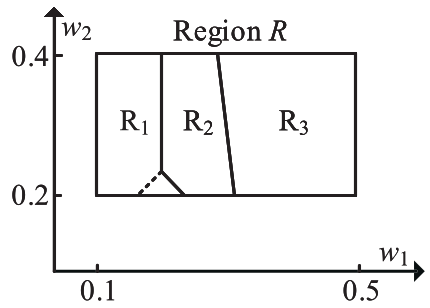 Above: (a) Social Network with attributes; (b) The Preference Domain R being partitioned into segments for different MACs.
Experimental Insights: Scaling to Millions
The team tested their algorithms on massive datasets like Yelp (3.6M vertices) and Aminer.
- Efficiency: Local search is consistently 10x faster than global search.
- Scalability: While traditional Skyline community methods (like Sky+) fail or become "infinite" when dimensions , the MAC model remains tractable.
- The "Yelp" Effect: In real-world data, attributes are often correlated. This naturally simplifies the dominance graph, making the search even faster than on synthetic, randomized data.
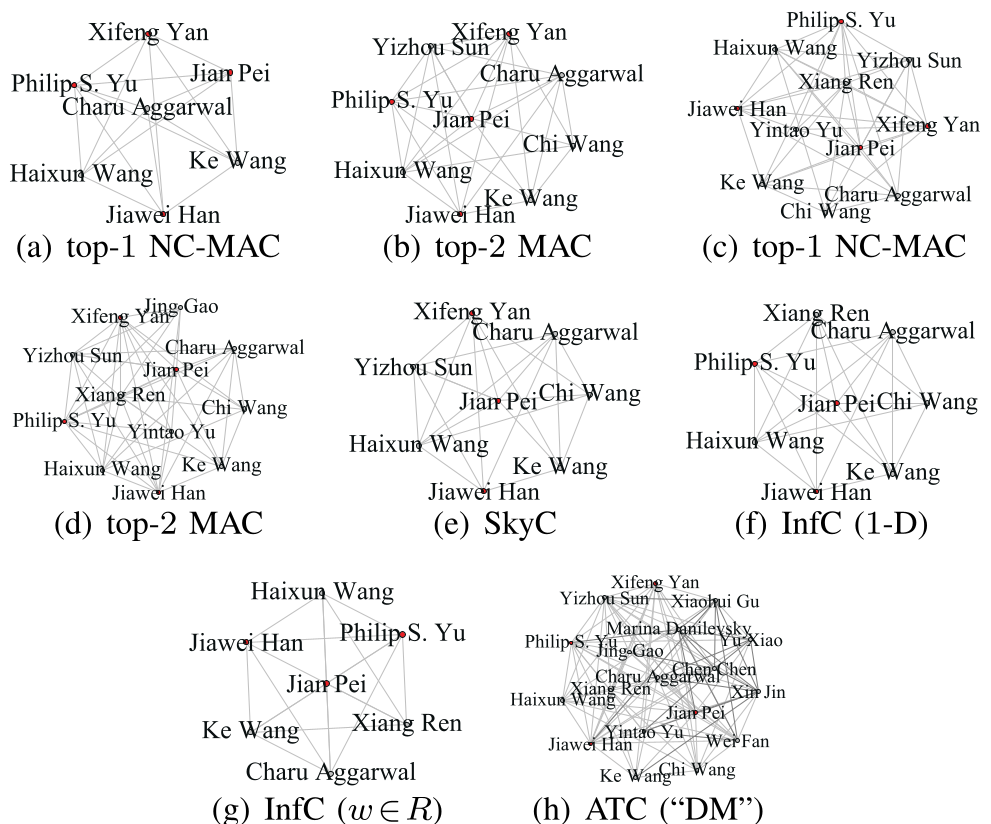 Case Study: Top MACs found in the Aminer network for famous researchers, balancing publications, h-index, and diverseness.
Critical Analysis & Takeaways
The MAC model is a significant step forward for Personalized Community Discovery.
- The Win: It acknowledges that "user preference" is a fuzzy region, not a single point. This makes the system robust against the noise of human input.
- The Limit: High-dimensional partitioning (the "Arrangement" of hyperplanes) still carries a geometric cost. While is fine, very high-dimensional feature vectors (like 100-d embeddings) would likely require approximate methods.
Ultimately, this research provides the mathematical tools to build better group-recommendation engines, suspect investigation tools, or targeted marketing systems in the increasingly complex world of road-social networks.