
MCMM: Ensuring Seamless Ubiquitous Services in Dynamic Mobile Social Networks
Multi-devices composition and maintenance mechanism in mobile social network
The paper introduces a Multi-Devices Composition and Maintenance Mechanism (MCMM) for Mobile Social Networks (MSN). It leverages dynamic programming and the TOPSIS method to select and maintain an optimal set of mobile devices, ensuring high-quality ubiquitous service under highly dynamic network topologies.
TL;DR
In the era of ubiquitous computing, providing stable services over Mobile Social Networks (MSN) is hindered by device mobility and resource constraints. This paper proposes MCMM (Multi-Devices Composition and Maintenance Mechanism), a framework that treats service composition as a dynamic planning problem. By maintaining a candidate pool of device sets and using multi-objective optimization (TOPSIS), it achieves higher reliability, lower energy consumption, and smoother service quality compared to existing SOTA methods.
The Challenge: Mobility vs. Stability
In a Mobile Social Network, a "Ubiquitous Service" is often a distributed task spread across multiple transient nodes (e.g., streaming a video via multiple hops in a crowd). The fatal flaw of current Manifold-based or Tree-based composition methods is their rigidity. When a single node moves out of range or runs out of battery:
- The service breaks (Interruption).
- The system must start a costly global discovery process (Latency).
- The quality fluctuates wildly (Jitter).
The authors argue that service composition shouldn't be a one-time event but a continuous maintenance cycle.
Methodology: Dynamic Planning and TOPSIS
The core of the paper lies in transforming the Multi-Devices Composition and Maintenance Problem (MCMP) into a formal mathematical model.
1. Quantitative Service Measurement
Instead of just looking at "connectivity," the authors use the TOPSIS method to calculate a Global Utility (). This considers:
- Service Distance: Proximity of devices to the user.
- Availability: Response time.
- Reliability: Battery levels and CPU capacity.
2. The Maintenance Algorithm (MCMA)
The proposed mechanism operates in four distinct phases:
- Discovery & Composition: Finding the initial optimal path.
- Service Monitor: Proactively identifying quality degradation before a failure occurs.
- Service Recover: Instead of restarting from scratch, the system switches to a Candidate Multi-device Composition Set (C-MCS)—a pre-calculated "Plan B."
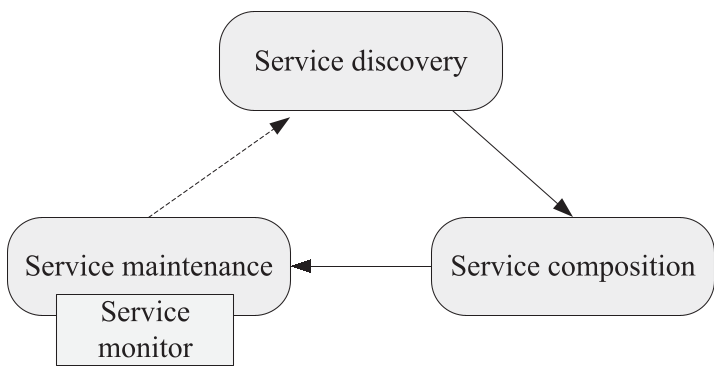 Fig 1: The Execution Cycle of Service Discovery, Composition, and Maintenance.
Experimental Validation
The authors validated their approach using OPNET and MATLAB, testing scenarios with up to 20 users and varying mobility speeds (up to 20 m/s).
Key Comparisons
The MCMM was compared against MDSCR, DTA, and SDA.
- Service Jitter: The utility range for MCMM remained between 0.60 and 0.93, significantly smoother than MDSCR, which dipped as low as 0.40.
- Re-start Time: By using the "Candidate Set" strategy, the time wasted in re-selecting devices was cut by nearly 40% compared to traditional anycasting methods.
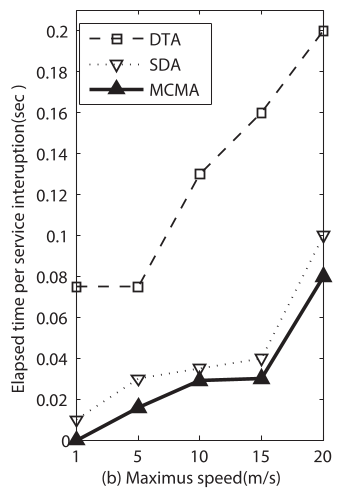 Fig 2: Impact of device speed on service interruption frequency and re-start time.
Critical Insight: Why it Works
The "Secret Sauce" of this paper is Theorem 2, which proves that the MCMP has an optimal substructure. This allows the researchers to apply dynamic programming principles. By minimizing the cost function (where is jitter and is interruption duration), the algorithm doesn't just look for the cheapest path, but the most sustainable one over time.
Conclusion
MCMM represents a significant step toward reliable ad-hoc networking. Its ability to maintain service continuity in high-mobility environments (like disaster recovery or crowded festivals) makes it a robust candidate for future 6G and Edge-AI applications. The next frontier, as the authors suggest, will be managing global synergy when thousands of users compete for the same limited device resources.
Takeaways
- Proactive > Reactive: Buffering candidate paths (C-MCS) is essential for low-latency recovery.
- Multi-Objective is Mandatory: Reliability cannot be measured by signal strength alone; energy and CPU load are critical.