
Multi-dimensional Incentives: Solving the Moral Hazard in Mobile Crowdsourcing
Multi-dimensional Contract Incentive Design for Mobile Crowdsourcing Networks
This paper proposes a multi-dimensional contract-based incentive mechanism for Mobile Crowdsourcing Networks (MCN) to address the reluctance of users to participate in multi-task scenarios. By modeling the relationship between a Service Provider (SP) and Mobile Users (MU) as a moral hazard model under asymmetric information, the authors derive an optimal payment scheme consisting of a basic salary and performance-linked bonuses.
TL;DR
Mobile Crowdsourcing Networks (MCN) rely on the hardware and efforts of individual users, yet "selfishness"—the desire to save battery and data—often hinders participation. This paper introduces a multi-dimensional contract mechanism that uses a combination of fixed salaries and performance-based bonuses to ensure that even when the Service Provider can't "see" exactly how hard a user is working (asymmetric information), the user is still mathematically incentivized to provide high-quality data across multiple tasks.
The Problem: The "Hidden Effort" Dilemma
In a typical MCN, a Service Provider (SP) needs data, and Mobile Users (MU) have the sensors to collect it. However, two major hurdles exist:
- Multi-tasking Complexity: Users aren't just doing one thing; they are balancing multiple tasks where efforts and costs might overlap.
- Asymmetric Information: The SP only sees the result (which might be noisy), not the actual effort expended by the user. If the reward is too low, the user quits; if it's not tied to performance, the user "loafs" (moral hazard).
Traditional one-dimensional incentives fail to capture the trade-offs users make when juggling multiple responsibilities.
Methodology: The Math of Trust
The authors model the MCN as a labor market. To solve the uncertainty of user behavior, they apply Contract Theory.
1. The Power of Linear Rewards
The proposed reward structure is defined as:
- : The Fixed Base, ensuring the user's basic costs are covered (Individual Rationality).
- : The Incentive Vector, tying the bonus to the perceived performance (Incentive Compatibility).
2. Modeling Risk and Cost
Unlike simpler models, this paper introduces a Symmetric Cost Matrix (). This acknowledges that doing Task A might make Task B harder (or easier). Furthermore, it accounts for Risk Aversion (), recognizing that users are less likely to participate if the rewards are too volatile or unpredictable.
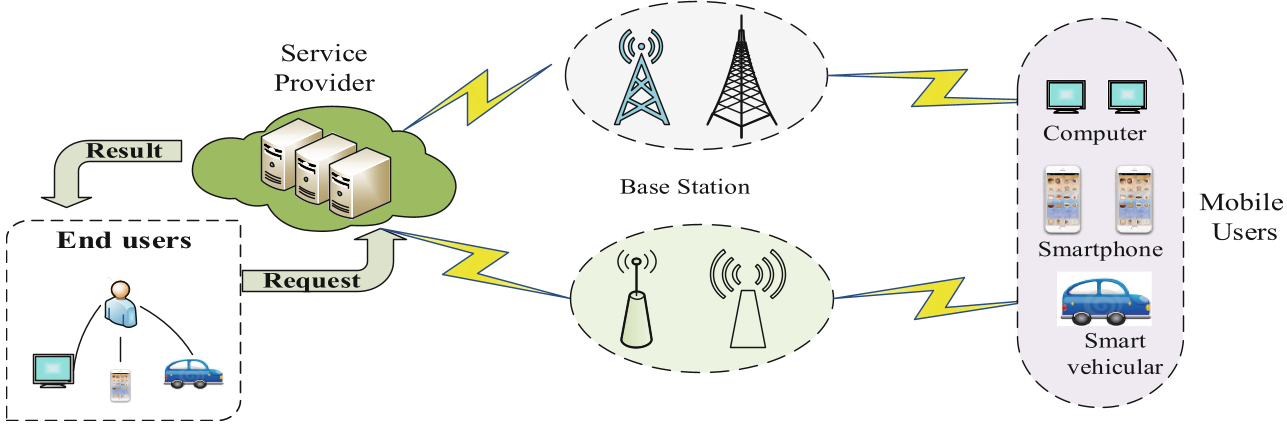 Figure 1: The interaction cycle between End Users, the Service Provider, and Mobile Users.
Experiments and Insights
The researchers tested how the Variance ()—basically the "noise" or difficulty in measuring performance—affects the system.
Key Finding: Noise Control
The simulations revealed a critical relationship: as the measurement noise for a specific task increases, the MU's optimal effort for that task decreases because they can "hide" their lack of effort more easily. To counter this, the SP must strategically increase the bonus coefficients for tasks that are easier to monitor, ensuring the overall utility for the platform remains high.
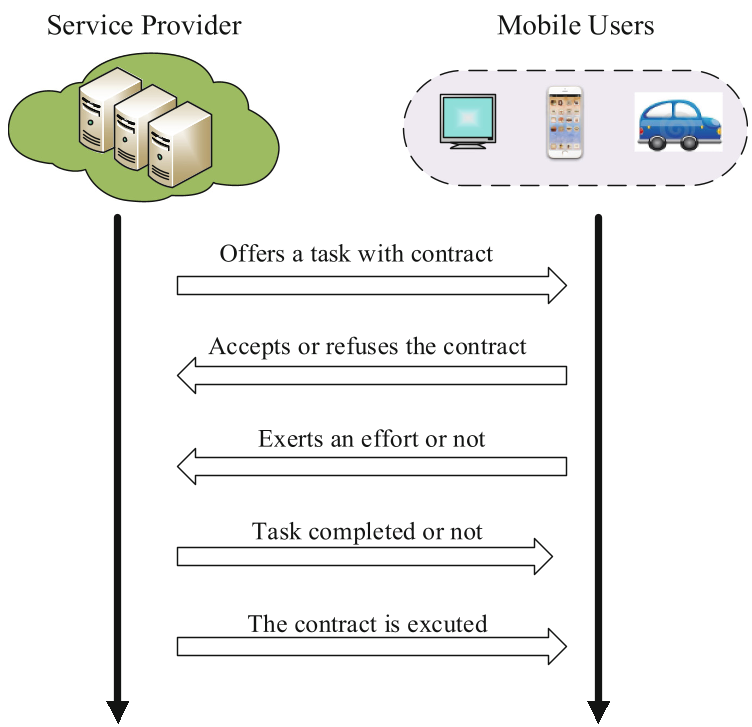 Figure 2: The optimal contract execution process, from broadcasting terms to final payment.
Performance Comparison
The results confirm that by adjusting the multi-dimensional bonus vector (), the SP can successfully motivate MUs to work harder even in scenarios where the SP has no direct visibility into the MU’s actual resource consumption.
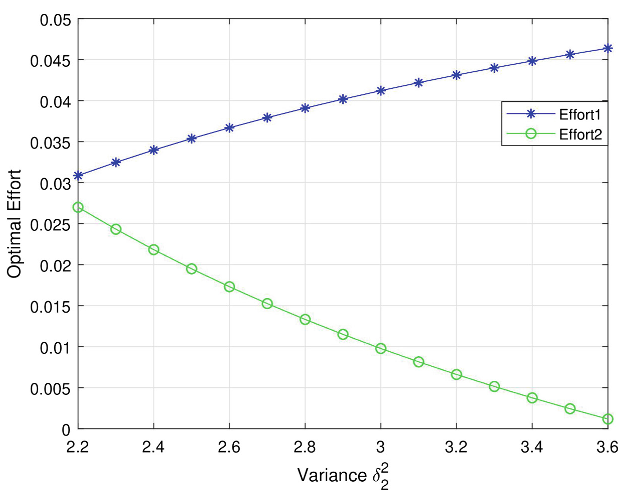 Figure 3: Impact of measurement variance on optimal user effort.
Critical Analysis & Conclusion
This work provides a robust mathematical foundation for specialized crowdsourcing platforms (like environmental monitoring or traffic reporting).
Takeaway: Effective incentives aren't just about paying more; they are about structured rewards that account for the user's risk tolerance and the interconnected nature of tasks.
Limitations:
- The model assumes a "Negative Exponential" utility function, which is mathematically convenient but may not capture all human psychological quirks.
- It assumes a static environment; in reality, user costs change as they move or as their battery drains.
Future Outlook: Integrating dynamic pricing or "Real-time Contract Renegotiation" could be the next step in making these networks truly autonomous and resilient.