
Optimized Job Placement: Breaking the Trade-off Between Utilization and Performance on Titan
A Multi-faceted Approach to Job Placement for Improved Performance on Extreme-Scale Systems
The paper presents a multi-faceted approach to job placement on extreme-scale 3D torus systems like the Titan supercomputer. It introduces "Dual-Ended Scheduling" and "Balanced Node-Layout" strategies to minimize network hop-counts and geometric digression without sacrificing system utilization or capability metrics.
TL;DR
At the scale of the Titan supercomputer, where 18,688 nodes communicate over a 3D torus, where you put a job is just as important as when you run it. This paper introduces a dual-strategy approach: Dual-Ended Scheduling to reduce fragmentation and Balanced Node-Layouts to optimize for anisotropic network bandwidth. The result? A 50% reduction in average hop-counts and a 10% boost in overall application performance without any loss in system utilization.
Problem: The Hidden Cost of "Filling the Gaps"
On extreme-scale systems like Titan (Cray XK-7), the goal is often high utilization (90%+). To achieve this, schedulers like MOAB and ALPS use "backfilling"—shoving small, short-lived jobs into the idle gaps left by large "capability" jobs.
While this is great for throughput, it creates a fragmentation nightmare. Large jobs are forced into non-contiguous node sets, increasing "hop-counts" (the distance data travels). In a 3D torus network like Gemini, more hops don't just mean higher latency; they expose data to geometric digression, where competing traffic flows slice into available bandwidth, leading to massive runtime variability.
Methodology: The Science of "Scores"
The authors first developed Scores, a framework using TorusVis to visualize job layouts and machine learning (Random Forest and SVM) to correlate layout features with performance.
1. The Discovery
ML analysis of NAS Parallel Benchmarks revealed that average hop-count and the number of partitions are the dominant predictors of performance. Interestingly, instantaneous network congestion was not a strong predictor, suggesting that static placement quality is the primary bottleneck.
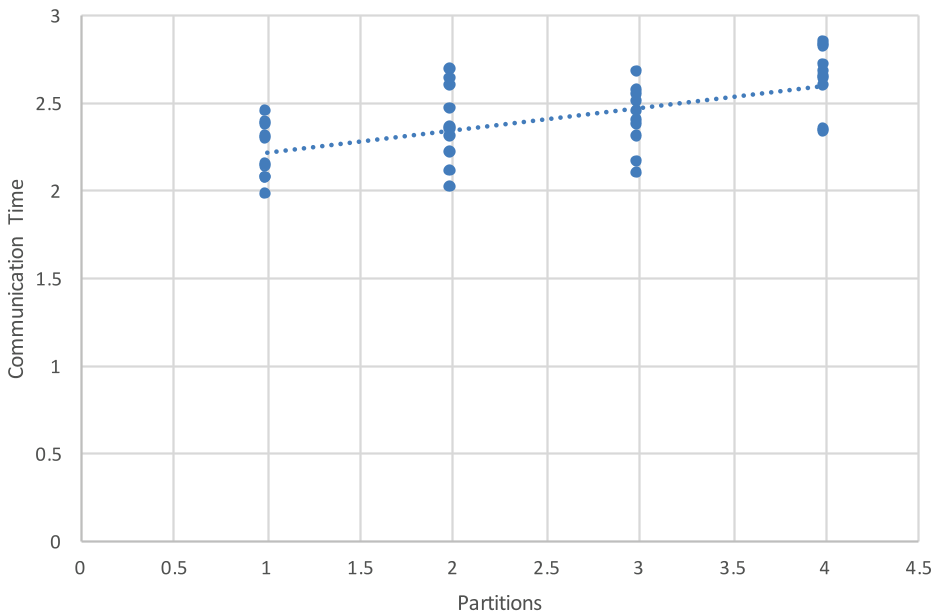 Figure: The clear correlation between job fragmentation (partitions) and communication latency.
2. Dual-Ended Scheduling: Separating the Giants from the Ants
The innovation here is simple yet profound. Typically, all jobs are allocated from the "top" of a node list. This causes the front of the list to be heavily used and fragmented. Dual-Ended Scheduling flips the script:
- Large, long-lived jobs: Allocated from the front of the list.
- Small, short-lived jobs: Allocated from the tail of the list. This "entropical separation" preserves contiguous blocks at the head for large jobs, while relegating fragmentation to the small jobs that are less sensitive to network distances.
3. Balanced Node-Layout: Beating Anisotropy
Titan’s Gemini network is anisotropic—the cabling in the Z and X dimensions provides higher bandwidth than the Y dimension. The default ALPS layout prioritized Z-Y-X, accidentally pushing traffic through the slower Y-links. The authors redesigned the node ordering to use Hilbert curves that prioritize Z and X, creating a "Balanced Layout" that better matches the physical hardware strengths.
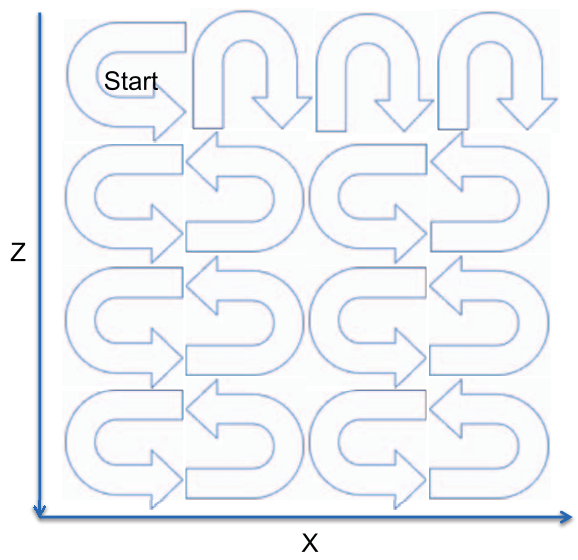 Figure: Using rotated Hilbert curve blocks to maintain zero-cost transitions in higher bandwidth dimensions.
Experiments & Results: Real-World Gains
The team tested these changes on the live Titan system.
- Hop-Count Reduction: Dual-ended scheduling moved average hop-counts 40-50% closer to the theoretical minimum for common job sizes.
- Application Speedup: Real science codes like CESM (Climate mapping) saw a 24% improvement, and LAMMPS saw significant gains.
- Large Scale Impact: At scales of 8,000 nodes, the "3D-Balanced" layout outperformed the default by a wide margin, especially for 3D stencil communication patterns common in physics simulations.
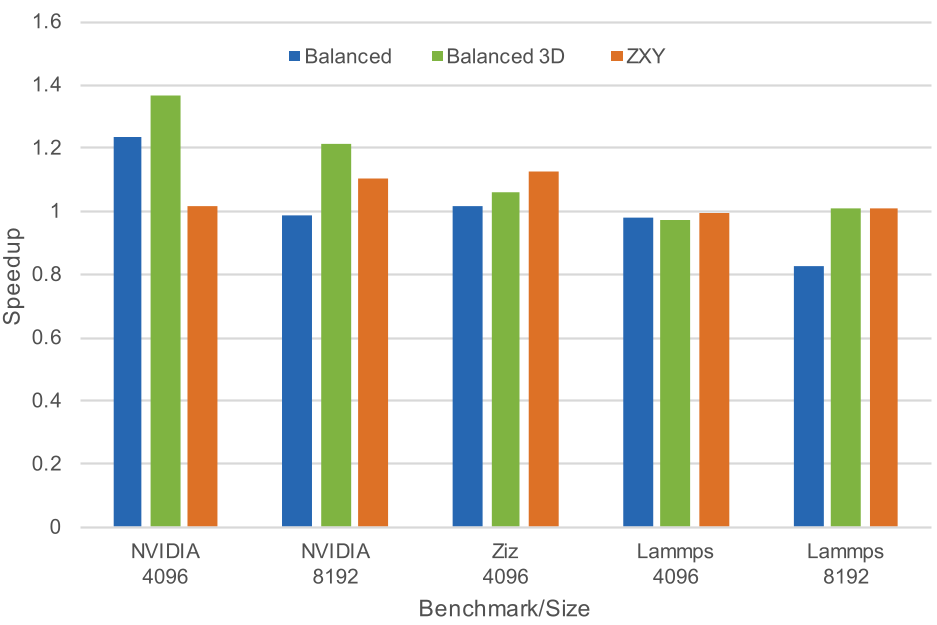 Figure: Performance improvements (speedup) across different layouts for large-scale jobs.
Critical Insight & Conclusion
The genius of this work lies in its operational pragmatism. Most academic placement papers suggest complex, computationally expensive algorithms that would cripple a production scheduler. By simply changing the direction of allocation and the sorting of the node list, these researchers achieved SOTA-level improvements with nearly zero overhead.
Future Outlook: As we move toward Exascale (Frontier, Aurora), the lessons here remain vital: topology matters. As interconnects become more complex (e.g., Slingshot's Dragonfly topology), the need for "layout-aware" scheduling will only grow.
Takeaway: If you want to scale, stop treating your supercomputer as a "bag of nodes" and start treating it as a physical 3D entity.