
Predicting Friendships in LBSNs: Why Your Evening Movement Matters More Than Your Resume
Using multi-features to recommend friends on location-based social networks
The paper introduces a multi-feature friendship recommendation framework for Location-Based Social Networks (LBSNs). By integrating social relationship similarity, temporal-spatial check-in distance, and check-in type semantics into an SVM classifier, it achieves high-accuracy friendship prediction on the Gowalla and Brightkite datasets.
TL;DR
Researchers have developed a multi-feature friendship recommendation system that combines social graph topology, time-sensitive geographic distance, and check-in semantic "types." By using an SVM-based classifier, the model achieves over 93% precision, demonstrating that friendships are best predicted by looking at how people move during their leisure time rather than their work hours.
The Core Motivation: Moving Beyond Simple Proximity
In the world of Location-Based Social Networks (LBSNs) like Foursquare or Gowalla, predicting who will become friends is a high-stakes task for user retention and targeted advertising. However, the data is notoriously sparse and unbalanced.
The authors observed that existing methods were too simplistic. Some looked only at geographic distance (the "you are near me, so we are friends" fallacy), while others looked only at common neighbors in a social graph. This paper argues that context is king: a common check-in at a workplace is a weak social signal, while a shared interest in specific "types" of locations (like niche cafes or gyms) combined with evening proximity is a much stronger predictor of a real-world bond.
Methodology: The "Weighted" Social and Temporal Insight
1. Re-thinking Social Similarity
Instead of using the standard Jaccard Coefficient or Adamic-Adar index, which treat all neighbors equally, the authors proposed a weighted similarity metric. They categorized edges into four types based on their proximity to the target users (e.g., edges between two common neighbors vs. edges to other strangers).
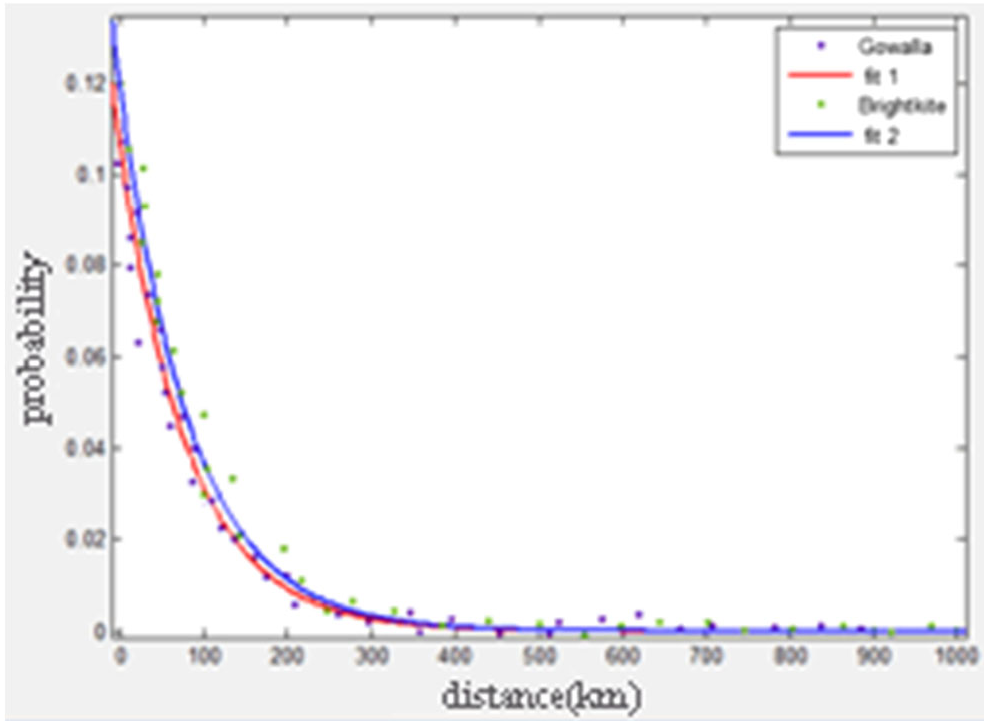 Figure: The hierarchical relationship of common neighbors used to calculate weighted similarity.
2. The Power of Temporal Filtering
One of the most profound insights in the paper is the Information Gain (IG) analysis of time periods. The researchers divided the day into morning, noon, afternoon, and evening. They found that mobility data from noon and evening yielded higher AUC (Area Under Curve) values than data from the entire day.
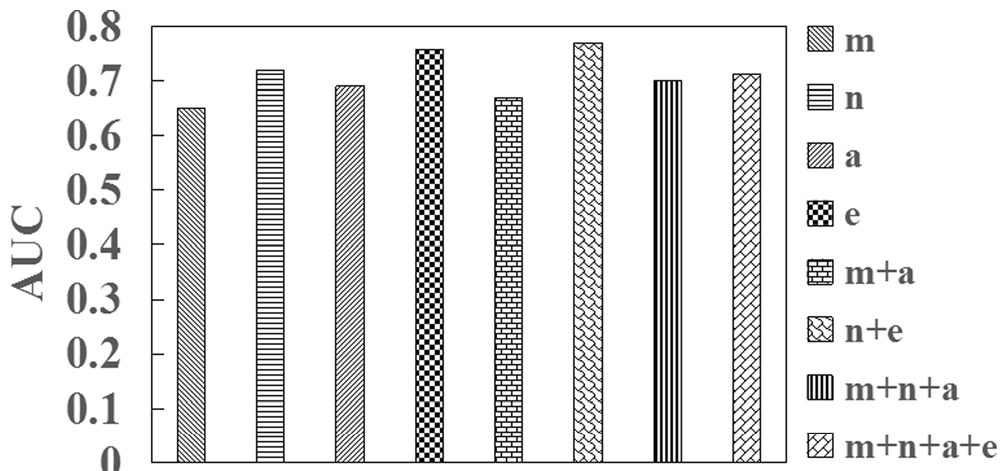 Figure: Performance comparison across different time slots—proving leisure time is the best social indicator.
Experimental Results: SOTA Comparison
The model was tested on the massive Gowalla (6.4M check-ins) and Brightkite (4.5M check-ins) datasets.
- The Multi-Feature Edge: Combining all three features (Social + Distance + Type) outperformed any single feature.
- Precision and Recall: On Gowalla, the fusion of features using "noon + evening" data hit a Precision of 0.931 and an F1-score of 0.889.
- Simplicity vs. Performance: While some complex models like Random Forests can reach slightly higher precision, the SVM approach here is computationally simpler and highly effective for real-time recommendation.
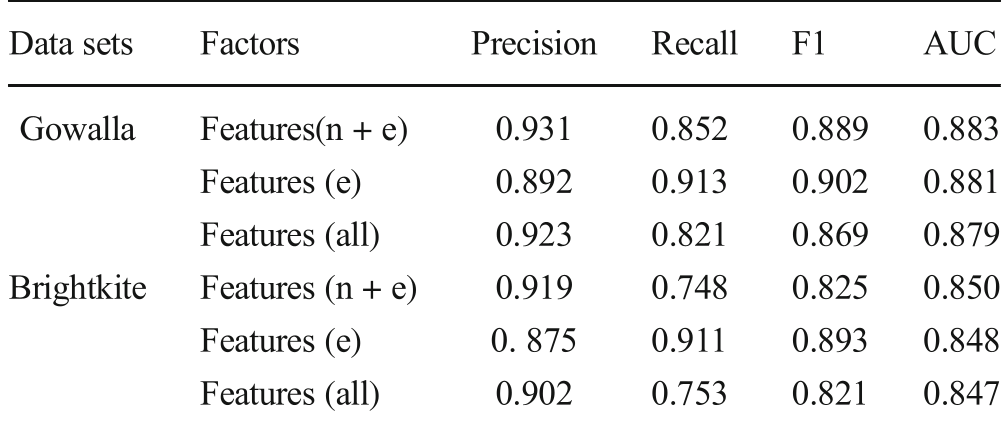 Table: Results showing the superiority of the "n + e" (noon and evening) fusion model.
Critical Analysis & Professional Takeaway
The paper successfully proves that semantic interest (Check-in Type) and temporal context are just as important as physical location. From a technical perspective, the use of Location Information Entropy to filter out "noisy" public locations (like transit hubs) is a brilliant way to clean LBSN data before it hits the classifier.
The Takeaway for Developers: When building social discovery features, don't just look for "nearby" users. Look for users who share niche interests and frequent similar locations during their non-work hours. This "leisure-time overlap" is the true signature of human friendship.
Future Outlook
While SVM provides a solid baseline, the future of this field lies in Deep Trajectory Modeling. The authors suggest that the next step is incorporating mobile datasets to find even more "latent" information, such as movement velocity or specific travel routes, to further refine the quality of LBSN recommendations.