
Beyond Monolithic Socializing: Why Multi-Group Perceptions Capture the True Logic of Friendship
Multi-group-based User Perceptions for Friend Recommendation in Social Networks
The paper proposes a multi-group-based friend recommendation method that utilizes the Markov Clustering Algorithm (MCL) to segment a user's social circle and the Niched Pareto Genetic Algorithm (NPGA) to discover distinct "social genomes" (perceptions) for each group. This approach achieves a significant boost in recommendation accuracy on real-world Facebook data compared to single-perception models.
TL;DR
Human friendship isn't governed by a single rulebook. We look for different traits in a gym buddy than we do in a professional colleague. This paper introduces a recommendation framework that recognizes this "multi-faceted perception" by clustering a user's existing friends and using genetic algorithms to decode the "social genome" of each group. The result? A massive jump in recommendation precision from 35.8% to 63.5%.
The Problem: The One-Size-Fits-All Fallacy
Most recommendation systems (like the classic "Friends-of-Friends" seen on LinkedIn or Facebook) treat your social preferences as a single, static profile. They assume that if you value "shared education," you apply that filter to everyone.
The authors argue this is fundamentally flawed. In the real world, human interaction is modular. We have different "perceptions" depending on the context of the group. Prior work that relied on a single "social genome" to represent a user's preference failed to capture why a user might belong to a "Sports Association" (valuing health/interests) while simultaneously belonging to a "Neighborhood" group (valuing location).
Methodology: Decoding the Social Genome
The proposed method follows a sophisticated three-stage pipeline to bridge the gap between network topology and human cognition.
1. Group Detection (Clustering)
The system first analyzes a user’s current local network. Using the Markov Clustering Algorithm (MCL), it identifies dense clusters where friends are more connected to each other than to the rest of the network. This provides the "context" for specific friend groups.
2. Multi-Objective Perception Discovery
For each detected group, the algorithm extracts a Social Genome—a binary vector representing eight key features:
- Shared Friends, Location, Age Range, Gender, General Interests, Education, Work, and General Groups.
To find the most representative genome for a group, the authors use the Niched Pareto Genetic Algorithm (NPGA). They treat this as a multi-objective optimization problem:
- Maximize the number of active genes (specific features).
- Maximize the number of group members who share those genes.
 Fig 1: The logic flow for generating filtered recommendations based on group-specific perceptions.
3. The Recommendation Filter
Finally, the system identifies "Friends-of-Friends" within each specific group and compares their genomes to that group's representative "perception." Only those who match the specific criteria of that specific sub-group are shortlisted for recommendation.
Experimental Results: A Performance Leap
The authors tested their method against a single-perception baseline on a dataset of over 13,000 Facebook nodes.
| Metric | Method A (Single Perception) | Method B (Multi-Group) |
|---|---|---|
| Average Precision | 35.85% | 63.53% |
The performance gain is not just a marginal improvement; it is a paradigm shift. By simply acknowledging that a user has multiple social "modes," the accuracy of predicting missed friends nearly doubled.
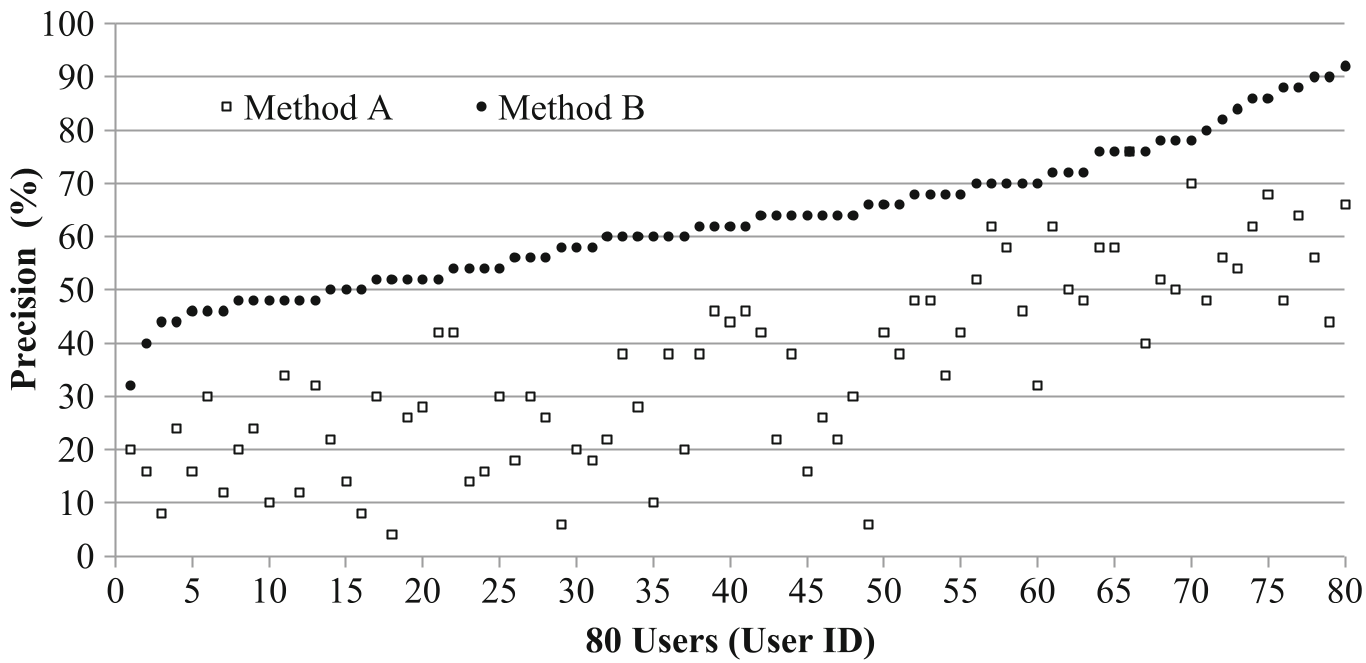 Fig 2: Per-user precision comparison. Method B (blue/top) consistently outperforms Method A (red/bottom) across all test subjects.
Critical Analysis & Conclusion
Takeaway
The paper effectively proves that granularity matters. The success of Method B suggests that user behavior in social networks is highly localized. Recommendations shouldn't just be about "who" you might know, but "which part of your life" the person would fit into.
Limitations & Future Work
Despite the strong results, the system faces two main hurdles:
- Data Integrity: If users hide their profiles (Education, Work, etc.), the Social Genome cannot be constructed accurately.
- The Cold Start Problem: For new users with very few friends, MCL cannot detect clusters, rendering the multi-group approach ineffective until the user manually builds a baseline network.
In the future, integrating this multi-perception logic with Deep Graph Embeddings could likely mitigate some of the data sparsity issues while maintaining the contextual intelligence demonstrated here.