
Multi-Hop Cooperative Caching: Bridging Social Ties and Physical Constraints in Social IoT
Multi-Hop Cooperative Caching in Social IoT Using Matching Theory
This paper proposes a <strong>Multi-Hop Cooperative Coded Caching</strong> framework for Social IoT (SIoT). It leverages erasure coding and multi-hop D2D communication to maximize the content sharing success rate, achieving near-optimal performance using a distributed <strong>Roth and Vande Vate (RVV)</strong> matching algorithm.
TL;DR
In the evolving landscape of the Social Internet of Things (SIoT), data congestion is a critical bottleneck. This paper introduces a distributed coded caching strategy that allows smart devices to share content via multi-hop paths. By combining erasure coding (for reliability) with matching theory (for social intelligence), the authors achieve high content delivery success rates with significantly lower computational overhead than traditional centralized methods.
Context: Why Social IoT Needs More Than Just "Physics"
Modern IoT devices aren't just sensors; they are mobile, social, and resource-constrained. Traditional D2D (Device-to-Device) caching often fails because:
- Mobility: Devices move out of range, breaking the "one-hop" connection.
- Selfishness: Without social incentives, a stranger's device might not want to act as a relay.
- Reliability: A single node failure in an uncoded system leads to total data loss.
The authors argue that by viewing IoT as a Social Network of Objects, we can use "social ties" (contact duration and history) as an indicator of reliability and willingness to cooperate.
Methodology: The Core Engine
The framework operates on two primary processes: Content Download and Content Repair.
1. Erasure Coding
Instead of storing whole files, content is fragmented. A requester needs fragments to recover a file, and a repair process requires fragments to restore a lost node. This provides a "redundancy-reliability" tradeoff that is far more efficient than simple replication.
2. Multi-Hop Connectivity
Breaking the "one-hop" barrier, this paper allows up to hops. This effectively increases the "reachable cache size" for any given user, particularly those in sparse regions of the network.
3. The Stable Matching Algorithm (RVV)
Instead of a "top-down" Master-Slave assignment, the authors use the Roth and Vande Vate (RVV) algorithm.
- Producers & Consumers: Content Helpers (CHs) and Requesters (CRs) form preference lists.
- Social Preference: CHs prefer serving nodes with stronger social ties.
- Link Preference: CRs prefer CHs that provide the highest physical link success probability.
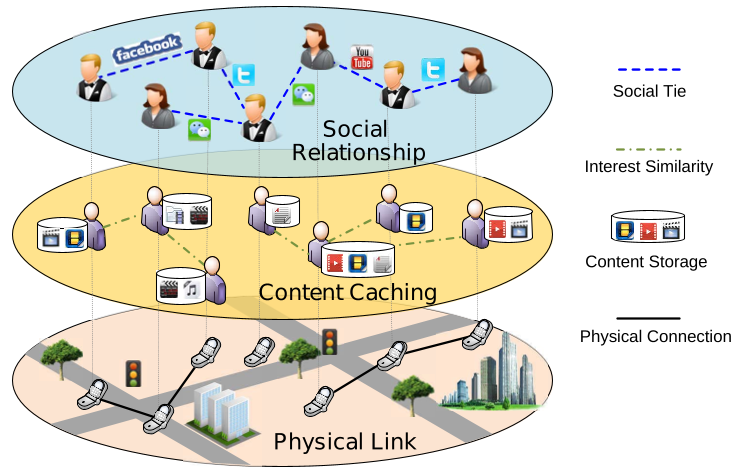 Fig 1: The layered architecture of Physical, Social, and Caching domains.
Experimental Insights
The research confirms several technical intuitions while providing surprising data on complexity:
- The Multi-Hop Sweet Spot: As shown in the simulation, increasing hops from 1 to 3 significantly improves success probability. Beyond 3 hops, the gain saturates while latency and energy consumption rise.
- Efficiency vs. Optimality: The centralized KM (Kuhn-Munkres) algorithm provides the "mathematical best" assignment but is computationally expensive. The distributed RVV algorithm achieves nearly the same success rate but completes the task in a fraction of the time.
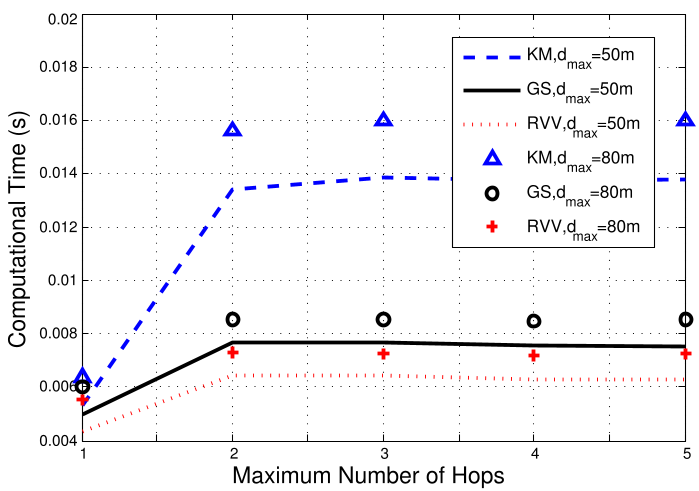 Fig 2: Comparison of success rates across different matching algorithms.
Deep Insight: Why matching theory?
The brilliance of using matching theory (specifically RVV) in a dynamic IoT environment is Stability. In a mobile network, nodes are constantly entering and leaving. A centralized algorithm must re-calculate everything from scratch every few seconds. In contrast, RVV can start from the current matching and only adjust "blocking pairs" (nodes that are unhappy with their current partners), drastically reducing the "flutter" in network resource allocation.
Conclusion & Future Outlook
This paper provides a robust blueprint for 5G and 6G edge caching. By treating social relationships as a first-class citizen in the communication stack, it transforms IoT from a collection of isolated sensors into a cooperative, self-healing swarm.
Future Directions: Extending this to Multi-modal content (video vs. text) and integrating Energy Harvesting constraints would be the logical next steps for this research lineage.