
Mining Multi-layer Social Networks: A Multi-objective Latent Variable Approach
15483_Multi-Layer Graph Analysis for Dynamic Social Netw
This paper introduces a hierarchical latent variable model for multi-layer network analysis, specifically targeting dynamic social networks. By leveraging Bayesian Model Averaging and multi-objective optimization, the authors propose a method to infer a common latent connectivity structure (represented by a similarity matrix ) from heterogeneous layers, achieving state-of-the-art results in noisy community detection.
TL;DR
The paper presents a unified framework for analyzing multi-layer graphs—networks where the same set of users are connected through various interactions (e.g., email patterns vs. shared interests). By modeling the underlying network as a latent variable and applying multi-objective optimization principles, the authors show how to filter noise and synchronize data across layers to reveal hidden community dynamics, specifically demonstrated on the ENRON corpus.
Background & Motivation: Beyond the Single Layer
Traditional social network analysis often treats connectivity as a single, static graph. However, real-world interactions are multifaceted. For instance, in a corporate environment, who you must email (relational layer) is different from who you share interests with (behavioral layer).
The core challenge is that these layers are often "noisy reflections" of a true underlying social structure. Simply combining them or treating them as independent loses the nuanced semantic relationships between them. The authors' insight is to treat the estimation of the "true" network as a problem of balancing competing objectives from different data sources.
Methodology: The Hierarchical Latent Variable Model
The authors propose a model where the observed layers () are conditionally independent given a latent selection variable and a shared similarity matrix .
1. The Probabilistic Framework
Instead of forcing a single average, they use Bayesian Model Averaging. This allows the posterior probability of the latent structure to be expressed as a weighted sum of the marginalized posteriors of each layer:
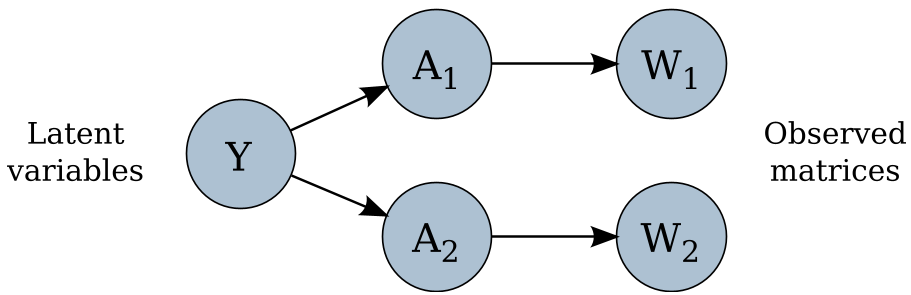 Fig 1. The graphical model showing how latent structure W and selection Z generate observed layers.
2. Multi-Objective Optimization & Pareto Frontiers
When the relative "trust" in a layer () is unknown, the problem shifts from standard MAP estimation to Multi-objective Optimization. The authors argue that the best estimate lies on a Pareto front—a set of solutions where one layer's likelihood cannot be improved without decreasing another's. This is crucial for non-convex cases where simple linear weighted averages might miss the most informative latent structures.
Temporal Analysis with Dynamic SBM
To handle networks that change over time, the authors integrate their multi-layer approach with the Dynamic Stochastic Block Model (DSBM). Using an Extended Kalman Filter (EKF), they track the probability of edges between groups (e.g., CEOs talking to Directors) across 120 weeks.
Experiments and Real-World Results
The framework was tested on the infamous ENRON email dataset. They extracted two layers:
- Relational: Direct email headers (Sender/Recipient).
- Behavioral: Content-based similarity using TF-IDF scores.
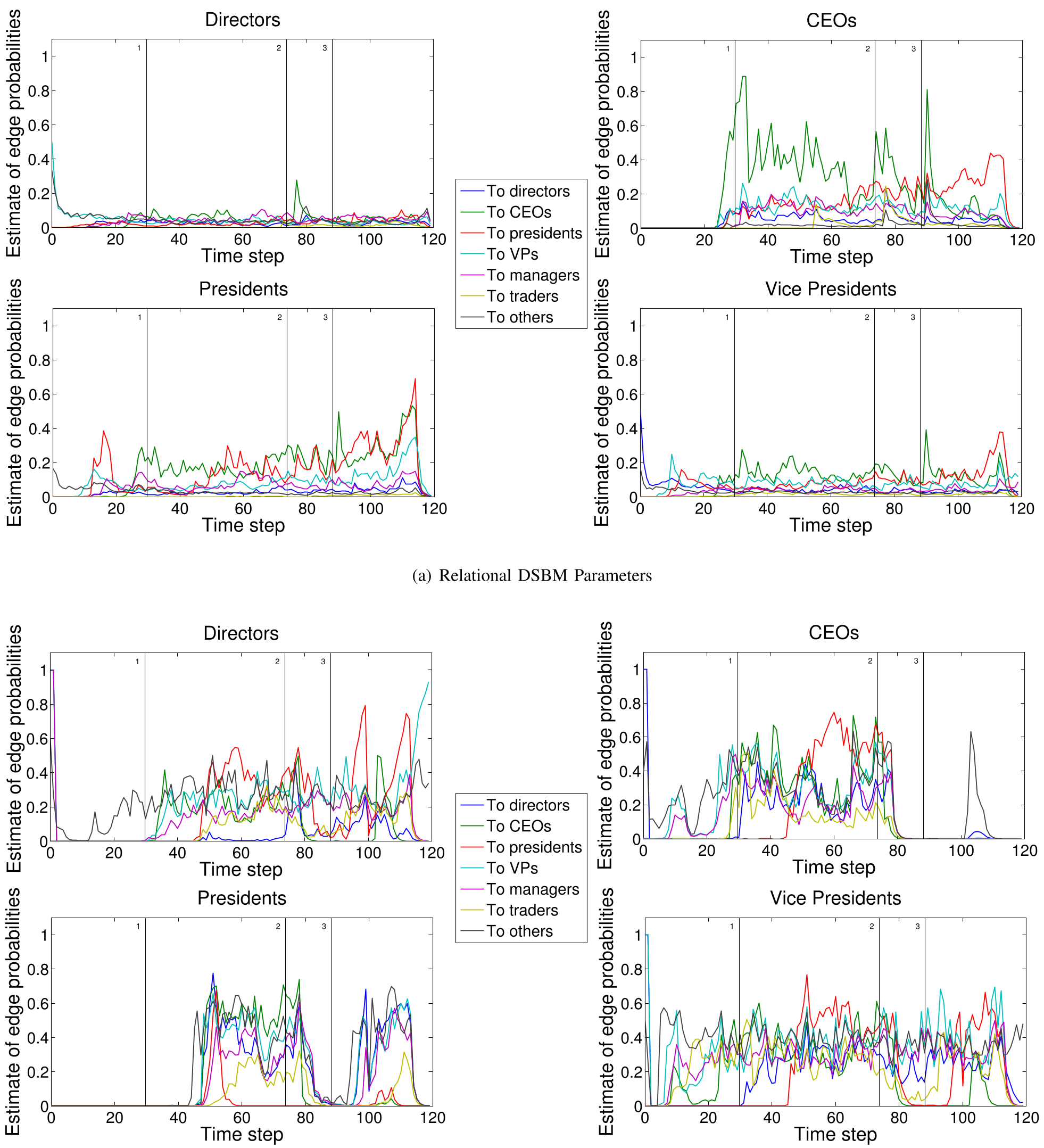 Fig 2. Contrasting behavioral vs. relational dynamics in the ENRON organization over time.
Key Findings:
- Noise Reduction: In synthetic tests, the multi-layer approach yielded significantly higher Adjusted Rand Index (ARI) scores in clustering tasks than single-layer models.
- Anomaly Detection: The model detected that during ENRON's demise, CEOs showed high relational activity (emailing others in "petition-like" bursts) but low behavioral similarity (content of outgoing emails was distinct or minimal), suggesting a divergence in "what they did" vs "who they were speaking to."
- Centrality Shifts: Betweenness centrality for the Directors group spiked during the corporate upheaval only when both layers were considered, revealing their role as a "conduit" of information that a single layer would have obscured.
Critical Insight & Conclusion
The true value of this work lies in its move away from "noisy averaging" toward "informed scalarization." By framing multi-layer inference as a multi-objective problem, it provides a mathematically rigorous way to handle the "apples and oranges" problem of different data types in a network.
While the Gaussian assumptions in the simulations are a simplification, the framework's adaptability to Pareto ranking offers a powerful tool for researchers who need to explore complex, multi-view social data without pre-judging which view is "correct."
Limitations
- Computational Complexity: Finding the full Pareto front for large-scale graphs remains a challenge.
- Binary Thresholding: The conversion of TF-IDF scores to binary edges (top 15%) is somewhat arbitrary and may lose information contained in the weights.