
Multi-Layer Graph Fusion: Beyond Simple Averaging in Social Network Analysis
15983_Multi-Layer Graph Analysis for Dynamic Social Netw
The paper introduces a hierarchical latent-variable model for multi-layer network analysis, integrating disparate connectivity sources like relational communication and behavioral similarity. By leveraging Bayesian Model Averaging and Pareto optimality, it enables joint inference and community detection, achieving superior clustering performance in noisy environments compared to single-layer methods.
TL;DR
Social networks are rarely one-dimensional. A single view (like "who emails whom") often hides the underlying behavioral truth (like "who shares interests"). This paper proposes a rigorous hierarchical latent-variable model to fuse these "relational" and "behavioral" layers. By treating network inference as a multi-objective optimization problem, the authors demonstrate that combining layers improves clustering accuracy and uncovers temporal patterns in the infamous Enron dataset that single-layer analysis would overlook.
Problem & Motivation: The Multi-Layer Latent Dilemma
In a world of heterogeneous data, a user might interact with another via direct messages (Relational Layer) while simultaneously sharing similar content consumption habits (Behavioral Layer). Existing methods usually pick the "best" layer or average them, but this is mathematically naive. The core difficulty lies in noise and dependency: how do we know which layer to trust when they disagree? If Layer A says two nodes are connected but Layer B says they aren't, is it noise, or is it a "multi-faceted" relationship?
Methodology: Decoupling and the Pareto Front
The authors solve this by introducing a latent variable (comprising a similarity matrix and a selector ) that acts as a bridge.
1. The Generative Hierarchical Model
By assuming that observed layers and are conditionally independent given the latent structure and the selector , the complex joint posterior can be simplified into a weighted mixture: This formulation allows for a "confidence" parameter to weight layers based on their perceived reliability.
2. ARCHITECTURE OVERVIEW
The following diagram illustrates the relationship between the observed noisy layers (), the true connectivity (), and the latent summary variable ().
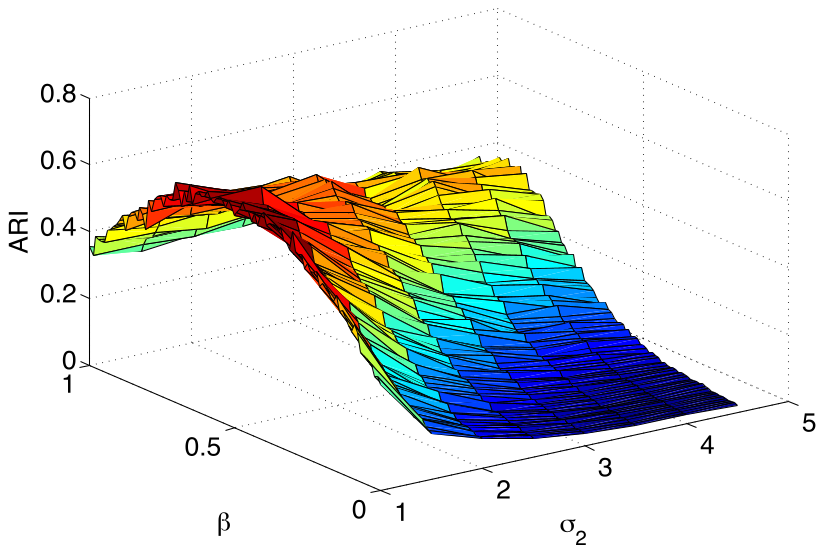 Fig. 3: The Latent Selection Variable Model where chooses between alternate views and .
3. Pareto Optimality in Graph Inference
The authors take the insight further: instead of just a single "best" answer (scalarization), they treat the inference as a Multi-objective Optimization problem. By finding the Pareto Front—the set of solutions where one layer's likelihood cannot be improved without hurting the other's—they allow for a more nuanced exploration of the network's structure, especially when distributions are non-convex.
Experiments & Results: The Enron Autopsy
The framework was tested on the Enron email corpus, splitting the data into a Relational Layer (who sent emails to whom) and a Behavioral Layer (similarly-themed emails via TF-IDF scores).
Key Findings:
- Clustering Gains: In simulated environments, the mixture model consistently outperformed single-layer spectral clustering.
- CEO Behavior: In the Enron data, the Relational Layer showed high activity among CEOs during the "Code of Ethics" release, while the Behavioral Layer remained silent. This suggests CEOs were communicating about the event without necessarily using the same language as their subordinates (or simply forwarding emails without comment).
- Betweenness Centrality: By fusing layers, the authors identified a spike in the "Director" group's centrality during the company's collapse, a sign that they became critical conduits of information as the hierarchy began to fail.
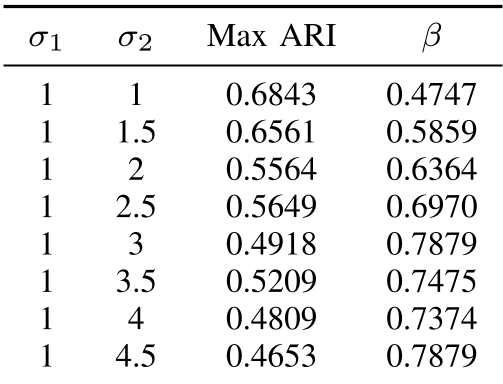 Table: Max ARI scores across different noise levels, showing optimal weights for layer mixing.
Critical Analysis & Conclusion
This work represents a vital bridge between Bayesian statistics and traditional social network analysis. Its strength lies in its flexibility—it doesn't assume layers are identical, but rather that they are noisy reflections of a shared latent core.
Limitations:
- Slight Supervison: Selecting the (mixing) parameter still requires semi-manual tuning or domain knowledge.
- Binary Constraint: While the model works for weighted graphs, the DSBM application required thresholding to binary states, potentially losing fine-grained signal.
Future Outlook:
The shift towards Pareto summarization is the most promising takeaway. As social networks become increasingly multi-modal (text, video, transaction logs), the ability to navigate a "front" of possible network structures rather than a single average will be essential for high-fidelity anomaly detection and organizational behavioral analysis.
Final Takeaway: Don't just average your data; identify the latent selectors that govern how different "views" of your graph interact.