
Multi-Dimensional Social Graphs: The Secret to Energy-Efficient Mobile Crowdsourcing
Multi-layer-based opportunistic data collection in mobile crowdsourcing networks
This paper introduces MLODC and EEMLODC, novel opportunistic data collection methods for mobile crowdsourcing networks. By leveraging multi-layer social graphs (encounter history, communication, friendship, and interests), the authors achieve SOTA delivery ratios and energy efficiency in intermittent connectivity environments.
TL;DR
Researchers have developed a new way to collect data from mobile crowds without relying on expensive cellular towers. By mapping nodes across four layers of "social reality"—including real-world encounters, digital communication, social media friendships, and shared interests—the proposed MLODC and EEMLODC algorithms achieve high data delivery rates with minimal battery drain.
Background: The Infrastructure Bottleneck
Mobile crowdsourcing (collecting sensor data from smartphones) usually funnels everything through base stations. This creates a bottleneck: it’s expensive, kills battery life, and fails in disaster zones. Opportunistic networks (D2D) offer a "store-carry-forward" alternative, but existing routing algorithms are often "blind"—they don't fully understand why certain people are better data carriers than others.
The Innovation: Multi-Layer Social Awareness
The core insight of this paper is that human connection isn't one-dimensional. A person you sit next to on the bus (encounter) is different from a person you message (communication) or share a hobby with (interest).
1. The Four Layers of Connection
The authors construct four distinct graph layers:
- Encounter Layer: Based on physical proximity history.
- Communication Layer: Based on actual data exchange events.
- Social Relationship Layer: Derived from Facebook friendships and mutual connections.
- Interest Set Layer: Calculated using the Jaccard similarity of nodal interests.
2. Extracting "Centrality" and "Similarity"
For each layer, the system calculates:
- Activity (Degree): How many connections does a node have?
- Importance (Betweenness): How many shortest paths pass through this node?
- Similarity: How many mutual friends does the carrier share with the destination?
Methodology: Weight Training & Energy Efficiency
Not all social layers are equally useful. The authors use a Heuristic Weight Training method (Algorithm 3) that uses "virtual messages" to verify decisions. If a layer’s metric correctly predicts a successful forward, its weight increases.
To save energy, the EEMLODC variant introduces an amp_ratio. Instead of forwarding to any slightly better node, it only forwards if the target is significantly better (e.g., better). This threshold dynamically lowers as the message’s Time-to-Live (TTL) runs out, ensuring a balance between "waiting for the best carrier" and "desperation to deliver."
Experimental Results
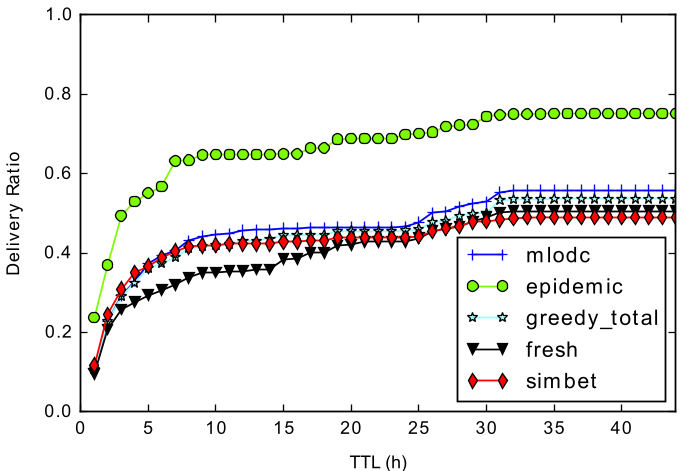
Using the SigComm2009 dataset, the authors compared their work against the classic Epidemic (flooding) and SimBet (social) algorithms.
- Delivery Ratio: MLODC/EEMLODC outperformed SimBet consistently as message TTL increased.
- Energy & Load: EEMLODC showed a "drastic drop" in network load. While Epidemic creates massive overhead, EEMLODC kept the average hops to roughly 2, preventing "active nodes" from dying early due to battery exhaustion.
Critical Analysis & Conclusion
Takeaway: This paper proves that "Social-Awareness" in networking shouldn't just be about who you met recently. By weighting digital interests and social graphs, we can predict movement and contact more accurately than location-based tracking.
Limitations: The algorithm requires nodes to share some social metadata (like interest sets), which raises privacy concerns. Future work would need to address how to calculate these weights in a privacy-preserving or encrypted manner.
Final Thought: For 5G/6G edge computing and disaster recovery, the EEMLODC approach provides a blueprint for how devices can autonomously form "intelligent swarms" to move data without ever touching a cell tower.