
Beyond Lurkers and Contributors: Multi-level Social Role Modeling in Micro-lending
15094_Multi-level Modeling of Social Roles in Online Micro-lending Platforms.
This paper presents a multi-level Gaussian Mixture Model (GMM) framework to identify social roles in Kiva.org, a peer-to-peer micro-lending platform. By analyzing 502,752 users across individual behaviors, topical interests, and team interactions, the authors discover distinct role structures—including 3 individual, 7 topical, and 8 team-oriented roles—and demonstrate that specific team role compositions significantly predict lending success.
TL;DR
Researchers from Carnegie Mellon and Georgia Tech have move beyond the simplistic "lurker vs. contributor" binary in online communities. By applying multi-level Gaussian Mixture Models to Kiva.org, they've mapped a complex ecosystem of social roles at the individual, topical, and team levels. Their findings reveal that team success isn't just about size; it's about the right mix of "Competitors," "Reminders," and "Encouragers."
Background: The Complexity of Online Contribution
Online micro-lending platforms like Kiva.org face a significant retention challenge: 86% of lenders contribute only once. To combat this, Kiva introduced "lending teams." While we know teams increase engagement, we haven't fully understood how the specific social roles members play—ranging from leaders to followers—influence a team's collective financial output.
Problem & Motivation: The Macro-Level Blind Spot
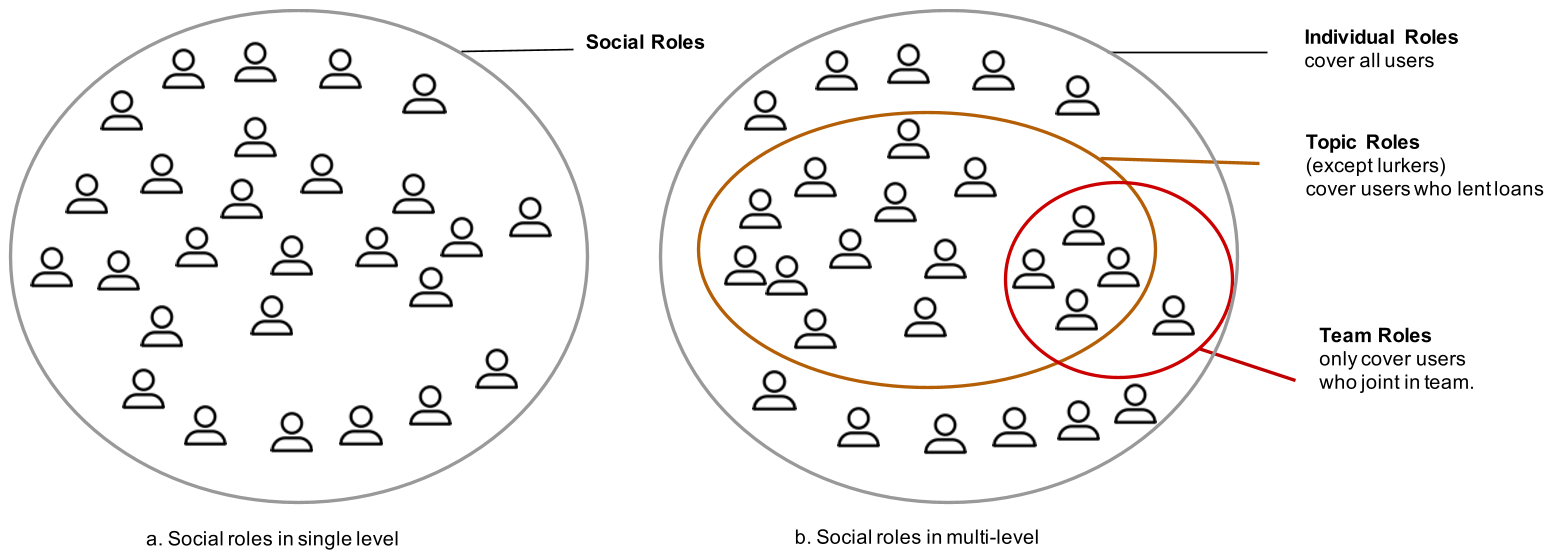
Prior research in CSCW (Computer-Supported Cooperative Work) often treats communities as monolithic entities. If you only look at the macro level, you see a flat structure. However, a user acts differently when browsing loans (Individual Level) compared to how they interact in a specialized forum (Team Level). The authors argue that to truly understand community dynamics, we must model roles at multiple granularities.
Methodology: The Multi-level GMM Framework
The core of this study is the Gaussian Mixture Model (GMM). Unlike K-means, which forces a user into one cluster, GMM allows for "soft clustering"—acknowledging that a user can be 70% a "Remover" and 30% an "Encourager."
The Three Levels of Analysis:
- Individual Level: Focused on 502,752 users. Features included loan count, team count, and "time to deadline" (behavioral signatures).
- Topical Level: Focused on 403,984 lenders. Features used 15 loan categories (e.g., Agriculture, Education) and geographical entropy.
- Team Level: Focused on 28,535 team-active users. Features involved social network centrality, linguistic cues (via LIWC), and persuasive tactics.
Experiments & Results: What Makes a Team Successful?
The authors identified eight distinct team roles. To validate them, they used a clever "intruder" test where human judges had to identify which role label did not fit a user's behavior.
Key Role Discoveries:
- The Competitor: Uses positive and competitive language to boost team ranking.
- The Reminder: Focuses on loan scarcity and upcoming deadlines.
- The Networker: The "hub" of the team, greeting others and building social ties.
The Impact on the Bottom Line:
Using linear regression, the study analyzed which roles actually drove money to borrowers.

Core Findings:
- Task-focused leadership wins: Teams with high concentrations of Reminders and Competitors lent significantly more money.
- The "Follower" Paradox: Interestingly, teams with more "Followers" (those who only lend when recommended) actually lent less total capital.
- Role Entropy: Teams with a more even distribution (higher entropy) of all eight roles were more successful. This suggests that a healthy "ecosystem" of roles is better than a team full of leaders.
Critical Analysis & Conclusion
Takeaway
This paper proves that social roles are not just descriptive tags; they are predictive of real-world outcomes (financial lending). For product designers, this suggests that recommendation engines shouldn't just suggest loans; they should suggest roles. A team lacking a "Welcomer" should be nudged to recruit one.
Limitations
- Correlational Nature: The study shows a link between role composition and success, but it doesn't prove that "adding a competitor" causes more lending.
- Subjectivity of Language: While LIWC and Empath are powerful, they may miss the nuance of a user's intent compared to manual annotation.
Future Outlook
The "intruder" validation method used here sets a new SOTA for evaluating unsupervised roles in social computing. Moving forward, applying this multi-level approach to platforms like Slack or Discord could redefine how we manage remote workforce productivity and community health.