
MCNN-TFW: Bridging Local Cues and Global Semantics for Fake News Detection
Multi-level word features based on CNN for fake news detection in cultural communication
The paper introduces MCNN-TFW, a fake news detection system specifically optimized for cultural communication. It combines a Multi-level Convolutional Neural Network (MCNN) for local and global feature extraction with a sensitive word weight calculation method (TFW) to achieve state-of-the-art accuracy on multiple benchmarks.
Executive Summary
TL;DR: In the era of information warfare, fake news in cultural communication mimics the truth with high precision. This paper presents MCNN-TFW, a framework that detects deception by combining a multi-level CNN architecture (capturing both local nuances and global themes) with a specialized weighting system for sensitive words (TFW).
Academic Positioning: This work enhances the standard text classification paradigm by introducing hierarchical consistency constraints. It shifts the focus from simple n-gram counts to a more sophisticated "Sensitivity-weighted Representation," marking a significant leap over baseline CNNs and linguistic tools like LIWC.
The Core Motivation: Why Textual Analysis Alone Fails
Detecting fake news is notoriously difficult because "truth" isn't just about keywords; it's about the intent hidden in the structure. Previous works relied on:
- Linguistic Cues (LIWC): Too rigid and hand-engineered.
- Standard CNNs: Heavy focus on local word patterns but often ignore the broader rhetorical context of an entire article.
- RST (Rhetorical Structure Theory): Theoretically sound but computationally unscalable for large social media datasets.
The authors observed that fake news often contains "sensitive words" that appear with specific statistical signatures. By identifying these and integrating them into a deep learning pipeline, the model can "listen" more closely to suspicious regions of a text.
Methodology: The MCNN-TFW Architecture
The architecture is a two-pronged attack on misinformation:
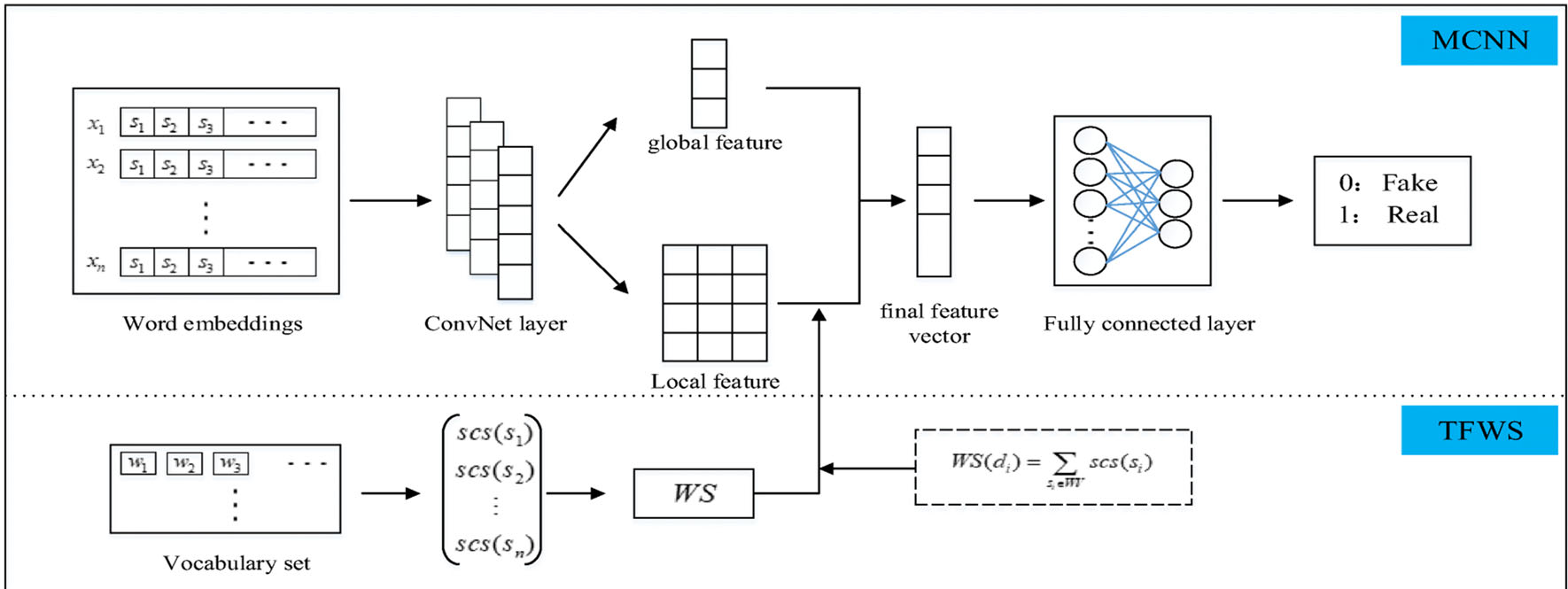
1. Multi-level CNN (MCNN)
Instead of treating an article as a flat sequence of words, MCNN uses a hierarchical approach:
- Word to Sentence: Word embeddings are condensed into sentence representations.
- Sentence to Article: Convolutional filters of varying sizes (3, 4, 5) slide over these representations.
- Dual Objectives: The model learns Local Convolutional features (capturing regional semantics/sensitive phrases) and Global Semantics features (capturing the article's overall gist) simultaneously.
2. TFW: The Sensitivity Metric
Drawing inspiration from TF-IDF, the authors developed the Sensitivity Coefficient (scs). A word is deemed sensitive if it appears frequently in fake news but rarely in real news across different categories. This allows the model to calculate a Weight of Sensitive Words (WS) for every news item, which then scales the neural features to emphasize deceptive signals.
Experimental Results & Performance
The researchers tested MCNN-TFW across five major datasets (LIAR, Weibo, Twitter15, etc.), focusing specifically on cultural communication.
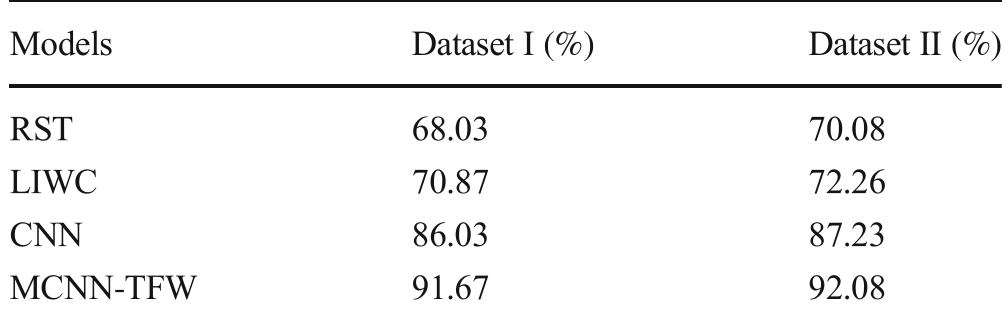
- Superior Accuracy: Reaching 92.08% accuracy, it significantly outperformed the standard CNN baseline (87.23%) and RST-based models (70.08%).
- High Stability: The model maintained high precision even when training data was reduced to 20%, showcasing the robustness of the TFW weighting system.
- Efficiency: Despite its multi-level nature, the total pipeline (vocabulary construction + training) takes only 9-11 minutes on standard GPU setups, making it highly scalable for real-time social media monitoring.
Critical Insight & Conclusion
The brilliance of MCNN-TFW lies in its Inductive Bias. By explicitly forcing the model to reconcile local word sensitivity with global article meaning, the authors created a system that is harder to "fool" with simple synonymous swaps.
Takeaway for the Industry: For AI-driven content moderation, the "Secret Sauce" isn't just larger models, but smarter feature weighting. Combining statistical "Sensitive Word" libraries with deep neural semantic extractors provides a pragmatic, explainable, and high-performance path forward.
Future Outlook: While highly effective for text, the next frontier for this model is multimodal fake news—applying similar multi-level convolutional logic to the relationship between suspicious text and its accompanying inflammatory imagery.