
CNN-BiLSTM Fusion: Bridging the Gap Between Brain and Voice for Emotion Recognition
Multi-Modal Emotion Recognition Based On deep Learning Of EEG And Audio Signals
This paper introduces a multi-modal emotion recognition framework that fuses raw EEG signals with audio signals using a hybrid CNN-BiLSTM architecture. By mapping 1D EEG data into 2D spatial frames and integrating Mel-frequency Cepstral Coefficients (MFCC) from audio, the model achieves state-of-the-art (SOTA) performance on the DEAP dataset.
TL;DR
Researchers from Tianjin University have developed a deep learning architecture that combines EEG (Electroencephalography) and Audio signals to decode human emotions. By leveraging a CNN for spatial brain-signal features and a BiLSTM for temporal audio features, the team achieved ~93% accuracy on both Valence and Arousal dimensions, setting a new benchmark for the DEAP dataset while reducing system latency to just 1 second.
Background & Motivation: Why Multi-Modal?
In the realm of affective computing, a single source of truth is often elusive. Voice can be masked by social performance, while EEG—the direct "readout" of the brain—is notoriously noisy. The authors identified a critical gap: existing models either rely on manual feature engineering (losing raw data nuances) or ignore the spatial relationships of EEG electrodes.
The core insight of this study is that internal physiological states and external behavioral expressions are complementary. By fusing them, the model can "verify" the intent of a voice signal against the reality of a brain signal.
Methodology: The Fusion Architecture
The proposed framework follows a refined two-pronged approach:
1. EEG Stream (Spatial Intelligence)
Instead of treating EEG as a simple time series, the authors reshaped the 32-channel data into a 9x9 2D matrix based on the actual physical locations of sensors on the scalp (the International 10-20 system). This allows a 2D CNN to apply spatial convolutions, effectively "seeing" the patterns of activation across different brain regions (e.g., frontal vs. parietal).
2. Audio Stream (Temporal Nuance)
Audio signals are processed into MFCCs (Mel-frequency Cepstral Coefficients) and fed into a Bidirectional LSTM (BiLSTM). This captures the prosody and emotional rhythm of speech from both past and future contexts within the window.
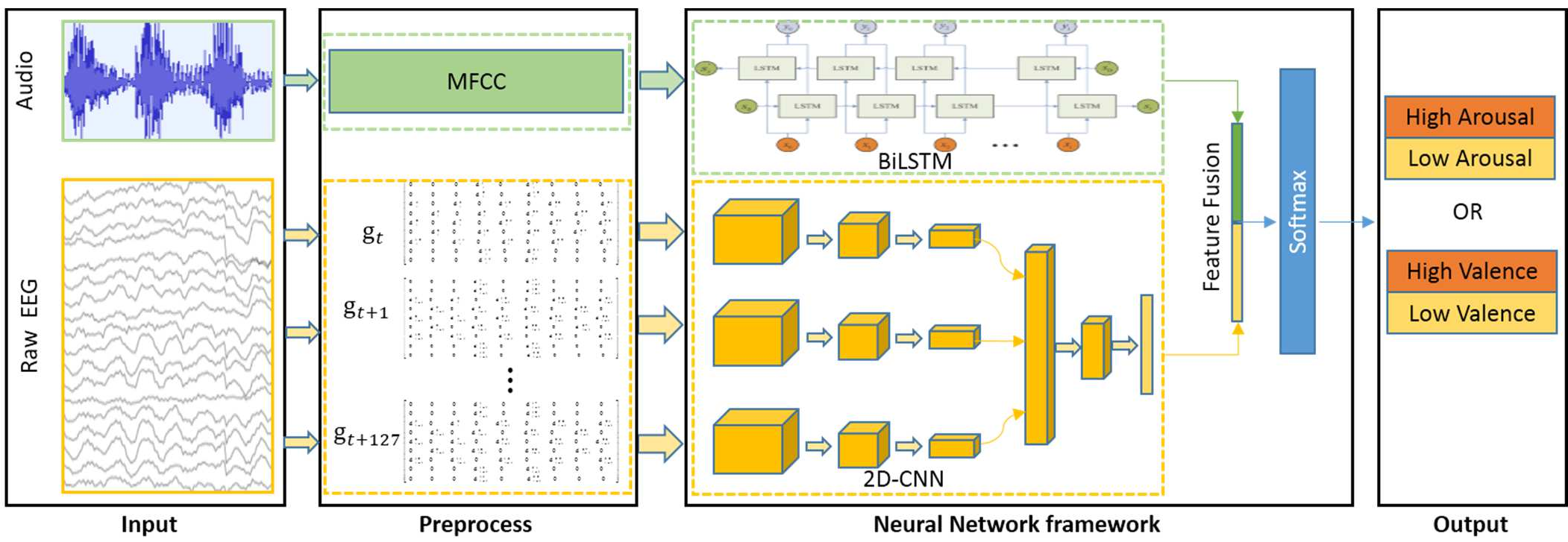 Fig. 1: The dual-stream CNN-BiLSTM architecture for multi-modal fusion.
Experiments & Breakthrough Results
The model was validated on the DEAP dataset, a gold standard in affective computing.
Key Findings:
- The Fusion Advantage: Multi-modal accuracy (~93%) significantly outperformed EEG-only (~90%) and Audio-only (~84%) models.
- Efficiency: The model uses a 1-second sliding window. Most previous high-performing models required 4 seconds of data, making this approach much more viable for real-time Human-Computer Interaction (HCI).
- Superiority Over SOTA: The model surpassed previous benchmarks including Deep Canonical Correlation Analysis (DCCA) and 3D CNNs.
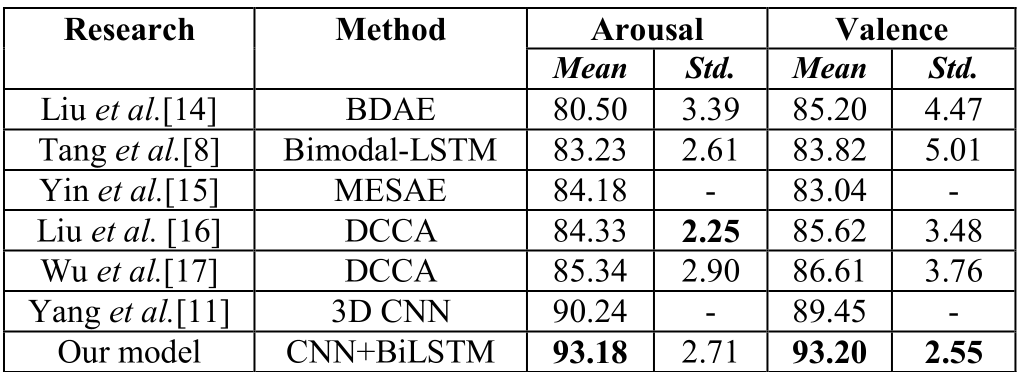 Table 1: Performance comparison showcasing the proposed model's dominance in both Arousal and Valence.
Critical Analysis & Future Outlook
What makes this work? The decision to process EEG and Audio separately before fusion is crucial. EEG is a multi-channel spatial signal, whereas audio is a single-channel temporal signal. Treating them as identical (e.g., feeding both into a standard LSTM) typically leads to sub-optimal results because the inductive bias of the network doesn't match the signal's physics.
Limitations & Future Directions: While the results are impressive, the authors note that the DEAP dataset is a controlled lab environment. The next frontier is In-the-Wild Recognition. In real-world scenarios, audio has background noise and EEG equipment is prone to motion artifacts. Future iterations will likely need to incorporate "attention mechanisms" to dynamically weight which modality is more reliable at any given moment.
Conclusion
This research underscores a pivotal shift in BCI: moving away from manual "feature hacking" toward architectures that respect the spatial-temporal topology of the human body. Whether for personalized gaming experiences or diagnosing clinical depression, the fusion of brain and voice remains one of the most promising paths to truly empathetic AI.