
mmETM: Bridging the Gap Between Visual and Abstract Semantics in Social Event Tracking
13159_Multi-Modal Event Topic Model for Social Event Analysis.
This paper introduces a multi-modal Event Topic Model (mmETM) and an incremental learning framework for social event tracking and evolution analysis. By separating topics into visual-representative and non-visual-representative categories, the model achieves state-of-the-art performance in tracking multi-modal social media documents across time.
Executive Summary
TL;DR: The multi-modal Event Topic Model (mmETM) is a generative framework designed to track social events by intelligently separating "visual-representative" topics (like "Obama") from "non-visual-representative" ones (like "Economy"). By moving beyond the rigid constraints of previous multi-modal LDA variants and employing an incremental learning strategy, it achieves a 0.74 MAP in multi-event tracking and superior efficiency in modeling event evolution over time.
Background: Within the academic landscape, this work marks a significant shift from "simple feature fusion" to "structural modality modeling." It addresses the inherent asymmetry in multi-modal social media data—where text is often richer and more abstract than accompanying images.
The "One-to-One" Fallacy: Why Previous Methods Failed
Before mmETM, standard models like Corr-LDA and mm-LDA operated under a heavy assumption: every topic mentioned in the text must have a corresponding visual representation in the image.
While this works for "tagged photos" (e.g., a photo of a dog tagged "dog"), it fails miserably for complex social events. In a news report about the "Greek Protests," the text might discuss "austerity measures" or "inflation"—concepts that are non-visual. Forcing these abstract terms into a visual topic space creates noise, leading to poor clustering and inaccurate event tracking.
Methodology: The Power of the Binary Switch
The core innovation of mmETM lies in its generative process. It introduces a latent binary variable that acts as a gatekeeper:
- Visual-Representative Space (): Topics shared by both modalities. Here, textual words and image patches are generated from the same document-topic distribution.
- Non-Visual-Representative Space (): A text-only space for abstract concepts that lack clear visual counterparts.
Architecture Overview
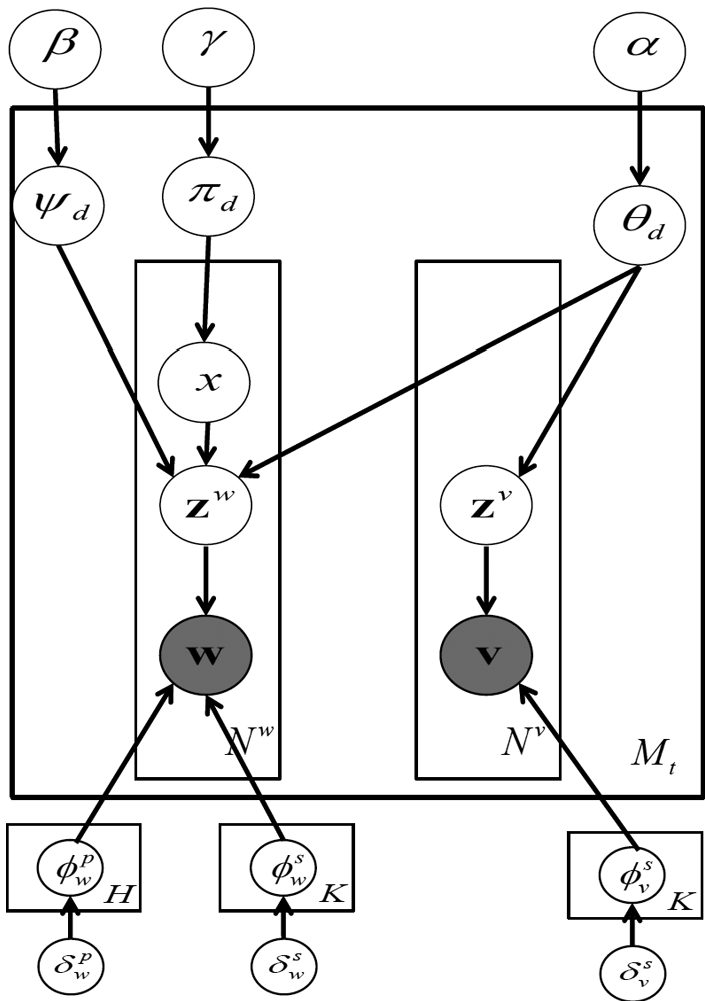 Fig 1: The graphical representation showing the dual topic distributions ( and ) controlled by the switch variable.
For temporal evolution, the authors didn't just re-train the model. They used an Incremental mmETM strategy. By treating the word counts in topics from the previous time step (epoch ) as the Dirichlet concentration parameters for the current step (epoch ), the model "remembers" the event's history while adapting to new developments.
Experimental Validation
The authors curated a unique dataset of 8 major social events (e.g., "Occupy Wall Street", "Syrian Civil War") totaling thousands of documents.
Performance vs. Baselines
The mmETM consistently outperformed baselines in Purity (clustering quality) and Perplexity.
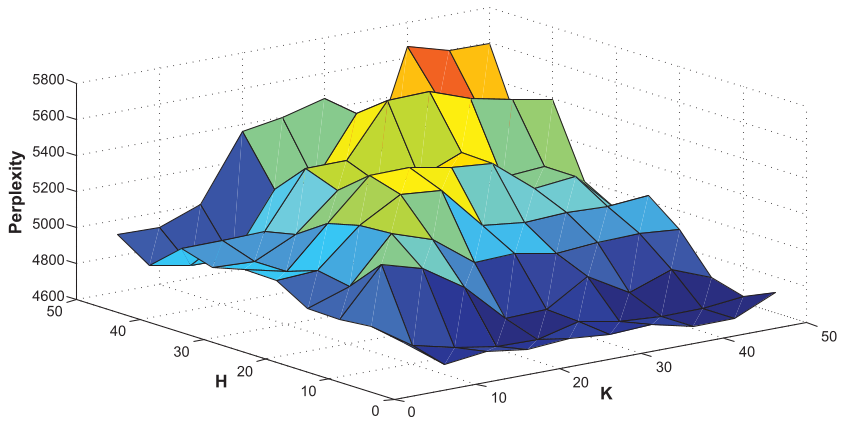 Fig 2: Purity scores across 8 events showing mmETM's dominance over Corr-LDA and tr-mmLDA.
Computational Efficiency
By utilizing the incremental strategy, the runtime remains nearly constant per epoch. In contrast, a standard batch mmETM's complexity would grow cumulatively as more data arrives, making it impractical for real-time monitoring.
Deep Insight: Visualizing the Latent Space
The qualitative results (Fig 5 in the paper) are perhaps the most convincing. In the "US Presidential Election" event:
- Visual-Representative Topic: "Obama," "Romney," "White House" paired with actual face patches.
- Non-Visual-Representative Topic: "Right," "Business," "Voters"—abstract terms correctly assigned to the text-only latent space.
Critical Analysis & Conclusion
Takeaway: mmETM successfully captures the "semantic asymmetry" of social media. It recognizes that while a picture is worth a thousand words, it cannot represent every word—especially the ones describing the underlying causes of a protest or an election's economic policy.
Limitations: The model currently relies on a bag-of-visual-words approach using regional features. In the modern era of Deep Learning, replacing these hand-crafted features with embeddings from a Vision Transformer (ViT) or CLIP could potentially push these results even further.
Future Outlook: This framework sets a precedent for "Asymmetric Multi-Modal Tracking." Future research could extend this logic to video-text streams or leverage Large Language Models (LLMs) to better define the "non-visual" priors.