
Smart Irrigation: Balancing Crop Yield and Environmental Stewardship via NSGA-II
A New Multi-objective Approach to Optimize Irrigation Using a Crop Simulation Model and Weather History
This paper presents a multi-objective optimization framework for agricultural irrigation, combining the WOFOST crop simulation model with the NSGA-II genetic algorithm. The system optimizes irrigation dates and water volumes to simultaneously maximize crop yield and minimize environmental water loss (deep percolation) across diverse weather scenarios.
TL;DR
Researchers have developed a new multi-objective approach that uses the WOFOST crop simulation model and the NSGA-II evolutionary algorithm to solve the age-old agricultural dilemma: how to get the most food with the least amount of water. By analyzing 20 years of weather history, the system finds optimal irrigation dates and volumes that maximize potato and sugar-beet yields while significantly slashing "water loss" (deep percolation) compared to traditional farmer intuition.
Context: Beyond the "More is Better" Fallacy
In modern agriculture, water is often treated as a cheap input to maximize the only metric that traditionally matters: yield. However, excessive irrigation leads to deep percolation—water that bypasses the root zone. This isn't just a waste of a precious resource; it carries pesticides and fertilizers into groundwater, causing eutrophication and ecological damage.
The technical challenge is twofold:
- Weather Uncertainty: You can't optimize for a single year because the weather is never the same twice.
- Discrete Timing: It’s not just about how much water you use, but when you apply it relative to the plant's growth stage.
Methodology: Evolutionary Intelligence meets Agronomy
The authors bridge this gap by treating irrigation as a multi-objective optimization problem under uncertainty.
1. The Simulation Engine (WOFOST)
The system uses the WOrld FOod Studies (WOFOST) model, a biophysical model that simulates photosynthesis, transpiration, and biomass partitioning. It acts as the "environment" where different irrigation strategies are tested virtually.
2. The Optimization Logic (NSGA-II)
Instead of a single "best" answer, the Non-dominated Sorting Genetic Algorithm-II (NSGA-II) provides a Pareto Front—a set of solutions where you cannot improve yield without increasing water loss.
- Decision Variables: A 14-dimensional vector (7 dates + 7 volume amounts).
- Objective 1: Maximize Mean Crop Yield (TWSO).
- Objective 2: Minimize Mean Water Loss (LOSST).
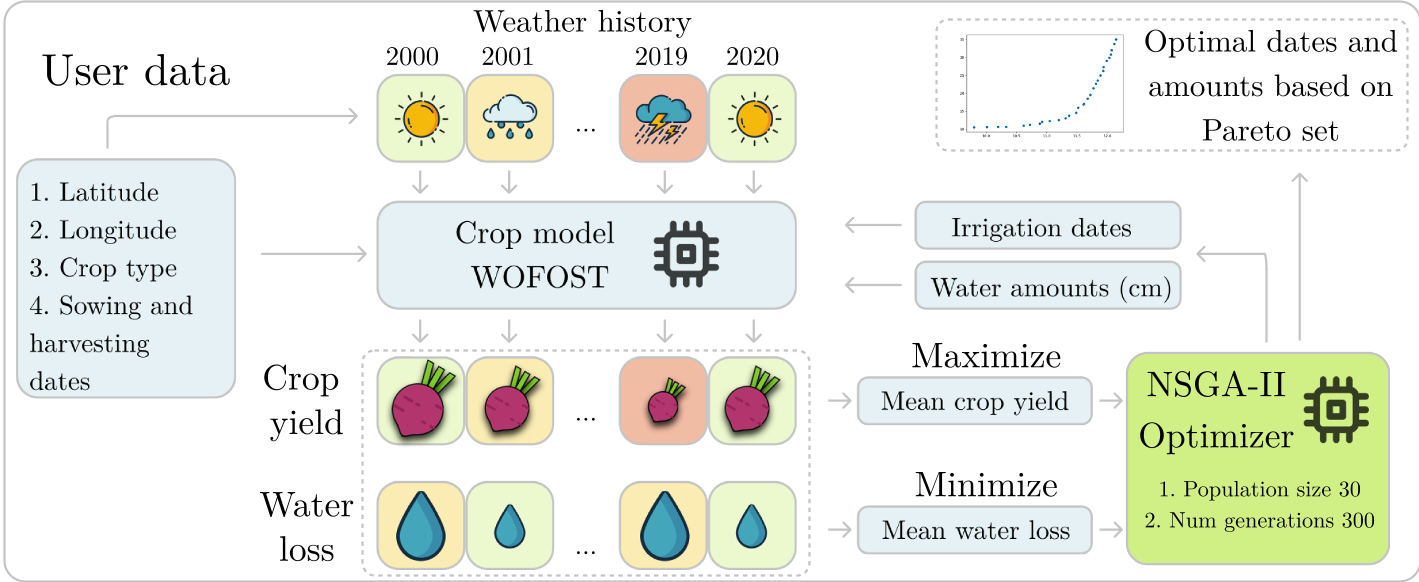 Figure 1: The experimental pipeline integrating NASA weather data, the WOFOST simulation, and the evolutionary optimizer.
Experiments and Results
The study focused on sugar-beet and potato fields in the Moscow region. The researchers compared their algorithm against a Monte Carlo search (random guessing) and a real farmer's strategy.
Case 1: Potato Crop
The algorithm found a "sweet spot" that increased potato yield by 9.7% compared to the farmer. While the water loss was slightly higher than the farmer's (who likely under-irrigated), it was vastly more efficient than the Monte Carlo approach, which wasted 33% more water for less yield.
Case 2: Sugar-Beet Crop
For sugar-beets, the algorithm achieved a "win-win." It matched the expected yield but reduced water loss by 11% compared to the farmer. The Pareto front analysis showed a clear "elbow" where further irrigation provided zero additional yield, essentially identifying the point of diminishing returns.
 Table 1: Performance metrics for Potato (Yield vs. Water Loss).
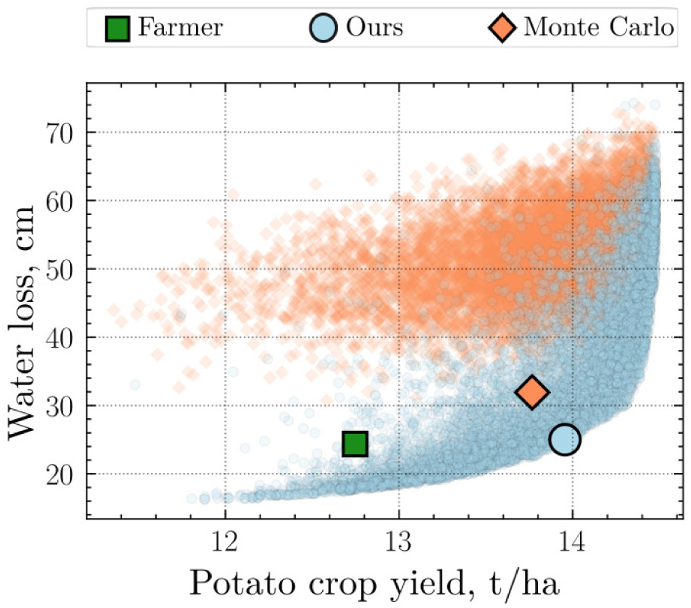 Figure 2: The Pareto front for Sugar-Beet. The algorithm (Points) successfully identifies solutions that dominate the farmer's strategy (Star).
Critical Insight: The Power of Weather History
The most impressive part of this work isn't just the optimization, but the robustness. By averaging the performance over 20 years of NASA weather data, the resulting irrigation schedule isn't "overfit" to a rainy or dry year. It represents a "Climate-Smart" strategy that holds up against historical variability.
Conclusion & Future Outlook
This paper proves that we don't need to choose between profit and the planet. By using zero-order optimization methods like NSGA-II, we can wrap complex, non-differentiable biological models (like WOFOST) into an automated decision-making loop.
Limitations: The model currently requires 25 hours to run for a single configuration. Future work likely needs to explore Surrogate Modeling (using Neural Networks to approximate the WOFOST model) to bring these optimization times down to seconds, enabling mobile apps for farmers in the field.